
Birth Chart Basics
How to Start Learning Astrology Without Overwhelm
Learn in layers: the Sun, Moon and Rising sign first, then planets, signs, houses and a few major aspects, at about 20 minutes a day, five days a week, leaving specialist points for later.
Table of contents
- Example or practical exercise
- What to learn first, and in what order
- An eight-week path at about 20 minutes, five days a week
- A first-week exercise on a constructed chart
- What to ignore for now
- How to keep a notes page that helps
- How to test a claim against your own life
- Common traps, and five questions to start with
- Questions beginners ask
- How to judge a source before you trust it
- What this does and does not establish
Example or practical exercise
In a first-week exercise, a constructed Sun at 14 degrees Pisces in the tenth and Moon at 17 degrees Scorpio in the sixth are 117 degrees apart, a trine 3 degrees from exact, summed up in one plain sentence.
What to learn first, and in what order
Astrology looks huge because a chart holds many layers, but the core is small: ten bodies, twelve signs, twelve houses and five major aspects. Learn those four vocabularies in that order and you can read the basics of nearly any chart. Everything else is a later layer.
Separate two questions early. What a chart computes, the positions, angles and houses, is arithmetic that software handles and that schools largely share. What a tradition interprets from it is a set of conventions that differ between schools. Keeping the two apart stops you from mistaking a convention for a fact.
An eight-week path at about 20 minutes, five days a week
Five sessions of 20 minutes a week for eight weeks comes to 800 minutes, about 13 hours and 20 minutes. That is enough for a working foundation, and the pace can stretch if life gets busy.
- Week 1: get a chart with a reliable birth time and find your Sun, Moon and Rising signs.
- Week 2: learn the ten planets as functions, one at a time.
- Week 3: learn the twelve signs as styles, along with their elements and modalities.
- Week 4: learn the twelve houses as life topics, using one house system that you name.
- Week 5: learn the five major aspects and orbs: conjunction 0°, sextile 60°, square 90°, trine 120° and opposition 180°.
- Week 6: read one whole chart in order, from Sun, Moon and Rising to the chart ruler and the tightest aspects.
- Week 7: read two more charts, such as a family member’s, with their permission.
- Week 8: meet transits as slow cycles, such as Jupiter at about 12 years and Saturn at about 29.5, and compare them with your own past instead of with forecasts.
A first-week exercise on a constructed chart
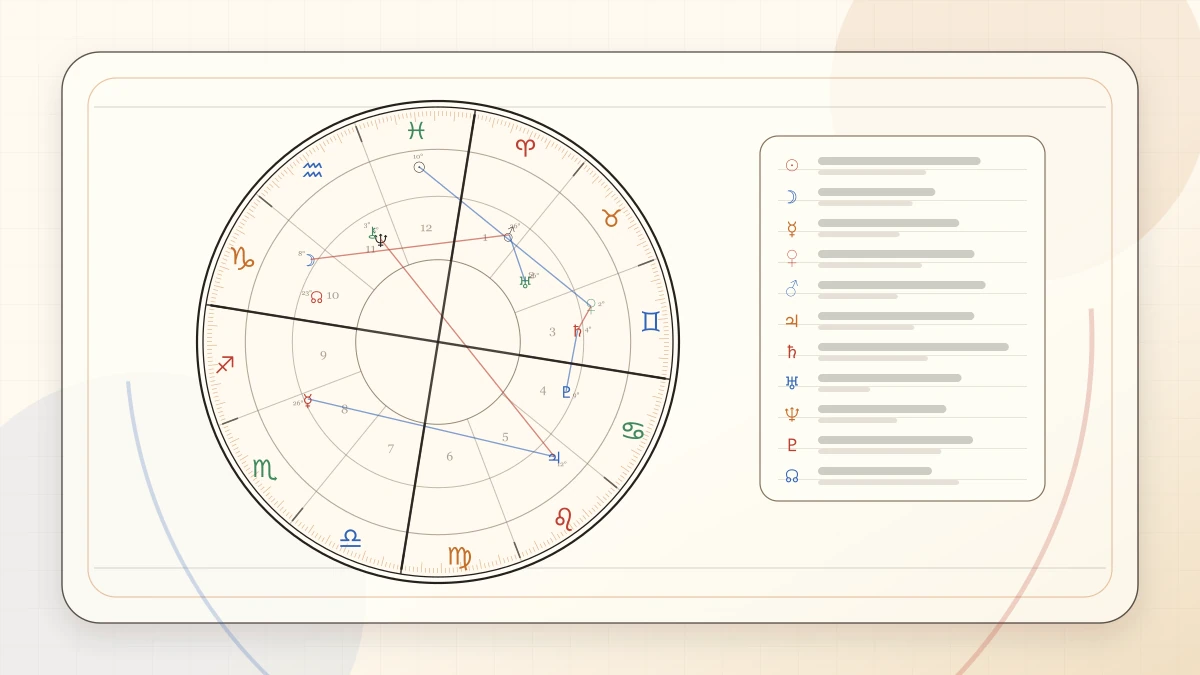
This chart is constructed for teaching. The Sun is at 14° Pisces, the Moon at 17° Scorpio and the Ascendant at 6° Gemini. Counting whole-sign houses from Gemini puts Pisces in the 10th house and Scorpio in the 6th.
Both signs are water. As numbers, the Sun is 330 + 14 = 344° and the Moon is 210 + 17 = 227°. The gap is 344 − 227 = 117°, which is 3° short of an exact trine and well inside the common natal orb. A first-week sentence is: identity and purpose shaped by imagination and compassion in a public role, with emotional needs for depth and privacy worked out in daily routines.
What to ignore for now
A beginner gains nothing from collecting more points before the basics settle. These can wait until the core vocabulary feels easy.
- Asteroids, Chiron and the lunar nodes
- Minor aspects, midpoints and harmonic charts
- Arabic parts and fixed stars
- Arguments about which house system is best. Pick one and name it.
- Predictive techniques beyond a simple look at slow transits
How to keep a notes page that helps
A notes page keeps facts, conventions and your own observations from blurring. Divide each page into four parts, and keep them in this order every time.
| Part | What to write | Example |
|---|---|---|
| Chart facts | Only computed positions | Mercury 12° Scorpio, 11th house, whole sign |
| The tradition says | One interpretive line and its school | Mercury in Scorpio: probing, private thinking |
| My question | A question for your own life | Do I research a topic deeply before deciding? |
| What fits and what does not | Specific moments from your past | Fits at work; does not fit in casual chats |
How to test a claim against your own life
Many astrological descriptions are broad enough to fit almost anyone, a known effect called the Barnum effect. Testing claims is how you separate the descriptions that tell you something from those that flatter or soothe.
- Write the claim in one sentence, specific enough to be wrong.
- List two moments from the past year where it fits and two where it does not.
- Ask someone who knows you to react to the sentence without telling them where it came from.
- Reread after a month and keep only what still holds.
Common traps, and five questions to start with
The usual traps are reading only the Sun sign, collecting sources that disagree, memorizing keywords without checking them, treating readings as predictions, and mixing rulership or house systems midway. If a source scares you, set it aside; calm, specific language is a better guide. When you are ready to read a chart, begin with these questions.
- Where do my Sun, Moon and Rising signs agree, and where do they pull apart?
- Which planet is my chart ruler, and in which sign and house does it sit?
- What is my tightest aspect, and which two functions does it connect?
- Which element and modality appear most often?
- What single question do I want to ask this chart?
Questions beginners ask
Do I need to be good at math? No. The arithmetic is adding and subtracting numbers up to 360, such as seeing that a Sun at 105 degrees and a planet at 195 are 90 degrees apart. Software does the rest.
Do I need to believe in astrology to learn it? No. You can study it as a symbolic language, test its claims against your own life and decide how much weight to give it.
How long until I can read a chart? After the eight-week path most people can describe a chart in plain sentences. Fluency comes from reading many charts, which is slower and has no deadline.
How to judge a source before you trust it
Run any book, video or site through this short check before you build on it.
- Does it say which house system and rulership scheme it uses?
- Does it separate computed positions from interpretation?
- Does it admit where astrologers disagree?
- Does it avoid predicting events, or making health or money claims, and avoid using fear to keep you reading?
- When it mentions research, does it say where the research comes from? A vague appeal to unnamed findings is not a source.
- Compare two sources on one placement, keep what they share and note where they differ.
What this does and does not establish
Collecting more sources and chart factors will not make a reading more reliable, and no stage of learning turns a chart into a prediction.
Related calculators
Use the matching tool when you want a direct chart or timing result after reading the guide.
Free Birth Chart Calculator
Create a birth chart from birth date, time, and place to review placements, houses, angles, and aspects.
Moon Sign Calculator
Exact Moon-sign verification from full birth-chart math for practical emotional and compatibility use cases.
Rising Sign Calculator
Exact Ascendant verification from full birth-chart math for practical house and Big 3 interpretation.
Calculation references
- Swiss Ephemeris: positions, angles and house-system conventions
Technical reference for calculation conventions. It does not certify an interpretation or mean every live tool uses this engine.
Related articles
Keep reading with nearby topics that deepen the same question from another angle.
The 12 Houses Explained
The twelve houses split a birth chart into twelve areas of life, measured from the horizon at your birthplace. A planet's sign shows how it behaves, and its house shows where that behavior appears.
6 min read
How to Read Current Transits Without Overreacting to Every Aspect
Choose your question first, list the slow-planet contacts within a tight orb, then add fast ones only for timing. A Saturn contact lasting months outweighs a Moon contact lasting hours.
6 min read
What an Empty House May Suggest in Astrology
An empty house simply holds no planets, and every chart has several. You read it through the sign on its cusp, that sign's ruler and the house where the ruler sits.
6 min read
Birth Chart Questions to Ask After Your First Reading
Ask first about inputs and method: the birth time and its source, daylight saving, house system and orbs. Then ask which placements are central, what would contradict them and what not to use them for.
6 min read
Keep exploring
Use the category page and the main hubs when you want the next layer of context.
Previous article
What an Empty House May Suggest in Astrology
Next article
Birth Chart Questions to Ask After Your First Reading