
Birth Chart Basics
Birth Chart Questions to Ask After Your First Reading
Ask first about inputs and method: the birth time and its source, daylight saving, house system and orbs. Then ask which placements are central, what would contradict them and what not to use them for.
Table of contents
- Example or practical exercise
- Questions about accuracy and method to ask first
- Questions about what the reading means
- Questions about what to do with it
- A constructed example: Dana and a 20-minute window
- A one-page plan for your next conversation
- What a good reader will and will not do
- Red flags in a reading
- Common questions after a first reading
- What to keep a record of
- What this does and does not establish
Example or practical exercise
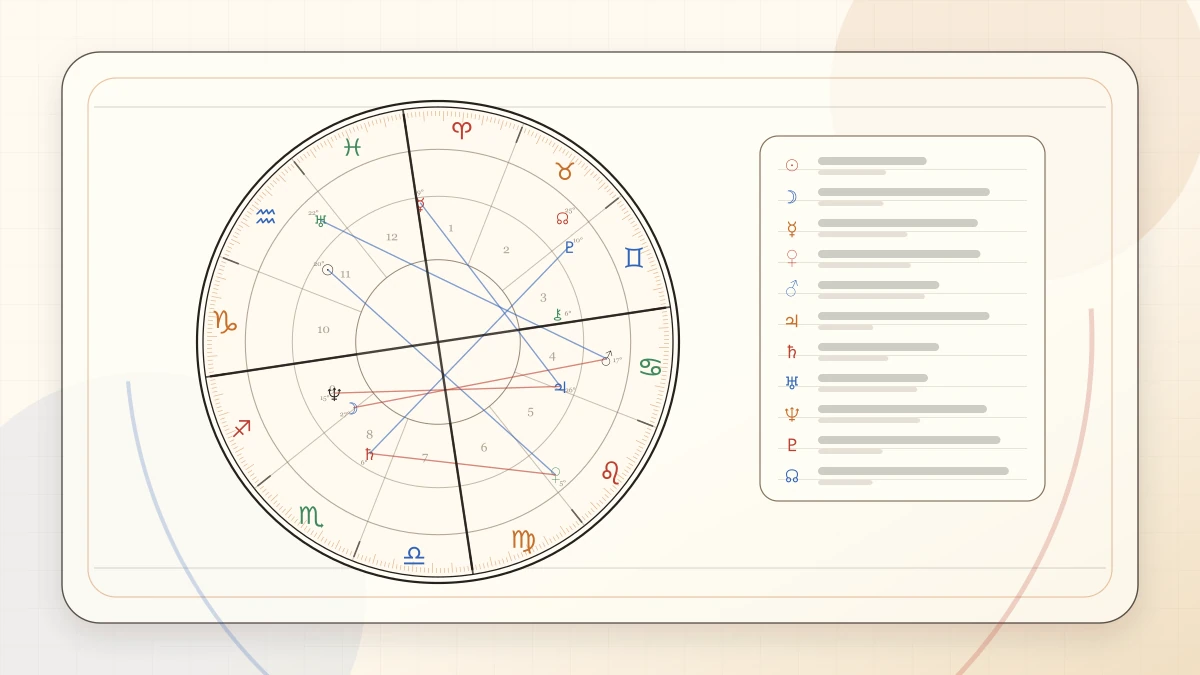
Dana's constructed chart has the Ascendant at 28 degrees Leo, but her birth time may be 20 minutes out, about 5 degrees, so a 6:50 birth would make her Virgo rising and change the first-house reading.
Questions about accuracy and method to ask first
A first reading raises as many questions as it answers, and the most useful ones are about inputs and method. A confident narrative built on a wrong input is still wrong, and a good reader welcomes the checking.
- What birth time, date and place did you use, and where did the time come from?
- Was daylight saving time handled correctly for the date and place?
- Which house system did you use, and would the reading change with another?
- Which zodiac and which planets are included? Are the nodes, Chiron or asteroids counted?
- What orb did you allow for aspects?
- How sure are you of the Ascendant, and what happens to the reading if it is off?
Questions about what the reading means
Once the inputs are checked, ask about the interpretation itself.
- Which placements are central to this reading, and why those?
- Which tradition is this interpretation from, and do other traditions disagree?
- Is this a tendency, a question or a statement of fact?
- What in my experience would you expect to confirm this, and what would contradict it?
- What parts of the chart did you leave out, and could they change the picture?
Questions about what to do with it
Interpretation is only useful if it connects to your own choices.
- What is one question I could reflect on this month?
- Which part is worth testing against my own history before I accept it?
- Which decisions should this not be used for? Ask for a plain answer.
- When would a different kind of help, such as a doctor, lawyer or counselor, be better than a chart?
A constructed example: Dana and a 20-minute window
Dana is constructed. Her chart shows Leo rising with the Ascendant at 28° Leo, which is 120 + 28 = 148. Her record says she was born around 6:30 in the morning, with a possible error of 20 minutes. The Ascendant moves about 1 degree every 4 minutes, so 20 minutes is 20 ÷ 4 = 5 degrees. A later time of 6:50 would put the Ascendant at 28 + 5 = 33, which is 3° Virgo.
So her rising sign could be Leo or Virgo, and the whole first-house reading depends on which. A useful question is how the reader treats that window. Another is whether the chart was run in local time or with daylight saving time applied: a one-hour error moves the Ascendant about 15 degrees on average (60 ÷ 4), often enough to change the sign by itself.
Dana’s follow-up is therefore concrete. She asks which time was used, whether the reader tried times a few minutes either side, and whether the key points of the reading hold if the rising sign changes. A reading that rests mostly on the Sun and Moon is sturdier here than one that rests on the Ascendant.
A one-page plan for your next conversation
Put the questions into an order that makes the time useful.
- Start with the inputs: birth time, source of the time, place and daylight saving.
- Ask for the method: house system, orbs and which bodies were counted.
- Ask for the two or three placements the reading rests on and why.
- Say which statements fit you and which do not, and ask how the reader would account for the mismatch.
- End with one question to reflect on and a date to look at it again.
What a good reader will and will not do
Astrology is an interpretive practice, so a reader’s manner matters as much as their chart knowledge. Use this table to compare a reading against your own experience; it applies equally to a person, a book and a chart report.
| A good reader will | A good reader will not |
|---|---|
| Explain their method and say which tradition they use | Hide the method or insist there is one correct way |
| Describe tendencies and ask what fits your life | Announce what you are like without asking |
| Say plainly what a chart cannot show | Claim to predict events, health, money or relationships |
| Welcome questions and corrections to your birth data | Treat questions as doubt or disrespect |
Red flags in a reading
Any one of these is a reason to pause. None of them proves bad intent, but each is a reason to slow down, ask for the reasoning and, if it is not offered, take your questions elsewhere.
- Fear-based claims, such as that a placement means a bad time, a curse or something you must avoid.
- Certainty about events: stating that something will happen, or that a relationship will end or begin.
- Pressure to pay more for a fix, an urgent session or a private remedy.
- Statements about illness, legal outcomes or money decisions, which a chart cannot answer.
- Refusing to say how the chart was calculated or to share the chart with you.
Common questions after a first reading
Should the reading feel accurate? It may fit in parts and miss in others. Notice which parts you recognize and which you do not, and keep both lists.
What if the reading upset me? Set it aside. A chart is a prompt for reflection, not a verdict, and if something weighs on you, talk with someone you trust or a qualified professional.
How many readings should I get before I judge the method? One reading is not a test. Compare more than one source, and judge by whether the reasoning is clear.
What to keep a record of
Keep a simple file for every reading so you can check it later without relying on memory.
| Item | Why it helps |
|---|---|
| Date, time and place of birth, and the source of the time | Lets you recheck the Ascendant and houses |
| House system, zodiac and orbs used | Explains why two charts differ |
| The reader’s main points, in your own words | Gives you something to test, not just to remember |
| Which statements fit and which did not | Shows whether the reading was useful |
| Questions you still have | Becomes the agenda for next time |
What this does and does not establish
A confident reading built on a wrong input is still wrong, and no reading should steer medical, legal or financial decisions.
Related calculators
Use the matching tool when you want a direct chart or timing result after reading the guide.
Free Birth Chart Calculator
Create a birth chart from birth date, time, and place to review placements, houses, angles, and aspects.
Moon Sign Calculator
Exact Moon-sign verification from full birth-chart math for practical emotional and compatibility use cases.
Rising Sign Calculator
Exact Ascendant verification from full birth-chart math for practical house and Big 3 interpretation.
Calculation references
- Swiss Ephemeris: positions, angles and house-system conventions
Technical reference for calculation conventions. It does not certify an interpretation or mean every live tool uses this engine.
Related articles
Keep reading with nearby topics that deepen the same question from another angle.
The 12 Houses Explained
The twelve houses split a birth chart into twelve areas of life, measured from the horizon at your birthplace. A planet's sign shows how it behaves, and its house shows where that behavior appears.
6 min read
How to Read Current Transits Without Overreacting to Every Aspect
Choose your question first, list the slow-planet contacts within a tight orb, then add fast ones only for timing. A Saturn contact lasting months outweighs a Moon contact lasting hours.
6 min read
How to Start Learning Astrology Without Overwhelm
Learn in layers: the Sun, Moon and Rising sign first, then planets, signs, houses and a few major aspects, at about 20 minutes a day, five days a week, leaving specialist points for later.
6 min read
Astrocartography Basics: How to Read Location Lines Without Overclaiming the Map
Astrocartography draws lines on a world map where each planet was rising, setting, overhead or underfoot at your birth. Each line names a symbolic theme for that place, not a verdict on living there.
6 min read
Keep exploring
Use the category page and the main hubs when you want the next layer of context.
Previous article
How to Start Learning Astrology Without Overwhelm
Next article
Astrocartography Basics: How to Read Location Lines Without Overclaiming the Map