
Love Compatibility
House Overlays in Synastry Explained
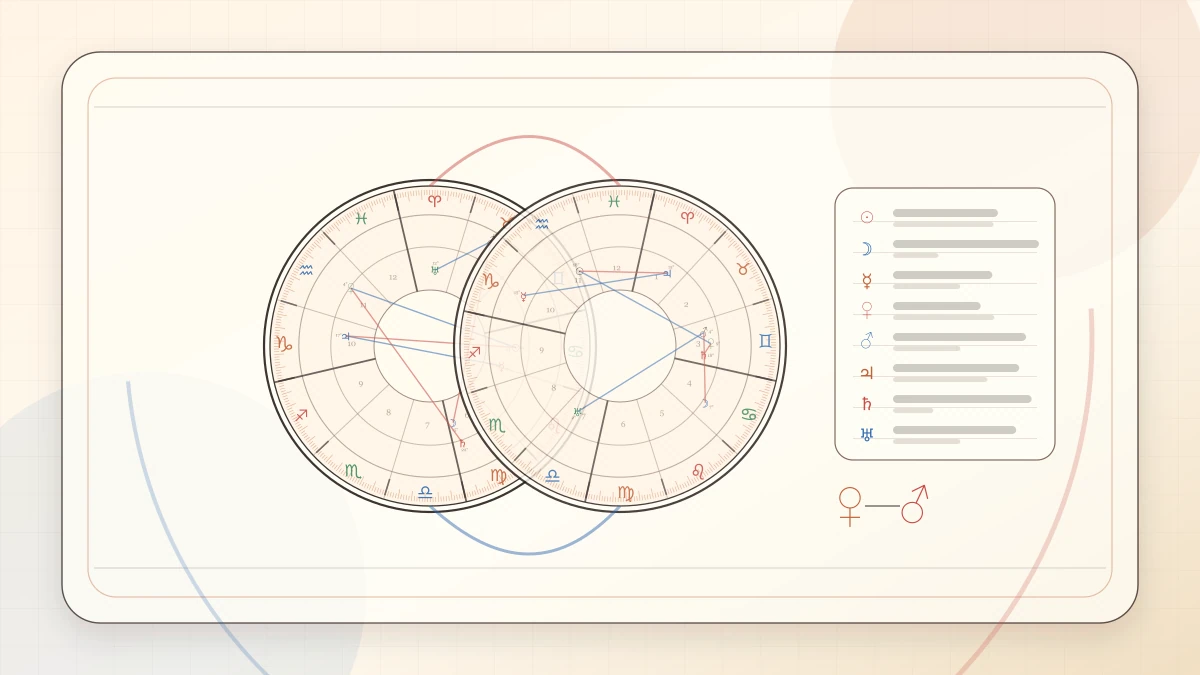
A house overlay places one person's planets in the other person's houses, showing which area of life each planet seems to stir. Each direction is a separate reading.
Table of contents
- Example or practical exercise
- What a house overlay is
- Finding the house: whole-sign arithmetic with two constructed charts
- What a partner’s planets tend to mean, by house group
- Why overlays change with the house system
- Reading the constructed overlays
- How to use overlays in practice
- Common misreadings of house overlays
- What this does and does not establish
Example or practical exercise
With A's Libra Rising and B's Cancer Rising in whole-sign houses, each person's Venus lands in the other's third house, so affection may arrive through conversation, messages and short trips.
What a house overlay is
A house overlay takes one person’s planets and places them in the other person’s houses. Houses are the twelve areas of life in a chart, such as self, money, home, partnership and friends, and they are counted from each person’s own Ascendant. When A’s Venus falls in B’s fourth house, that Venus is read through B’s fourth house of home and roots, whatever house it occupies in A’s own chart.
Overlays run in both directions, and the two directions are separate readings. A’s planets in B’s houses describe what A’s energy seems to stir up in B’s life; B’s planets in A’s houses describe the reverse. Neither direction is the real one.
Finding the house: whole-sign arithmetic with two constructed charts
In whole-sign houses, the first house is the complete sign that contains the Ascendant and each following sign is the next house. Person A has Libra Rising, so Libra is the first house, Scorpio the second, Sagittarius the third, Capricorn the fourth, Aquarius the fifth, Pisces the sixth, Aries the seventh, Taurus the eighth, Gemini the ninth, Cancer the tenth, Leo the eleventh and Virgo the twelfth. Person B has Cancer Rising, so Cancer is first, Leo second, Virgo third, Libra fourth, Scorpio fifth, Sagittarius sixth, Capricorn seventh, Aquarius eighth, Pisces ninth, Aries tenth, Taurus eleventh and Gemini twelfth. Both charts are invented.
The arithmetic is the same each time: number the signs from Aries as 1, subtract the Rising sign’s number, add 1, and add 12 if the result is zero or below. For B’s Moon in Gemini (sign 3) against A’s Libra Rising (sign 7): 3 minus 7 plus 1 is minus 3, and adding 12 gives 9. The Moon falls in A’s ninth house.
| Planet | Owner | Sign | House in the other person’s chart |
|---|---|---|---|
| Sun | B | Capricorn | A’s fourth |
| Moon | B | Gemini | A’s ninth |
| Venus | B | Sagittarius | A’s third |
| Mars | B | Leo | A’s eleventh |
| Saturn | B | Aquarius | A’s fifth |
| Sun | A | Scorpio | B’s fifth |
| Moon | A | Aquarius | B’s eighth |
| Venus | A | Virgo | B’s third |
| Mars | A | Pisces | B’s ninth |
| Saturn | A | Libra | B’s fourth |
What a partner’s planets tend to mean, by house group
Instead of twelve separate readings, group the houses by the part of life they cover. This is a traditional shorthand and a prompt for questions, not a fixed meaning.
| Partner’s planet | Houses 1 to 3: self, money, talk | Houses 4 to 6: home, play, routine | Houses 7 to 9: partners, sharing, belief | Houses 10 to 12: public life, friends, retreat |
|---|---|---|---|---|
| Sun | Notices you and energizes your sense of self | Gives home and fun a center of warmth | Treats you as an equal or a mirror | Draws attention to your goals and place among others |
| Moon | Feels familiar and attentive to your moods | Feels like home, a place to settle | Cares about your commitments and shared needs | Supports you in public or in private rest |
| Venus | Appreciates you and what you value | Brings pleasure and ease to daily life | Puts attraction and harmony into the partnership | Adds warmth to friendships and social life |
| Mars | Stirs you to act, argue or compete | Brings energy, and sometimes friction, to the household | Adds drive and desire to the partnership | Pushes you toward goals and groups |
| Saturn | Steadies you, or seems strict about money and speech | Asks for responsibility in home and routine | Adds seriousness and commitment | Adds structure to ambitions and to time alone |
Why overlays change with the house system
A house system is a way of dividing the chart into twelve houses, and astrologers disagree about which is best. Whole-sign houses, used above, give each house exactly one sign. Quadrant systems such as Placidus start the first house at the exact Ascendant degree and place the other cusps by calculation, so houses vary in size and a boundary can fall in the middle of a sign.
That matters for overlays. In a quadrant system the line between two of A’s houses may sit several degrees from where a sign line would put it, so a planet near the edge of a sign can change house. A planet in the first or last few degrees of a sign is the one to flag.
Birth time adds a second source of drift. In whole signs the houses shift only when the Ascendant changes sign, but in quadrant systems every cusp slides as the time moves. Say which system you used whenever you share an overlay, and read near-edge planets as between two houses.
Reading the constructed overlays
In the example, B’s Moon falls in A’s ninth house of belief, learning and distant places, so A may find B emotionally interested in A’s views and big questions. A’s Saturn lands in B’s fourth house, which raises a question: does A’s caution feel like steadiness at home or like restriction?
The most repeated theme is mutual. B’s Venus is in A’s third house and A’s Venus is in B’s third house, so affection in this pair may arrive through conversation, messages and short trips. Each reading is a question, and each can be checked against what the two people actually do.
How to use overlays in practice
Overlays work best as a second layer, after you have seen the closest aspects between the two charts. This order keeps them honest.
- Fix the house system and write it at the top of the page.
- Place each person’s Sun, Moon, Venus, Mars and Saturn in the other’s houses, in two columns.
- Flag any planet within a few degrees of a house edge.
- Look for houses that repeat, such as two planets from one person in the same house of the other.
- Pair each overlay with any close aspect between the same planets before deciding what it means.
- Write one question for each repeated theme.
Common misreadings of house overlays
Because an overlay produces a tidy list, it is easy to read more into it than it holds.
| Misreading | Why it happens | What to check instead |
|---|---|---|
| A partner’s planet in my eighth house means danger or an unbreakable bond | The house carries old words such as death and debt | Read it as what is shared and changing between you, and ask about trust and boundaries |
| Their Venus in my fourth house means they feel at home with me | A symbolic prompt is easy to mistake for a feeling someone has | Ask them; an overlay names a theme, and only they can say whether they feel it |
| The overlay list tells us whether we are a good match | A tidy list looks like a score | Treat each line as a question, and let the two of you answer it |
What this does and does not establish
An overlay names a theme, not someone's feelings, and a different house system or an uncertain birth time can move a planet into another house.
Related calculators
Use the matching tool when you want a direct chart or timing result after reading the guide.
Birth Chart Compatibility Calculator
Higher-trust compatibility report built from two verified natal charts and exact synastry analysis.
Synastry Chart Calculator
Compare two birth charts for relationship patterns, emotional rhythm, attraction, and communication themes.
Zodiac Compatibility Calculator
Broad sign-to-sign compatibility page tuned for lifestyle readers.
Calculation references
- Swiss Ephemeris: positions, angles and house-system conventions
Technical reference for calculation conventions. It does not certify an interpretation or mean every live tool uses this engine.
Related articles
Keep reading with nearby topics that deepen the same question from another angle.
Moon Sign Meaning in Love, Emotions, and Daily Life
Your Moon sign describes what you need to feel safe: your moods, instincts, habits and the kind of comfort that settles you, which shows most clearly at home and in close relationships.
6 min read
How to Read Your Birth Chart: A Beginner's Guide
Read your birth chart in five steps: find the Sun, Moon and Rising sign, count the elements, note crowded houses, locate the chart ruler, then read the two or three closest aspects.
6 min read
Mercury in Synastry: A Communication Guide
Mercury in synastry compares how two people think, talk and listen. Its sign shows a conversational style, and its contacts show where words flow easily or get crossed.
6 min read
Long-Distance Relationship Astrology
In a long-distance relationship, chart symbols such as the Moon, Venus and Mercury can prompt talk about contact, but time zones, travel money and plans to move do the real work.
6 min read
Keep exploring
Use the category page and the main hubs when you want the next layer of context.
Previous article
Mercury in Synastry: A Communication Guide
Next article
Long-Distance Relationship Astrology