
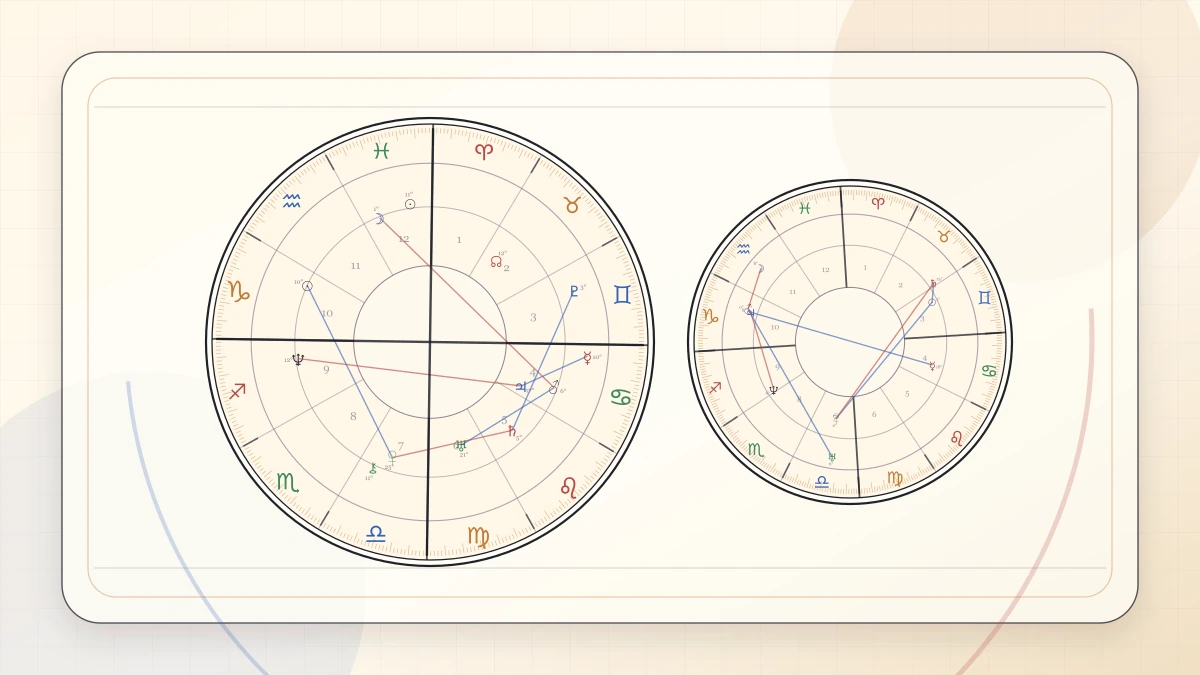
Planetary Transits
How Long Do Transits Last?
A transit lasts as long as the moving planet stays inside your chosen orb: hours for the Moon, about two months for Saturn and a year or more for the outer planets.
Table of contents
- Example or practical exercise
- What “how long” measures: the exact moment versus the window
- Applying and separating: the two halves of the window
- Typical durations by planet
- Retrograde passes: why one contact can hit once, twice or three times
- The exact date, the build-up and the aftermath
- A constructed timeline for one slow contact
- Adding up the timeline
- Why the same window can feel short or long
- What this does and does not establish
Example or practical exercise
Saturn approaching a natal Moon at 14 degrees Virgo with a 1-degree orb makes three exact hits, at weeks 3, 15 and 39, so one contact runs about ten months.
What “how long” measures: the exact moment versus the window
A transit is a moving planet making an angle to a point in your birth chart. Strictly, that angle is exact for an instant, the moment the moving planet sits at precisely the right degree. Nobody lives inside an instant, so astrologers talk about a window around it, and the length of that window depends on two things: which planet is moving and how wide an orb you allow.
An orb is the number of degrees on either side of exact that you still count as being in contact. Transit orbs are commonly about 1 to 3 degrees for slower planets and about a degree for fast ones, and there is no official size. State yours before you start counting, because the same contact is a short visit under a 1-degree orb and a long one under a 3-degree orb.
Applying and separating: the two halves of the window
While the moving planet is still approaching the exact degree, the contact is applying. After it has passed that degree and is moving away, the contact is separating. Many astrologers read the applying half as the stretch when a theme is taking shape and the separating half as the stretch when it is absorbed, though that is a habit of interpretation, not a rule.
Retrograde motion, the apparent backward drift of a planet as seen from Earth, can swap the labels. A contact that was separating becomes applying again when the planet turns around. Check the direction of motion and not just the order of the degrees.
Typical durations by planet
The table gives a rough time for one pass through a 2-degree window, which is a 1-degree orb on each side of exact. The figures come from average speeds, and every planet except the Sun and Moon slows almost to a standstill when it turns retrograde or direct, so treat them as the middle of a range.
| Moving planet | Typical pace | One pass through the window | Can it pass more than once? |
|---|---|---|---|
| Moon | about 13 degrees a day | about four hours | No, it never turns retrograde |
| Sun | about 1 degree a day | about two days | No, it never turns retrograde |
| Mercury | about a degree a day on average | one to a few days | Yes, in its retrograde loops |
| Venus | about a degree a day on average | a day or two, or weeks near a turn | Yes, in its retrograde loops |
| Mars | about half a degree a day on average | about four days, or weeks near a turn | Yes, in its retrograde loops |
| Jupiter | about 30 degrees a year | about three to four weeks | Yes, every year |
| Saturn | about 12 degrees a year | about two months | Yes, every year |
| Uranus | about 4 degrees a year | about six months | Yes, every year |
| Neptune | about 2 degrees a year | about a year | Yes, every year |
| Pluto | about 1 to 2.5 degrees a year, uneven | roughly one to two years | Yes, every year |
Retrograde passes: why one contact can hit once, twice or three times
A slow planet that turns retrograde near your degree can cross it, back over it and cross it a third time after turning direct again. Which of these happens depends on where the turning points fall relative to the degree in question.
- One hit: the planet crosses your degree and carries on without turning back before the contact is over.
- Two hits: the planet turns retrograde just after crossing, comes back over the degree, then turns direct before reaching it a third time.
- Three hits: the planet crosses, turns retrograde beyond the degree, backs over it, turns direct below it and crosses once more.
The exact date, the build-up and the aftermath
It helps to separate three things people often blur. The build-up is the time before exactness when the planet is inside your orb and approaching. The exact date, or dates, is when the angle is closest to perfect. The aftermath is the separating half, when the planet is leaving.
When there are three hits, the traditional habit is to read the first as an introduction, the second as a revisit and the third as a settling, with the long gaps between them as time to think. Treat that as a framework for your notes, not a schedule.
A constructed timeline for one slow contact
This example is constructed. Take a natal Moon at 14 degrees Virgo and a transit Saturn approaching it, with a 1-degree orb, so the window runs from 13 to 15 degrees Virgo. To keep the arithmetic readable, assume Saturn covers one degree every three weeks in this stretch. That is faster than the yearly average of about a degree a month, which includes the backward stretch, but slower than Saturn’s typical direct speed, which suits a stretch near its turning points. The retrograde stretch is assumed to carry it from 16 degrees back to 10 degrees.
- Week 0: Saturn reaches 13 degrees and enters the window, applying.
- Week 3: Saturn reaches 14 degrees, the first exact hit. Week 6: it leaves the window at 15 degrees. Week 9: it stops at 16 degrees and turns retrograde.
- Week 12: back at 15 degrees and inside the window again. Week 15: 14 degrees, the second exact hit. Week 18: it leaves at 13 degrees.
- Week 27: Saturn stops at 10 degrees and turns direct. Week 36: it reaches 13 degrees and enters the window a third time.
- Week 39: 14 degrees, the third exact hit. Week 42: it leaves at 15 degrees.
Adding up the timeline
Each pass through a 2-degree window at three weeks per degree takes six weeks, and there are three of them, so Saturn spends 18 weeks inside the window. The whole contact runs from week 0 to week 42, which is about ten months. The exact hits fall at weeks 3, 15 and 39, separated by gaps of 12 and 24 weeks.
A one-pass estimate would have called it over at week 6.
Why the same window can feel short or long
How long a transit feels active is subjective. A busy month can make a three-week window vanish, and a quiet year can make a six-month one drag. Attention matters too: once you know a contact is active you notice what fits it, and once it closes you stop looking.
Keep the calculation and the experience apart: the calculation tells you when the planet is inside your orb, and your notes tell you when anything seemed worth noticing. The two will not always line up.
To track a contact you care about, work through these steps in a notes page.
- Write the natal point, the moving planet, the aspect and your orb.
- Look up every date the planet enters the orb, reaches exact and leaves it, including retrograde passes.
- Mark the three phases on a simple timeline.
- Add a line each week about what stood out, and leave it blank when nothing did.
What this does and does not establish
Durations depend on the orb you choose, and the calculation shows when a planet is in orb, not when anything will feel active.
Related calculators
Use the matching tool when you want a direct chart or timing result after reading the guide.
Current Transits Calculator
Exact current-sky snapshot for a selected city, built for repeat-use daily astrology readers.
Transit to Natal Calculator
Exact current-sky comparison against one verified natal chart for more personal practical transit guidance.
Retrograde Calendar
Exact retrograde-period page for year-based planning, editorial planning, and current-sky timing checks.
Calculation references
- Swiss Ephemeris: positions, angles and house-system conventions
Technical reference for calculation conventions. It does not certify an interpretation or mean every live tool uses this engine.
Related articles
Keep reading with nearby topics that deepen the same question from another angle.
Yearly Astrology Guide
A yearly astrology guide maps the cycles that run through any twelve months, from the monthly Sun and Moon to slow Saturn, and separates checkable dates from symbolic interpretation.
6 min read
Solar Return Chart Guide: How to Read the Year Without Overpredicting It
A solar return chart is cast for the moment the Sun returns to its exact birth position, once a year near your birthday, and read as a yearly theme for planning rather than a forecast of events.
6 min read
Outer-Planet Transits vs Inner-Planet Transits
Inner-planet transits, from the Moon through Mars, last hours to weeks and work as timing cues. Outer-planet transits, from Saturn outward, last months or years and set long background themes.
6 min read
Retrograde Shadow Periods Explained
A shadow period is the stretch of zodiac between a retrograde's two station degrees, crossed once before the retrograde and once after. It is an astrological convention, not an astronomical event.
5 min read
Keep exploring
Use the category page and the main hubs when you want the next layer of context.
Previous article
Outer-Planet Transits vs Inner-Planet Transits
Next article
Retrograde Shadow Periods Explained