
Moon Phases
Do Moon Phases Affect Motivation? What a Diary Can Show
There is no good evidence that motivation follows the Moon. Still, the eight phases, each about 3.7 days long, make a handy schedule for a plan-versus-done ledger.
Table of contents
- Example or practical exercise
- Is there a motivation curve that follows the Moon?
- The eight phases as a schedule
- How to keep a plan-versus-done ledger
- The barriers a diary should catch
- A constructed ledger: one cycle, 24 planned actions
- Expectation and memory can make a pattern appear
- Questions people ask about the Moon and motivation
- Using the cycle as a planning rhythm
- What this does and does not establish
Example or practical exercise
Noor plans three actions at each of eight checkpoints, finishes 15 of 24, and finds time and clarity behind 7 of her 9 misses, with her weakest checkpoints in deadline weeks.
Is there a motivation curve that follows the Moon?
Many Moon guides describe a cycle: start things at the new Moon, push at the first quarter, peak at the full Moon, wind down afterward. As a planning rhythm it is neat, and as a description of human motivation it has no good evidence behind it. Studies looking for effects of the Moon on mood or behavior have mostly found nothing reliable, and there is no established motivation curve tied to the phase.
That does not make the calendar useless. A repeating cycle of about 29.5 days is an easy schedule for check-ins, and checking in on your motivation regularly is useful whatever the Moon is doing. The most revealing thing to track is not a feeling score but a plain count of what you planned and what got done.
The eight phases as a schedule
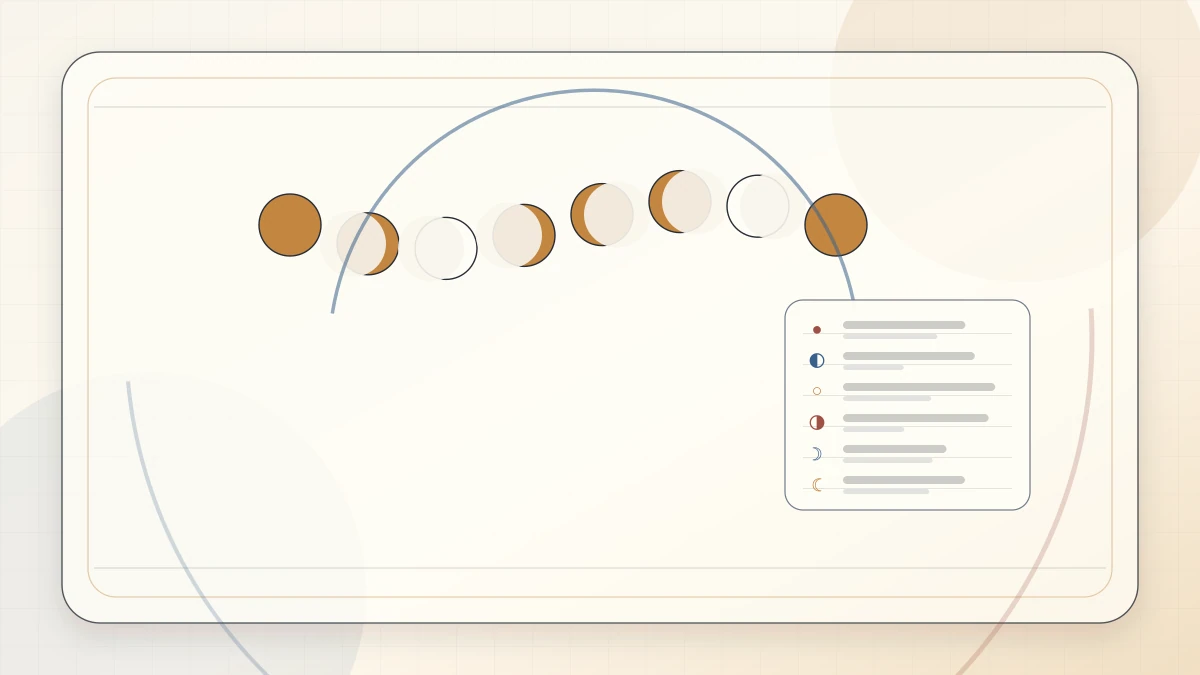
The Sun–Moon angle grows by about 12 degrees a day. In the eight-phase convention used across this site, each phase begins at a multiple of 45 degrees and covers a 45-degree band, so each lasts about 3.7 days. The exact new Moon, quarters and full Moon are the instants that open four of those bands. Here are the phases with the check-in each can host.
| Phase | Moon ahead of the Sun by | A planning question |
|---|---|---|
| New Moon | 0 to 45 degrees | What do I want to work on this cycle? |
| Waxing crescent | 45 to 90 degrees | What is the first small action? |
| First quarter | 90 to 135 degrees | What is in my way? |
| Waxing gibbous | 135 to 180 degrees | What needs adjusting? |
| Full Moon | 180 to 225 degrees | What have I finished or learned? |
| Waning gibbous | 225 to 270 degrees | What can I share or teach? |
| Last quarter | 270 to 315 degrees | What should I stop? |
| Balsamic | 315 to 360 degrees | What do I need before I restart? |
How to keep a plan-versus-done ledger
A ledger asks two plain questions at each checkpoint: what did I plan, and what got done? It needs no rating scale, so there is less room for the day’s mood to tilt the record.
- At each checkpoint you use, write up to three actions you mean to finish before the next one.
- At the next checkpoint, mark each action done or not done, with no partial credit.
- Give every action that was not done one barrier tag from the list below.
- Write the phase name at the top of the entry as a label, nothing more.
- After one full cycle, count the tags before you look at the phases.
The barriers a diary should catch
Motivation is often blamed for what is really a practical block. The barrier tags in your ledger show which block was in play for each missed action, and the answer changes what helps.
- Time: the task simply did not fit into the day.
- Health: you were tired, unwell or in pain, which deserves rest and, if it persists, a doctor.
- Clarity: you did not know what the first step was.
- Other people: you were waiting for a reply, a decision or help.
A constructed ledger: one cycle, 24 planned actions
Noor is invented. She plans three actions at each of the eight checkpoints, 24 in all, and marks them at the next checkpoint.
She finished 15 of 24, which is 62.5 percent. Of the 9 misses, 4 were tagged time, 3 clarity, 1 other people and 1 health, so time and clarity together account for 7 of 9, about three quarters. Her two weakest checkpoints, first quarter and last quarter, each fell in a deadline week at work, a fact about her calendar rather than the sky.
Her changes follow the tags. In deadline weeks she plans two actions instead of three, and she writes the first step of each action when she plans it, which aims at the clarity misses. The health miss was a cold, and it called for rest, not a new plan.
| Checkpoint | Planned | Done | Barrier tags for the misses |
|---|---|---|---|
| New Moon | 3 | 2 | Clarity |
| Waxing crescent | 3 | 3 | None |
| First quarter | 3 | 1 | Time, time |
| Waxing gibbous | 3 | 2 | Other people |
| Full Moon | 3 | 2 | Time |
| Waning gibbous | 3 | 2 | Clarity |
| Last quarter | 3 | 1 | Health, time |
| Balsamic | 3 | 2 | Clarity |
Expectation and memory can make a pattern appear
If you expect to feel driven at the new Moon, you may remember driven days near it and forget the flat ones. This is a common feature of attention, not a flaw in you, and it is why marking done or not done at the time matters. A ledger filled in on the day is more trustworthy than a memory of the past month.
If you would still like to test whether a motivation score rises and falls with the phase, the full diary test, with its averages and its checks against weekdays and sleep, is in our guide to whether the Moon phase changes the mood of the month. Swap the mood score for a motivation score and the method works the same way.
Questions people ask about the Moon and motivation
Should I save big tasks for the new Moon? You can, but only because a fresh start in the calendar feels motivating. Starting on any day works too, and waiting for a phase can become a polite way of putting something off.
Is the full Moon a bad time to focus? There is no good evidence that it is. If you sleep badly on bright nights, curtains and an earlier bedtime are practical fixes, and if the problem continues, a doctor can help sort out why.
What if my misses cluster in one phase? Look at what else sat in those days, such as a deadline, a trip or a bad week of sleep. A cluster can be a real feature of your life without being evidence that the Moon caused it.
What if I just can’t get going for days? Low motivation has many ordinary causes, including tiredness, stress and unclear goals. If it lasts or comes with low mood, speak with a doctor or a qualified professional.
Using the cycle as a planning rhythm
A practical way to use the cycle is as a monthly rhythm for review. At the new Moon, write what you want to do. At the first quarter, check progress. At the full Moon, note what is done. At the last quarter, drop what you no longer want. Four short check-ins a month is a habit that helps whether or not the Moon does anything.
What this does and does not establish
Expectation and memory can create a lunar pattern, so a cluster of misses in one phase is not evidence that the Moon caused it.
Related calculators
Use the matching tool when you want a direct chart or timing result after reading the guide.
Current Moon Phase Calculator
reader-focused-friendly exact current Moon phase page for a selected city and live local timestamp.
New Moon Calculator
Exact monthly New Moon lookup page for reset and intention-planning readers.
Full Moon Calculator
Exact monthly Full Moon lookup page for release, visibility, and completion timing readers.
Calculation references
- NASA: Moon phases
Reference for illuminated phases and physical geometry; not evidence for personal or ritual interpretations.
Related articles
Keep reading with nearby topics that deepen the same question from another angle.
Moon Phases and Social Energy Carefully Explained
There is no good evidence that Moon phases change how sociable people are. A simple log of gatherings shows far more about what drains and restores you.
6 min read
How to Build a Lunar Routine That Stays Simple
Keep a lunar routine simple by using a few short checkpoints, such as the four main phases at 5 to 10 minutes each, instead of a nightly task.
6 min read
Moon Phases Explained for Beginners
Moon phases show how much of the Moon's sunlit half we can see as it circles Earth. One 29.5-day cycle splits into eight phases of about 3.7 days, each starting at a multiple of 45 degrees.
6 min read
New Moon Meaning and How to Set Intentions
A new Moon is the monthly moment when the Sun and Moon share the same degree. To set an intention, write one small, specific goal you control and schedule its first step.
6 min read
Keep exploring
Use the category page and the main hubs when you want the next layer of context.
Previous article
Moon Phases and Social Energy Carefully Explained
Next article
How to Build a Lunar Routine That Stays Simple