
Moon Phases
How to Build a Lunar Routine That Stays Simple
Keep a lunar routine simple by using a few short checkpoints, such as the four main phases at 5 to 10 minutes each, instead of a nightly task.
Table of contents
- Example or practical exercise
- What a simple lunar routine is, and what it leaves out
- Four checkpoints that cover a whole cycle
- Prompts that fit on one line
- What the routine costs in time
- How to build the routine in one evening
- Three sizes of routine, from bare minimum to fuller
- Start with the minimum and add only what you miss
- A constructed routine: Jo’s shift-work months
- When the Moon dates are awkward: time zones, clouds and hemispheres
- A diary test: does the routine help you?
- Common questions about a simple lunar routine
- What this does and does not establish
Example or practical exercise
Jo, a shift worker, uses only the new and full Moon checkpoints, skips one after a double shift without catching up, and keeps 9 of 12 checkpoints over six cycles.
What a simple lunar routine is, and what it leaves out
A lunar routine is a small set of recurring checkpoints tied to the Moon’s phases. The Moon goes from one new Moon to the next in about 29.5 days, so the cycle is roughly a month long, which suits planning, review and rest better than a daily rule does. A routine stays simple when it asks for a few short pauses and not a task every night.
The Moon does not change outcomes, and the routine does not depend on it. What helps is the pause and the monthly rhythm, with the Moon serving as an easy-to-find calendar marker. If a phase passes while you are busy, nothing is lost except a chance to check in.
Four checkpoints that cover a whole cycle
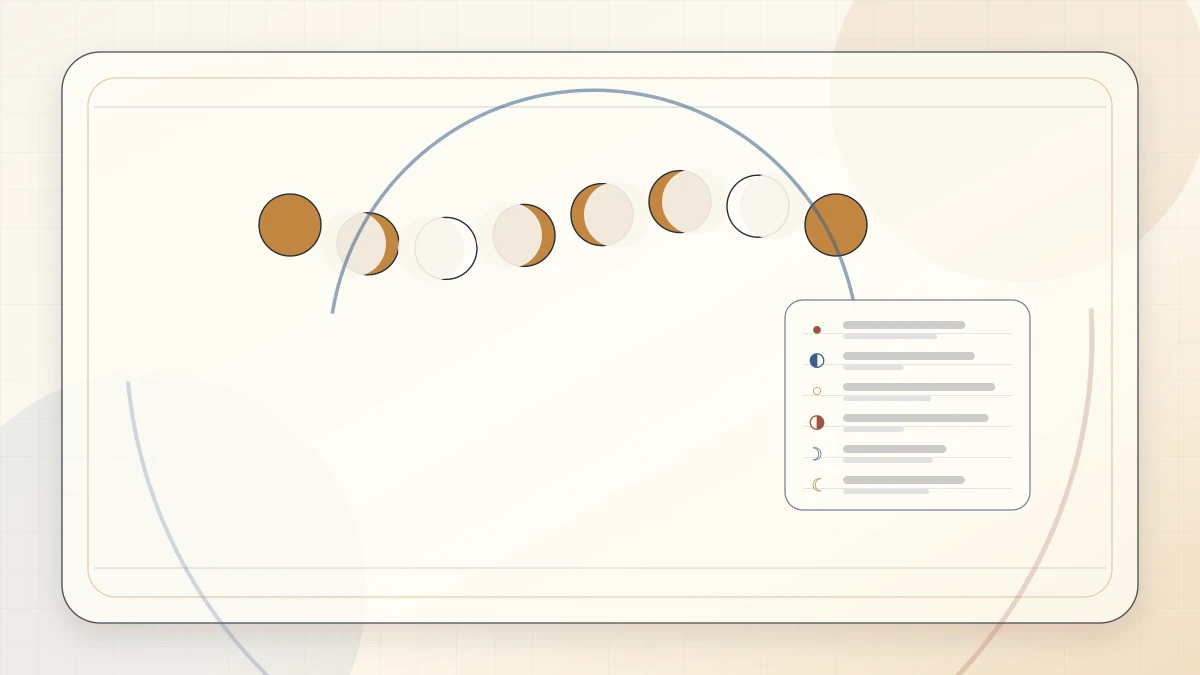
There are eight named phases of about 3.7 days each, but you do not need all eight. Four anchors, a quarter of a cycle apart, are enough for most people.
| Checkpoint | Moon position at the exact instant | About day of the cycle | Minutes | What to do |
|---|---|---|---|---|
| New Moon | Same place in the sky as the Sun | 0 | 10 | Write one intention for the cycle |
| First quarter | Moon 90 degrees ahead of the Sun | 7.4 | 5 | Check progress and adjust |
| Full Moon | Moon 180 degrees from the Sun | 14.8 | 10 | Note what is working and what is not |
| Last quarter | Moon 270 degrees ahead of the Sun | 22.1 | 5 | Clear up one loose end |
Prompts that fit on one line
Each checkpoint works best with one short prompt you can answer in a sentence or two. At the new Moon, ask what you want to give attention to. At the first quarter, ask what has pushed back. At the full Moon, ask what has become clearer, and at the last quarter, ask what you can put down. Short answers keep each checkpoint inside its time limit and make a later review quick, since a month of entries fits on a single page.
What the routine costs in time
The minutes in the table add to 30 per cycle. Over about 12 or 13 cycles in a year, that is roughly six hours in total, compared with about 30 hours for five minutes every single day. A small, honest cost is a large part of why a routine survives a busy season.
How to build the routine in one evening
You can set the whole thing up in about half an hour.
- Look up the next three months of phase dates in a Moon calendar and add the four checkpoints to the calendar you already use.
- Name each event after its question, such as “What is the one thing?” at the new Moon.
- Set a timer for the minutes in the table and stop when it rings.
- Choose one place to write, such as a single notebook or one note on your phone, so the entries sit together.
- Decide in advance what a skipped checkpoint means: you go to the next one and do nothing else.
Three sizes of routine, from bare minimum to fuller
Pick the size you can keep in your busiest month. You can always grow it later.
| Size | Checkpoints | Minutes per cycle | Suits |
|---|---|---|---|
| Minimum | New Moon and full Moon, 5 minutes each | 10 | Weeks when everything else is full |
| Standard | The four checkpoints above | 30 | Most people in most months |
| Fuller | All eight phases, 5 minutes each | 40 | People who enjoy watching the whole cycle |
Start with the minimum and add only what you miss
Run the minimum size for two cycles, then add a checkpoint only if you find yourself wanting it. A routine that grows because you wanted more tends to last longer than one that starts large and shrinks under pressure.
A constructed routine: Jo’s shift-work months
Jo works shifts and has little predictable time, so Jo chose the minimum size. At the new Moon Jo wrote one line: “Finish sorting the paperwork box.” At the full Moon, about two weeks later, Jo reread the line and added two more: what had moved and what was stuck.
A double shift made Jo miss the next new Moon, and Jo simply picked up at the following full Moon. The routine absorbed the gap because it was built to, with no streak to protect and no catching up. Over six cycles Jo kept 9 of the 12 checkpoints, three quarters of them.
When the Moon dates are awkward: time zones, clouds and hemispheres
A Moon calendar lists the moment of each phase in a stated time zone, usually UTC or your local time. The phase itself is the same everywhere on Earth, but the calendar date can differ by a day between time zones, so use the date your own calendar shows. You do not need to see the Moon either, since clouds and city lights do not change the cycle.
In the Southern Hemisphere the lit side of the Moon appears on the opposite side of the disc, though the phases and dates are the same. If you prefer fixed dates, such as the first and fifteenth of each month, use them. The monthly rhythm is the point.
A diary test: does the routine help you?
There is no good evidence that the Moon’s phase reliably changes mood, motivation or productivity, so the fair test of a lunar routine is whether you find it useful. After three cycles, count the checkpoints you kept and ask three questions: did writing the line make me more likely to act, did I read it again, and did the routine feel like relief or a chore?
If the answer is mostly chore, shorten it or move it to fixed dates. If low energy or mood is a real problem, a routine is no substitute for talking with a doctor or another qualified professional.
Common questions about a simple lunar routine
Do I need to know the Moon’s sign? No. The phase alone is enough for this routine, and the sign is an optional extra that many people ignore.
Should I add a ritual? You can, if it adds meaning without adding pressure. A cup of tea is fine, and a long ceremony you dread is not.
Can I do this weekly instead? Yes. A weekly pause is a separate routine, and some people prefer it to a monthly one.
What if I forget a whole cycle? Begin again at the next checkpoint. The Moon carries on regardless, and so can you.
What this does and does not establish
The Moon does not change outcomes, and a routine is no substitute for a doctor or professional if low energy or mood is a real problem.
Related calculators
Use the matching tool when you want a direct chart or timing result after reading the guide.
Current Moon Phase Calculator
reader-focused-friendly exact current Moon phase page for a selected city and live local timestamp.
New Moon Calculator
Exact monthly New Moon lookup page for reset and intention-planning readers.
Full Moon Calculator
Exact monthly Full Moon lookup page for release, visibility, and completion timing readers.
Calculation references
- NASA: Moon phases
Reference for illuminated phases and physical geometry; not evidence for personal or ritual interpretations.
Related articles
Keep reading with nearby topics that deepen the same question from another angle.
Do Moon Phases Affect Motivation? What a Diary Can Show
There is no good evidence that motivation follows the Moon. Still, the eight phases, each about 3.7 days long, make a handy schedule for a plan-versus-done ledger.
6 min read
Moon Phases for Reflection and Emotional Check-Ins
A Moon-phase check-in is a short, regular pause to notice how you are doing, using four lines: what happened, what you felt, what you told yourself and what would help.
6 min read
Moon Phases Explained for Beginners
Moon phases show how much of the Moon's sunlit half we can see as it circles Earth. One 29.5-day cycle splits into eight phases of about 3.7 days, each starting at a multiple of 45 degrees.
6 min read
New Moon Meaning and How to Set Intentions
A new Moon is the monthly moment when the Sun and Moon share the same degree. To set an intention, write one small, specific goal you control and schedule its first step.
6 min read
Keep exploring
Use the category page and the main hubs when you want the next layer of context.
Previous article
Do Moon Phases Affect Motivation? What a Diary Can Show
Next article
Moon Phases for Reflection and Emotional Check-Ins