
Planetary Transits
How to Read Saturn Transits for Responsibility
Read a Saturn transit as an audit of what you carry in the area it touches: what you chose, what was assigned and what you inherited, and whether each still fits.
Table of contents
- Example or practical exercise
- What a Saturn transit asks about responsibility
- Saturn’s pace and why contacts return
- Saturn’s quarter-cycle ages
- How the contacted natal planet shapes the question
- Reading the house Saturn is crossing
- A constructed Saturn contact, worked through
- A responsibility review for a Saturn contact
- Why Saturn is not a punishment
- Common questions about Saturn transits
- What this does and does not establish
Example or practical exercise
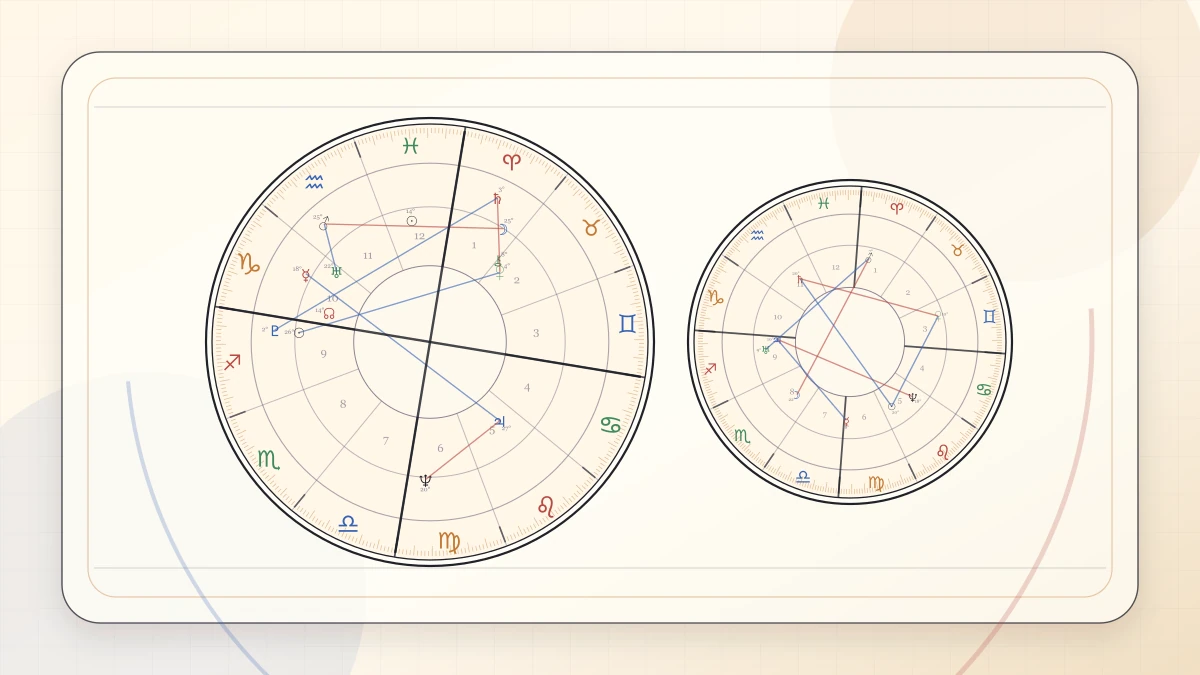
Dev's natal Moon at 17 Pisces in his seventh house is squared by Saturn at 16 Gemini in his tenth for about four months, raising who carries what when work and home compete.
What a Saturn transit asks about responsibility
In the tradition Saturn stands for limits, structure, time and accountability. When it transits a natal point, the usual question is not what will happen but what you are responsible for in that part of life, and whether the arrangement still fits.
Responsibility here means three things: what you chose, what was assigned to you and what you inherited without deciding. Saturn contacts are often read as moments for an audit of those three, which is why they feel heavier than other transits even when nothing dramatic occurs.
That makes Saturn a good planet for slow, honest bookkeeping. You are not asked to take on more. You are asked to see clearly what you already carry and to decide, one item at a time, whether it still belongs to you.
Saturn’s pace and why contacts return
Saturn takes about 29.5 years to circle the zodiac and spends about two and a half years in each sign. On average that is about a month per degree. A contact with a two degree orb on either side spans four degrees, so at average speed it lasts about four months.
Saturn is retrograde for about four and a half months each year, so it often crosses one natal degree up to three times. A Saturn contact tends to be read in stages: a first arrival that raises the issue, a revisit that tests your answer and a final pass that settles it.
Saturn’s quarter-cycle ages
Saturn also makes angles to its own natal place at fairly predictable ages. A waxing square comes when Saturn has moved 90 degrees past its natal place, and a waning square when it is 90 degrees short of returning. These ages are approximate, since Saturn’s speed varies, and many people notice nothing dramatic.
| Approximate age | Angle to natal Saturn | A common reading |
|---|---|---|
| 7.4 | First waxing square | Rules and expectations arrive from outside |
| 14.75 | First opposition | Testing the limits you were given |
| 22.1 | First waning square | Taking up adult obligations |
| 29.5 | First return (conjunction) | Reviewing the commitments you hold |
| 36.9 | Second waxing square | Rebuilding what no longer fits |
| 44.25 | Second opposition | Weighing what has been built |
| 51.6 | Second waning square | Simplifying duties |
| 59 | Second return (conjunction) | A second review of what you carry |
How the contacted natal planet shapes the question
Saturn takes the character of whatever it touches. The same planet asks a different question of the Moon than of Venus, and these are prompts to think with, not verdicts about your life.
| Natal point | The responsibility question |
|---|---|
| Sun | What am I committed to being, and what is mine to carry? |
| Moon | Whose feelings and needs am I looking after, and are mine included? |
| Mercury | Which promises have I put into words, and can I keep them? |
| Venus | What do I owe in close ties, and what do I expect in return? |
| Mars | Where is my effort being asked for, and is it sustainable? |
| Jupiter | Which hopes need a plan before they need more energy? |
| Ascendant | What role have I settled into, and did I choose it? |
| Midheaven | What duties come with my public position? |
Reading the house Saturn is crossing
Saturn stays in a typical house for about two to three years, depending on the house’s size, so a house passage is the long background to the shorter contacts inside it. A few houses tend to bring the responsibility question into sharp focus.
- Second house: what you look after and keep, including your time and your values.
- Fourth house: home, family and the obligations that come with belonging.
- Sixth house: daily duties, routines and how much work is too much.
- Seventh house: what you have promised to partners, in words and in practice.
- Tenth house: the public role you hold and the standards you set for it.
A constructed Saturn contact, worked through
Take a constructed person, Dev, with natal Moon at 17 Pisces, which is 330 plus 17, or 347, and a Virgo Rising in whole-sign houses. Pisces is then his seventh house. Transiting Saturn is at 16 Gemini, which is 60 plus 16, or 76, and Gemini is his tenth house.
The gap runs from 347 around to 76: 76 plus 360 is 436, and 436 minus 347 is 89. That is one degree from a square. A square sets two points in tension, so the Moon in the seventh house, tied to partnerships and close feelings, meets Saturn in the tenth, tied to work and public duty.
A reflective question might be who is carrying what when work obligations and home needs compete. At an average of a month per degree, a window with a two degree orb on each side is four degrees wide and runs about four months.
A responsibility review for a Saturn contact
You do not need a ritual. A written review of one area is enough, and it works whether or not you believe in the transit.
- Name the area from the natal planet and the house Saturn is crossing.
- List the obligations in that area, one line each.
- Mark each one as chosen, assigned or inherited.
- Note which obligations fit your present time and energy.
- Pick one to keep, one to renegotiate and, if you wish, one to set down.
- Review the list again at the turn of the contact.
Why Saturn is not a punishment
Not every difficulty is a Saturn lesson. A job loss, a caregiving crisis or a setback has causes in the world, and reading it as a message from a planet can add blame to a hard time. A transit is a lens for sorting your commitments, not an explanation for why something went wrong.
If the load feels too heavy, talk it through with someone you trust or a qualified professional. An astrological label is not a substitute for support.
Common questions about Saturn transits
How long does a Saturn transit last? Each contact lasts a few months at average speed, but retrograde turns can stretch the full sequence across more than a year.
Is Saturn bad? The tradition has long called it a malefic, a difficult planet, but modern readers usually frame it as structure. It can ask for effort, yet effort is not the same as harm.
Does Saturn only matter at its return? No. Returns get attention, but Saturn contacts every natal planet in turn over its roughly twenty-nine and a half year cycle.
Do I have to wait for exact? No. Many people review their commitments as the contact applies, not only once it peaks.
What this does and does not establish
Not every difficulty is a Saturn lesson; real setbacks have causes in the world, and a transit is a lens for sorting commitments, not an explanation.
Related calculators
Use the matching tool when you want a direct chart or timing result after reading the guide.
Current Transits Calculator
Exact current-sky snapshot for a selected city, built for repeat-use daily astrology readers.
Retrograde Calendar
Exact retrograde-period page for year-based planning, editorial planning, and current-sky timing checks.
Transit to Natal Calculator
Exact current-sky comparison against one verified natal chart for more personal practical transit guidance.
Calculation references
- Swiss Ephemeris: positions, angles and house-system conventions
Technical reference for calculation conventions. It does not certify an interpretation or mean every live tool uses this engine.
Related articles
Keep reading with nearby topics that deepen the same question from another angle.
How to Read Jupiter Transits for Growth
Read a Jupiter transit through the natal point it touches, since that point names the topic where wider thinking is welcome. Then turn a loose wish for more into a goal you can check.
6 min read
How to Read Mars Transits for Energy and Conflict
Read a Mars transit as a brief push to act, lasting about three or four days, aimed at whatever natal point it touches. It points at pace and impatience, not at arguments.
6 min read
Mercury Retrograde Meaning and a Practical Checklist
Mercury retrograde is a few weeks, three or four times a year, when Mercury appears to drift backward as seen from Earth. Astrologers read it as a time to review, revise and double-check.
6 min read
How to Read Current Transits Without Overreacting to Every Aspect
Choose your question first, list the slow-planet contacts within a tight orb, then add fast ones only for timing. A Saturn contact lasting months outweighs a Moon contact lasting hours.
6 min read
Keep exploring
Use the category page and the main hubs when you want the next layer of context.
Previous article
How to Read Jupiter Transits for Growth
Next article
How to Read Mars Transits for Energy and Conflict