
Career Astrology
How to Read the Sixth House for Daily Work
Find your sixth-house sign, its ruler and any planets inside, turn each into a question about routine, then compare the questions with a week of real calendar and task notes.
Table of contents
- Example or practical exercise
- The sixth house is a map of the ordinary week
- Five steps from chart to calendar
- A planet inside the sixth house: one prompt for your calendar
- Setting up the week log: columns and a sample day
- A constructed chart: Aquarius rising with Mercury in the sixth
- A one-week check that keeps the reading honest
- Questions people ask about the sixth house and work
- What your calendar can answer that the chart cannot
- What this does and does not establish
Example or practical exercise
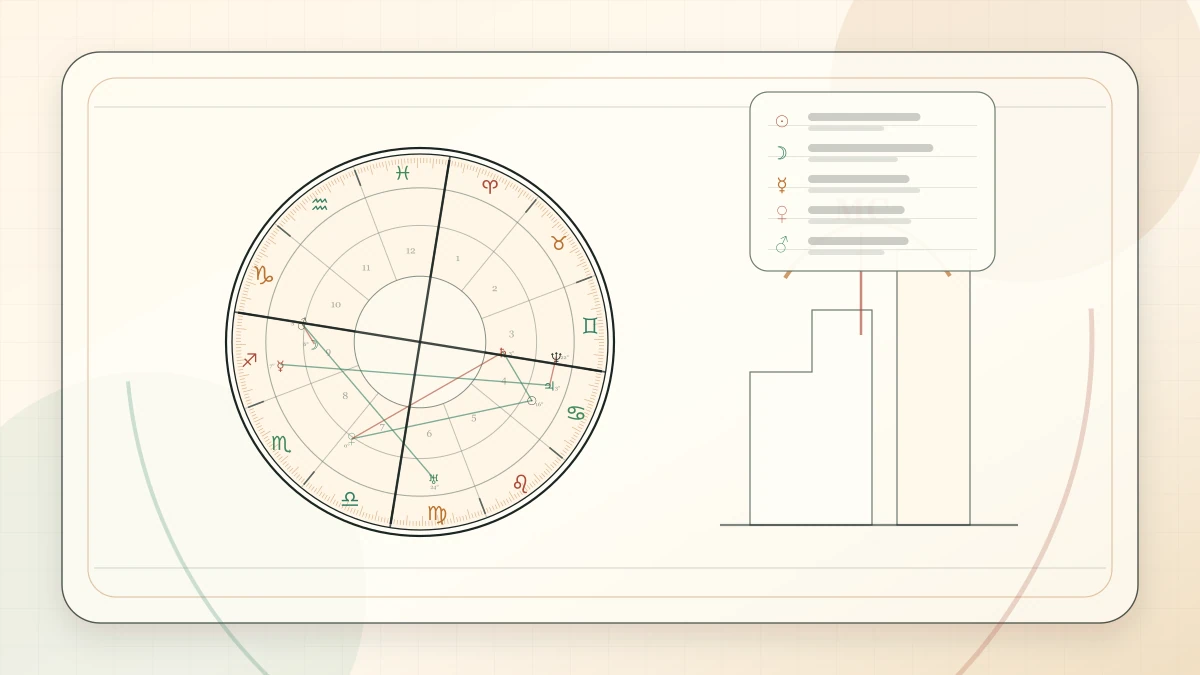
In a constructed Aquarius-rising chart, the Moon rules the Cancer sixth from Taurus in the fourth, linking work with home, and Mercury in the sixth sextiles it; 35 task switches in five days averages 7 a day.
The sixth house is a map of the ordinary week
The sixth house is traditionally the house of daily work, routines, service and small obligations. It is cadent, one of the houses (3, 6, 9, 12) that tradition describes as falling away from the angles, which fits its subject: the unremarkable tasks that fill most days. Reading it well means looking at the texture of an ordinary Tuesday rather than at a job title.
This guide gives a sequence for reading it and a way to check the result against a real calendar. It does not tell you what work to do or whether a workload is safe. Those are questions for you, your employer and, where health is involved, a doctor.
Five steps from chart to calendar
Work through these in order. Each step produces a prompt you can hold up against what actually happens in your week.
- Find the sixth house. In whole signs, count five signs on from your Rising sign (the Rising sign is the first house). In a quadrant system, read the sign on the sixth cusp.
- Note the sign’s element and modality as a tone for routine: for example, a cardinal sign suggests starting tasks, a mutable one switching between them. Our Sixth House Work Style Guide gives a tone for each sign.
- Find the ruler of that sign and record its house. That house names the area of life most tangled up with your routines.
- List any planets inside the sixth house and read each as a prompt, using the table below.
- Check aspects to the ruler and occupants, then write three questions and compare them with a week of real calendar and task data.
A planet inside the sixth house: one prompt for your calendar
Planets tend to be the most specific part of the reading. This table gives one calendar prompt for each of the seven visible bodies. These are vocabulary, not instructions, and a person with an empty sixth house is not missing anything.
| Planet in the sixth | Traditional theme | What to look for in a week of work |
|---|---|---|
| Sun | Identity and vitality | Which tasks make me feel most like myself, and which drain that feeling? |
| Moon | Rhythm and mood | Does my task order match my usual energy across the day? |
| Mercury | Messages and paperwork | How many times a day do I switch between messages and focused work? |
| Venus | Pleasantness and harmony | How much does the atmosphere of a workplace affect my output? |
| Mars | Pace and friction | Where do I rush, and where does friction with others build? |
| Jupiter | Scope and growth | Do small tasks keep expanding into larger ones? |
| Saturn | Structure and duty | Which routines hold me up, and which hold me back? |
Setting up the week log: columns and a sample day
A log works only if it is quick. Keep one line per block of work and five short columns, and fill it in as you go rather than at night, when memory smooths things over.
This constructed day has four blocks, one of them unplanned, and five interruptions. Five such days give you about twenty lines, enough to see whether the patterns your chart questions point to actually appear.
| Time | Task | Planned? | Interruptions | Energy, 1 to 5 |
|---|---|---|---|---|
| 8:30 to 9:15 | Email and messages | Planned | 0 | 3 |
| 9:15 to 11:00 | Report draft | Planned | 2 | 4 |
| 11:00 to 11:30 | Call about a late order | Unplanned | 0 | 2 |
| 1:00 to 3:00 | Report draft, continued | Planned | 3 | 3 |
A constructed chart: Aquarius rising with Mercury in the sixth
Take an invented chart with Aquarius rising, read in whole signs. Counting five signs on from Aquarius puts the sixth house in Cancer, so the ruler is the Moon. Suppose the Moon sits at 17 degrees of Taurus, which is the fourth house (Aquarius 1, Pisces 2, Aries 3, Taurus 4), the house of home and foundations. The ruler therefore links the workday with home.
Add Mercury at 15 degrees of Cancer, inside the sixth. Cancer begins at 90 degrees, so Mercury is at 105. Taurus begins at 30, so the Moon is at 47. The gap is 58 degrees, a sextile (60 degrees) with an orb of 2.
The prompts follow. Cancer is cardinal and watery, so ask how this person sets up tasks and how feelings enter routine. The Moon in the fourth house asks whether home or a home base shapes working hours. Mercury in the sixth asks about messages and paperwork, and the sextile suggests those two themes can cooperate. If this person logged 35 switches between messages and focused work over five days, that is an average of 7 a day, and the next question is which of them could wait. That is a calendar question the chart only helped phrase.
A one-week check that keeps the reading honest
For five working days, note three things in a few words each: when your first task started, how often your focus was broken, and which task you were most reluctant to begin. Add a short note at the end of the week about what you would change if you could.
Then place your three chart questions next to the notes. Some will match. Many will not, and that is useful: you learn which parts of the traditional vocabulary describe you and which are simply noise. Trust the notes over the symbol.
- Match: the prompt describes a pattern you can point to in at least two of the five days.
- Partial: it fits one day or one kind of task, so keep it as a question for next week.
- Miss: nothing in the notes reflects it, so drop it without looking for a reason to keep it.
Questions people ask about the sixth house and work
Does the sixth house show what job I should have? No. It describes tendencies in how a day is arranged, and every sign and planet appears in every occupation. Use it to ask about routine, not to pick a field.
Is the sixth house about health? Traditionally it has been linked with illness, but this guide does not use it that way. A chart cannot say anything about your body, and questions about health belong with a doctor.
What if my job has no routine? Then the sixth house asks what routine you build around it, such as how you begin and end a day, and what you do when nothing is scheduled.
Does the Virgo link matter? Virgo is the sign associated with the sixth house in the natural order, but your own sixth house can be any sign. Read yours, not the textbook default.
What your calendar can answer that the chart cannot
A chart can raise a question about pace, but only your calendar can tell you whether your workload is too heavy. If you routinely work beyond your agreed hours, skip breaks or feel worn out for weeks, talk with your employer about the workload and with a doctor about your health. Astrology is a way to phrase questions, not a way to settle them.
What this does and does not establish
Only your calendar can show whether a workload is too heavy, and a chart says nothing about your body or health.
Related calculators
Use the matching tool when you want a direct chart or timing result after reading the guide.
Career Astrology Calculator
Saved-chart practical career page built from Midheaven, Sun, Saturn, and tenth-house structure.
Midheaven / MC Sign Calculator
Exact Midheaven sign verification from full birth-chart math for practical career and visibility questions.
Money Astrology Calculator
Saved-chart money-style page built from second-house, eighth-house, Venus, and Jupiter patterns.
Calculation references
- Swiss Ephemeris: positions, angles and house-system conventions
Technical reference for calculation conventions. It does not certify an interpretation or mean every live tool uses this engine.
Related articles
Keep reading with nearby topics that deepen the same question from another angle.
How to Read the Second House for Money Patterns
Declare your house system, find the second-house sign and its ruler, locate the ruler, list planets inside, check aspects, then turn each finding into a question tested against a log of your behavior.
6 min read
Career Timing With Saturn and Jupiter
Saturn and Jupiter act as two slow clocks: Saturn contacts prompt questions about responsibility and Jupiter contacts about growth. Record each as a date range on its own line, never as one score.
6 min read
Career Astrology for Beginners
Career astrology reads six layers: the tenth house and Midheaven for public role, the sixth for daily work, the second for resources, and the Sun, Saturn and Mars for purpose, discipline and drive.
6 min read
Midheaven Sign Meaning
Your Midheaven sign describes the public style you tend to show in your work and reputation, such as precise and helpful for Virgo. Its ruler and nearby planets add detail.
6 min read
Keep exploring
Use the category page and the main hubs when you want the next layer of context.
Previous article
How to Read the Second House for Money Patterns
Next article
Career Timing With Saturn and Jupiter