
Career Astrology
How to Read the Second House for Money Patterns
Declare your house system, find the second-house sign and its ruler, locate the ruler, list planets inside, check aspects, then turn each finding into a question tested against a log of your behavior.
Table of contents
- Example or practical exercise
- Reading the second house is a method, not a verdict
- The seven steps, in order
- What each layer adds, and the question it raises
- What if the second house is empty?
- A constructed chart: Cancer rising with Saturn in the second house
- Turning a symbol into a habit you can observe
- Questions people ask about reading the second house
- What to do with your own second house this week
- What this does and does not establish
Example or practical exercise
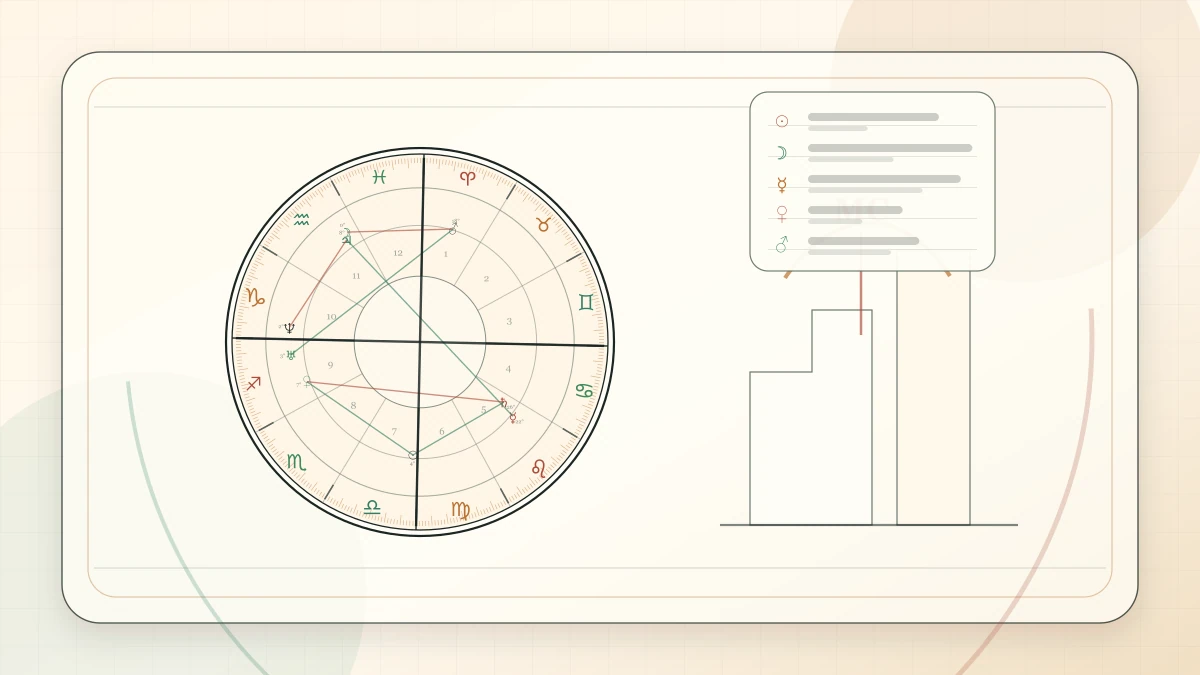
In a constructed Cancer-rising chart, the Sun rules the Leo second house from Taurus in the eleventh, and Saturn at 12 Leo squares it within 3 degrees, prompting a question about belonging versus holding tight limits.
Reading the second house is a method, not a verdict
The second house is the part of the chart that astrologers have traditionally linked with resources, possessions and what a person values. People search for “money patterns,” and the useful word in that phrase is patterns: repeated habits and attitudes that you can see in your own behavior. It is not an amount, an income source or a forecast of either.
This guide is a procedure you can run on any chart, followed by a constructed example and a way to check what you find. It assumes your chart has a birth time, because houses depend on it. Without a birth time the planets still sit in their signs, but the second house cannot be placed.
The seven steps, in order
Do the steps in this order and write each result down. Skipping ahead to the planets is the usual mistake, because a planet’s meaning shifts depending on which house system put it where it is.
- Declare your house system. Whole-sign houses give each house one full sign, counted from the Rising sign. Quadrant systems such as Placidus draw cusps at uneven degrees. Write down which one you are using.
- Find the second-house sign. In whole signs it is the sign after your Rising sign. In Placidus, read the sign on the second cusp and note any second sign that begins partway through the house.
- Name the ruler of that sign. Use the traditional ruler, add the modern one if you like, and say which you chose.
- Locate the ruler by sign and house. This is the link that connects the resources topic to another area, such as learning, home or work. The twelve possible links are listed in our Second House Money Guide.
- List any planets inside the second house. Occupants are the loudest voices in the topic.
- Check aspects to the ruler and to each occupant, using a natal orb of about 6 to 8 degrees, and record them as angles: a square is 90 degrees, a trine 120, an opposition 180.
- Turn every finding into a question rather than a statement, and test it against a log of your own behavior.
What each layer adds, and the question it raises
A reading has layers, and each one asks something different. Keep them apart so that a single symbol does not carry the whole interpretation.
| Layer | What it describes | A question to ask yourself |
|---|---|---|
| Element of the house sign | The texture of how you approach having things (fire: spirited, earth: practical, air: conceptual, water: felt) | Do I decide about resources by feeling, by logic, by habit or by impulse? |
| Modality of the house sign | Cardinal starts arrangements, fixed holds them, mutable adjusts them | Do I tend to set things up, maintain them, or keep changing them? |
| Ruler’s house | Where the topic of resources connects to the rest of life | Which other area of my life do my resource choices seem tied to? |
| Planets inside the house | Extra voices in the conversation | Which impulse shows up whenever I make a resource decision? |
| Aspects to ruler or occupants | Support or friction between that topic and another | Where do my values pull against something else I want? |
What if the second house is empty?
A typical chart has several houses with no planets, so an empty second house is ordinary and says nothing about the topic being unimportant. The sign on the house and the placement of its ruler carry the reading, and you can skip step five.
A constructed chart: Cancer rising with Saturn in the second house
Take an invented chart with the Ascendant at 20 degrees of Cancer, read in whole-sign houses. Counting from Cancer as the first house, the second house is Leo, so the ruler is the Sun. Say the Sun sits at 9 degrees of Taurus. Counting on from Cancer (Leo 2, Virgo 3, Libra 4, Scorpio 5, Sagittarius 6, Capricorn 7, Aquarius 8, Pisces 9, Aries 10, Taurus 11), the Sun is in the eleventh house of groups and hopes.
Add Saturn at 12 degrees of Leo, inside the second house. On the zodiac wheel the Sun is at 39 degrees (30 for Taurus plus 9) and Saturn at 132 (120 for Leo plus 12). The gap is 93 degrees, which is a square with an orb of 3, within the orb of 6 to 8 degrees used in step six.
Now translate. Leo gives a fixed, fiery tone, so the first question is whether this person holds firmly to what they value and likes to be seen valuing it. The Sun in the eleventh asks whether those values connect with friends, groups or shared causes. Saturn, which traditionally concerns limits and effort, sits in the house itself and squares the ruler, so the prompt is about tension between wanting to belong and wanting to hold tight limits.
Turning a symbol into a habit you can observe
A question stays interesting only if you can test it. For the example above, the person keeps a four-week log of resource decisions of any size: something bought, lent, refused, saved for or given away. Beside each entry they note what drove it, choosing from habit, a value, social pressure, fear of running short, or enjoyment.
After four weeks they count the reasons. If social pressure appears in 9 of 21 entries, that is a pattern worth discussing and it has the shape the chart question suggested. If it appears twice, the chart question did not fit, and nothing is lost by dropping it. Either way the log does the work.
Questions people ask about reading the second house
How many log entries are enough? Around twenty over four weeks gives you something worth counting. With fewer than ten, a single busy weekend can make one reason look like a pattern, so keep logging before you draw anything from it.
Is Venus part of the reading? Many astrologers add Venus because the second house is naturally linked with Taurus. If you do, treat it as one more voice and note its sign, house and aspects.
Why does my second house differ between two websites? Probably because one used whole-sign houses and the other a quadrant system. Neither is wrong; pick one and say so.
Can I read it without a birth time? Only the planets’ signs, not the house. A chart set for noon is a placeholder, not a true second house.
What to do with your own second house this week
Run steps one to six on your own chart and write the result as three questions, no more. Then keep the log described above for two weeks, even a line a day.
If your questions turn toward saving, debt, taxes or investing, set the chart aside. Those are decisions for a qualified financial adviser, and no house or ruler can stand in for one.
What this does and does not establish
The second house cannot verify wealth, debt or earning power, and without a birth time you can read only planet signs, not the house.
Related calculators
Use the matching tool when you want a direct chart or timing result after reading the guide.
Career Astrology Calculator
Saved-chart practical career page built from Midheaven, Sun, Saturn, and tenth-house structure.
Midheaven / MC Sign Calculator
Exact Midheaven sign verification from full birth-chart math for practical career and visibility questions.
Money Astrology Calculator
Saved-chart money-style page built from second-house, eighth-house, Venus, and Jupiter patterns.
Calculation references
- Swiss Ephemeris: positions, angles and house-system conventions
Technical reference for calculation conventions. It does not certify an interpretation or mean every live tool uses this engine.
Related articles
Keep reading with nearby topics that deepen the same question from another angle.
How to Read the Sixth House for Daily Work
Find your sixth-house sign, its ruler and any planets inside, turn each into a question about routine, then compare the questions with a week of real calendar and task notes.
6 min read
Career Astrology for Beginners
Career astrology reads six layers: the tenth house and Midheaven for public role, the sixth for daily work, the second for resources, and the Sun, Saturn and Mars for purpose, discipline and drive.
6 min read
Midheaven Sign Meaning
Your Midheaven sign describes the public style you tend to show in your work and reputation, such as precise and helpful for Virgo. Its ruler and nearby planets add detail.
6 min read
How to Use Astrology for Career Reflection
Turn chart themes into questions about your own work, then check each one against your work history, feedback and the conditions you have enjoyed. The chart supplies prompts; your record supplies evidence.
6 min read
Keep exploring
Use the category page and the main hubs when you want the next layer of context.
Previous article
Part of Fortune Meaning in Astrology
Next article
How to Read the Sixth House for Daily Work