
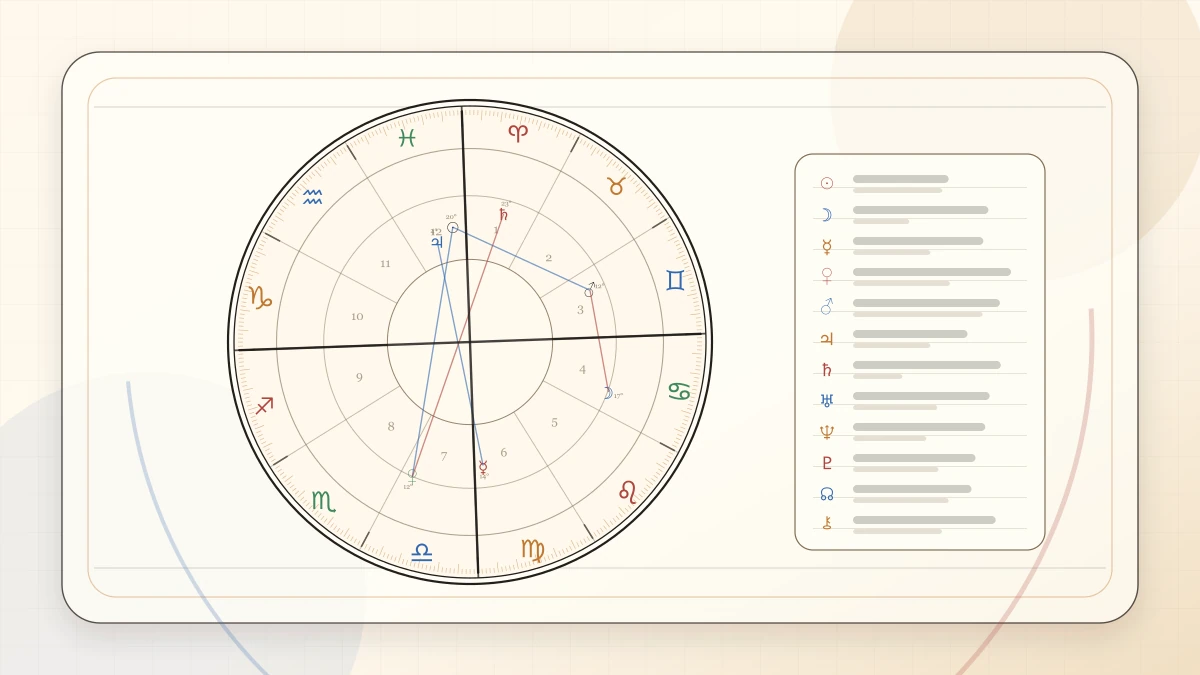
Houses, Aspects, and Planets
Part of Fortune Meaning in Astrology
The Part of Fortune is a calculated point, not a body. It carries the Sun-Moon relationship onto the Ascendant: Ascendant plus Moon minus Sun by day, with Sun and Moon swapped at night.
Table of contents
- Example or practical exercise
- What the Part of Fortune is
- The day formula and the night formula
- How do I know whether my chart is a day or night chart?
- Three constructed charts, four calculations
- How to calculate your own Part of Fortune by hand
- What birth data the Part of Fortune needs
- How the Part of Fortune is read by sign and house
- The Part of Fortune in the houses, in four groups
- What the Part of Fortune cannot tell you
- Common questions about the Part of Fortune
- What this does and does not establish
Example or practical exercise
In a constructed day chart, Ascendant 195 plus Moon 340 minus Sun 125 gives 410, and subtracting 360 places the Part of Fortune at 50 degrees, 20 Taurus.
What the Part of Fortune is
The Part of Fortune is a calculated point, not a planet or a physical object. It comes from the Hellenistic tradition, the astrology of the early centuries of the common era, which used “lots”: points found by adding and subtracting the positions of other things in the chart. Fortune is the best known of them.
In plain words, it carries the relationship between the Moon and the Sun onto the Ascendant. In a day chart, the distance from the Ascendant to the Part of Fortune equals the distance from the Sun to the Moon; in a night chart the Sun and Moon swap roles, as the formulas below show. Despite the name, it makes no promise about luck or wealth.
The day formula and the night formula
Every position is measured in degrees along the zodiac, from 0 at the start of Aries to 360 at the end of Pisces. The two formulas reverse the Sun and the Moon.
- Day chart: Ascendant + Moon − Sun.
- Night chart: Ascendant + Sun − Moon.
- If the answer is above 360, subtract 360. If it is below 0, add 360.
How do I know whether my chart is a day or night chart?
A day chart has the Sun above the horizon, in houses 7 to 12. A night chart has it below, in houses 1 to 6. Traditionally this difference, called sect, decides which formula to use. Many modern astrologers use the day formula for every chart, which is simpler and gives a different point in a night chart.
If you are not sure which side the Sun is on, a chart program shows it, or you can think of it as birth after sunrise and before sunset for a day chart.
Three constructed charts, four calculations
The charts below are constructed for teaching. The night chart is worked twice, once with the night formula and once with the day formula that many modern astrologers use for every chart, so there are four rows for three charts. Each step is plain addition and subtraction, in degrees, with the 360 adjustment at the end.
| Case | Positions in degrees | Arithmetic | Result |
|---|---|---|---|
| Day chart | Ascendant 195, Moon 340, Sun 125 | 195 + 340 − 125 = 410; 410 − 360 = 50 | 50 degrees, 20 Taurus |
| Night chart | Ascendant 285, Sun 40, Moon 160 | 285 + 40 − 160 = 165 | 165 degrees, 15 Virgo |
| Same night chart, day formula | Ascendant 285, Moon 160, Sun 40 | 285 + 160 − 40 = 405; 405 − 360 = 45 | 45 degrees, 15 Taurus |
| Negative result | Ascendant 20, Moon 40, Sun 300 (day) | 20 + 40 − 300 = −240; −240 + 360 = 120 | 120 degrees, 0 Leo |
How to calculate your own Part of Fortune by hand
A chart program or an ephemeris, a table of planetary positions, gives you the three positions you need. Then the work is arithmetic.
- Get the Ascendant, Sun and Moon positions for your birth date, time and place.
- Convert each to degrees from 0 Aries: add 30 for each full sign before it, then the degrees within the sign.
- Decide whether it is a day or a night chart, and pick the formula.
- Add and subtract in the order given, then apply the 360 adjustment.
- Convert back: divide by 30 for the sign, and the remainder is the degree inside it.
What birth data the Part of Fortune needs
It needs a birth time, because the Ascendant does. The Ascendant rises through the zodiac at about 1 degree every 4 minutes, and the Part of Fortune moves at nearly the same pace. A 20-minute error shifts it by about 5 degrees, and a few hours can move it into a different sign.
It also needs a birth place, since the Ascendant depends on the latitude and longitude. A chart set for noon when the real time is unknown cannot give a reliable Part of Fortune.
How the Part of Fortune is read by sign and house
In the Hellenistic tradition, Fortune concerned worldly circumstances and the Moon’s side of life, in contrast to the Part of Spirit, tied to the Sun and the mind. The house where it falls was said to be an area where things tend to come to you without much effort, and the condition of the sign’s ruler was read as a sign of how smoothly that area goes.
Many modern readers simplify this: the sign is the style in which you feel in your element, and the house is the area of life where you feel at ease. Treat that as a reflection prompt about where life feels natural, not as a measure of success.
The Part of Fortune in the houses, in four groups
House placement tells you where the point sits in the chart. A house needs the same birth time as the point itself.
- Houses 1 to 3: ease in self-expression, personal resources and everyday exchange.
- Houses 4 to 6: ease at home, in creative play and in the routines of daily work.
- Houses 7 to 9: ease in partnership, in what is shared and in learning or belief.
- Houses 10 to 12: ease in public life, in groups, or in time apart from others.
What the Part of Fortune cannot tell you
It cannot tell you whether you will be lucky or rich. It cannot say anything about anyone’s money, health or future. It is one calculated point, and many astrologers use it little or not at all, either because the lots belong to an older system or because they prefer the planets.
If you use it, note which formula you used. Two astrologers can place the point in two signs for the same night chart and each be consistent with their own method.
Common questions about the Part of Fortune
Why swap the Sun and the Moon at night? The tradition holds that the Sun leads in a day chart and the Moon leads in a night chart, so the formula follows whichever one is above the horizon. Not every modern astrologer finds the idea convincing.
Is there a point for the other lots? Yes. The Part of Spirit reverses the Fortune formula, so it is Ascendant + Sun − Moon by day and Ascendant + Moon − Sun by night. It is a different lot.
Which formula should I use? Whichever you can explain. Use the traditional day and night version if you follow sect, or the day formula for every chart if your chart program or teacher does. Be consistent.
What this does and does not establish
Despite its name, the Part of Fortune cannot tell you whether you will be lucky or rich, and two formulas can place it in different signs.
Related calculators
Use the matching tool when you want a direct chart or timing result after reading the guide.
12 Houses Calculator
Complete 12-house overview page for readers who want the full natal house framework before drilling into one exact placement.
House Placement Calculator
Manual placement page that combines one known planet and one known house into a reusable interpretation page.
Planet Meaning Finder
Plain-English planet reference page for beginner chart readers.
Calculation references
- Swiss Ephemeris: positions, angles and house-system conventions
Technical reference for calculation conventions. It does not certify an interpretation or mean every live tool uses this engine.
Related articles
Keep reading with nearby topics that deepen the same question from another angle.
Semisextile Meaning in Astrology
A semisextile is a 30-degree angle, exactly one sign, usually between planets in neighboring signs, with a tight orb of 1 to 2 degrees. It is a minor aspect many astrologers leave out.
6 min read
The 12 Houses Explained
The twelve houses split a birth chart into twelve areas of life, measured from the horizon at your birthplace. A planet's sign shows how it behaves, and its house shows where that behavior appears.
6 min read
Conjunction, Square, Trine, and Opposition Explained
The major aspects are angles between two planets: conjunction at 0 degrees, square at 90, trine at 120 and opposition at 180, with the sextile at 60. Planets in aspect modify each other.
6 min read
What Each Planet Means in a Birth Chart
Each planet stands for a function: the Sun for identity, the Moon for emotional needs, Mercury for thinking, Venus for values, Mars for drive, Jupiter for growth and Saturn for limits.
6 min read
Keep exploring
Use the category page and the main hubs when you want the next layer of context.
Previous article
Semisextile Meaning in Astrology
Next article
How to Read the Second House for Money Patterns