
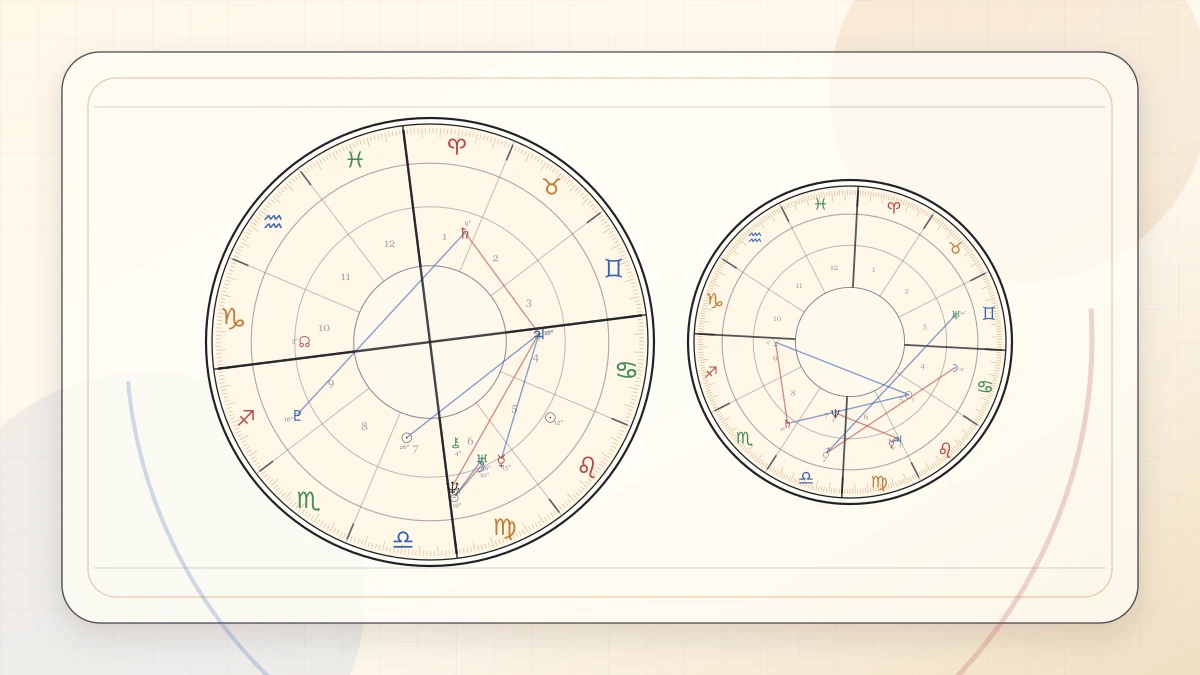
Planetary Transits
Jupiter Return vs Saturn Return
Both are a planet returning to its birth degree, but Jupiter comes back about every 12 years as a checkpoint for growth, while Saturn returns about every 29.5 years as an audit of structure.
Table of contents
- Example or practical exercise
- Two returns, one idea: what Jupiter and Saturn returns share
- Jupiter return and Saturn return compared in a table
- What a Jupiter return is said to be about
- What a Saturn return is said to be about
- How the two returns tend to feel to the people who track them
- A constructed timeline with both returns
- How Jupiter and Saturn interact in the same chart
- Common questions about the two returns
- How to compare your own two returns in fifteen minutes
- What this does and does not establish
Example or practical exercise
Dana, with Jupiter at 20 degrees Gemini and Saturn at 10 degrees Virgo, reaches her first Saturn return at about 29.5, between Jupiter returns at 24 and 36, and her second at 59, beside Jupiter's fifth at 60.
Two returns, one idea: what Jupiter and Saturn returns share
A return happens when a planet comes back to the zodiac degree it held at your birth. The geometry is the same for every planet; what changes is the length of the lap. Jupiter takes about 12 years to circle the zodiac and Saturn about 29.5, so Jupiter returns come often enough to feel like a rhythm, while Saturn returns arrive only two or three times in a whole life.
Astrologers read the two planets differently. Jupiter is the traditional symbol of growth, learning, generosity and belief; Saturn stands for structure, limits, duty and time. A return to either is read as a checkpoint for that theme, a moment to compare where you started with where you are now. Read it as a prompt for reflection, not a forecast.
Jupiter return and Saturn return compared in a table
The table sets the main facts and the traditional readings side by side. The ages are rounded averages, so your own return can fall a little earlier or later.
| Feature | Jupiter return | Saturn return |
|---|---|---|
| Time around the zodiac | About 12 years | About 29.5 years |
| Time in each sign | About a year | About 2.5 years |
| Typical ages | About 12, 24, 36, 48, 60, 72, 84 | About 28 to 30, 57 to 60, 86 to 89 |
| Returns in a long life | Seven by age 84 | Three by about 89 |
| Retrograde each year | About 4 months | About 4.5 months |
| Traditional theme | Growth, learning, belief, generosity | Structure, responsibility, limits, commitment |
| Question it invites | What do I want to widen or learn? | What am I building, and what holds up? |
| Passes over the natal degree | Can be more than one, because of retrograde turns | Up to three over a couple of years |
What a Jupiter return is said to be about
Astrologers who use the idea describe a Jupiter return as a point of widening. Jupiter spends about a year in each sign, so a return opens a fresh lap of that expansive story: new study, a larger circle of people, a bigger sense of what is possible, or a renewed question about what you believe. Traditional writers called Jupiter the greater benefic, which is the root of its cheerful reputation.
The tradition also warns that more is not always better. Jupiter’s themes include excess and taking on more than you can hold, so a thoughtful reading asks what deserves to grow. Because the laps are short, a Jupiter return at 24 or 36 is read as a waypoint, smaller than a Saturn return.
What a Saturn return is said to be about
A Saturn return is read as an audit. Saturn rules time, boundaries and work done by hand, so astrologers describe the first return, near 28 to 30, as a stretch when the structures of early adulthood are tested: career, home, commitments and the roles you took on from other people.
The second return, near 57 to 60, carries a different question, usually about what you want to keep carrying and what you can set down. The third, in the late eighties, is rarely discussed. The tradition offers a vocabulary here, not a verdict, and plenty of people say they noticed little.
How the two returns tend to feel to the people who track them
People who connect their lives to these cycles often describe the pair in contrast. Jupiter returns are remembered as openings: a course begun, a move, a new circle of friends, a sense of room. Saturn returns are remembered as sorting: a hard look at obligations, a decision to commit or to leave something, more seriousness about time.
Treat those descriptions as reports of how some people tell their story, not as a rule. Memory is generous to a pattern once you know it, and a Jupiter year can feel heavy while a Saturn year can feel like relief. The honest test is whether the theme fits what you wrote down at the time.
A constructed timeline with both returns
Take a constructed person, Dana, born with Jupiter at 20 degrees Gemini and Saturn at 10 degrees Virgo. Jupiter’s lap is about 12 years and Saturn’s about 29.5, so the arithmetic is repeated addition of each number to her age at birth.
- Age about 12: first Jupiter return, with Jupiter back at 20 degrees Gemini.
- Age about 24: second Jupiter return (12 plus 12).
- Age about 29.5: first Saturn return, with Saturn back at 10 degrees Virgo.
- Age about 36: third Jupiter return, 6.5 years after the Saturn return (36 minus 29.5).
- Age about 48: fourth Jupiter return.
- Age about 59: second Saturn return (29.5 plus 29.5).
- Age about 60: fifth Jupiter return, only a year after the second Saturn return.
How Jupiter and Saturn interact in the same chart
The overlap at the end of Dana’s timeline is arithmetic, not magic: five Jupiter laps of about 12 years make 60, and two Saturn laps of 29.5 make 59. Her first Saturn return sits roughly midway between two Jupiter returns, 5.5 years after one and 6.5 before the next. Real dates will shift by a year or so, because neither planet moves at an even pace.
Astrologers often pair the two planets as expansion and limit. A chart where they form an aspect is read as holding that tension in one place, and some astrologers read a window where both returns fall close together as asking what to widen and what to commit to at once. Others say that is a plain result of cycle length and adds no extra force. Either way, keep one entry for each planet in your notes, with its own dates.
Common questions about the two returns
Which return matters more? Neither has official priority. Saturn returns get more attention because they are rarer and fall at a time of large life choices, but a person who likes Jupiter’s themes may find its returns more useful. Choose by what helps you reflect.
Do I have to be exactly 29.5? No. A return is a window of a year or two, since retrograde turns can bring the planet back across the degree. The ages are averages across many charts.
Do these returns predict a promotion, a crisis or a life change? No. Neither return predicts a promotion, a crisis or any particular life transition; each describes a theme to reflect on.
How to compare your own two returns in fifteen minutes
You can build a timeline like Dana’s for yourself with a birth chart and a pencil.
- Find natal Jupiter and Saturn in your birth chart and write each as a sign and degree.
- Add 12 years to your birth date repeatedly to list Jupiter’s approximate returns, then 29.5 years repeatedly for Saturn’s.
- Mark any Jupiter return that falls within two years of a Saturn return.
- Check the actual crossings with a transit calculator, because the arithmetic is only an estimate.
- Beside each return, write what you remember from that period, including the parts that did not fit the theme.
What this does and does not establish
Neither return predicts a promotion, a crisis or any particular life change, and real dates shift by a year or so from the averages.
Related calculators
Use the matching tool when you want a direct chart or timing result after reading the guide.
Current Transits Calculator
Exact current-sky snapshot for a selected city, built for repeat-use daily astrology readers.
Retrograde Calendar
Exact retrograde-period page for year-based planning, editorial planning, and current-sky timing checks.
Transit to Natal Calculator
Exact current-sky comparison against one verified natal chart for more personal practical transit guidance.
Calculation references
- Swiss Ephemeris: positions, angles and house-system conventions
Technical reference for calculation conventions. It does not certify an interpretation or mean every live tool uses this engine.
Related articles
Keep reading with nearby topics that deepen the same question from another angle.
Mars Return Meaning
A Mars return is when Mars comes back to the degree it held at your birth, about every two years. Astrologers read it as a recurring check on drive, initiative and friction.
6 min read
Pluto Square Pluto Explained
Pluto square Pluto is transit Pluto reaching 90 degrees from its birth position. Because Pluto's speed is so uneven, it can arrive anywhere from the late thirties to beyond a lifetime.
6 min read
Mercury Retrograde Meaning and a Practical Checklist
Mercury retrograde is a few weeks, three or four times a year, when Mercury appears to drift backward as seen from Earth. Astrologers read it as a time to review, revise and double-check.
6 min read
How to Read Current Transits Without Overreacting to Every Aspect
Choose your question first, list the slow-planet contacts within a tight orb, then add fast ones only for timing. A Saturn contact lasting months outweighs a Moon contact lasting hours.
6 min read
Keep exploring
Use the category page and the main hubs when you want the next layer of context.
Previous article
Mars Return Meaning
Next article
Pluto Square Pluto Explained