
Moon Phases
Moon Phase Rituals for Beginners
A beginner's Moon ritual is a small repeated act: check the phase, take a few quiet minutes, and write or decide one thing. A notebook and a pen are all you need.
Table of contents
- Example or practical exercise
- What a Moon ritual is, and what it is not
- Start small: three layers you can add one at a time
- Choosing a time and a place
- What you actually need
- A four-phase ritual for beginners
- One prompt for each of the eight phases
- A constructed example: ten minutes on a Sunday evening
- A five-minute ritual in order
- Safety notes for candles, baths and incense
- Common questions about Moon rituals
- What this does and does not establish
Example or practical exercise
Lena checks the phase each Sunday, sets a ten-minute timer and writes three lines, which comes to 40 minutes a month and about 8 or 9 hours a year.
What a Moon ritual is, and what it is not
A Moon ritual is a small repeated act tied to a point in the lunar cycle: you check the phase, take a few quiet minutes, and write or decide something. The Moon does not change outcomes, and no ritual brings money, love, healing or luck. The value is the pause, the attention and the planning rhythm it gives you.
That means you can build one with almost nothing. This guide shows a short version, a fuller version, and the safety points worth knowing before you add candles, baths or incense.
Start small: three layers you can add one at a time
Begin with the first layer for a full cycle before you add the second. Many people find the first is enough.
- Layer one: check the phase and write a single sentence about what you want to notice this week.
- Layer two: add five to ten minutes of quiet writing with a prompt from the phase.
- Layer three: add one deliberate action, such as clearing a drawer, sending a message or scheduling something.
Choosing a time and a place
Pick a spot where you will not be interrupted and a time that already exists in your week, such as a Sunday evening or a morning before work. Attaching the ritual to something you do anyway, such as making tea, makes it easier to repeat.
You do not need to wait for the exact minute of a phase. Doing it a day or two before or after is fine, since the Moon changes slowly, about 12 degrees a day against the Sun.
What you actually need
A notebook, a pen and a way to check the phase are the whole kit. A moon calendar or the current Moon phase calculator on this site tells you where you are in the cycle. Any other object is optional, and none carries any power of its own.
If you borrow practices from a particular tradition, take the time to learn what they mean and where they come from. Respect for the source matters more than the props.
An altar, if you want one, can be a shelf with a few objects that mean something to you, such as a stone, a photograph or a plant. Nothing on it needs to be bought, and nothing on it has power of its own. Its only job is to remind you to pause.
A four-phase ritual for beginners
Four points a month are easier to keep than eight.
| Point in the cycle | A small act | Practical note |
|---|---|---|
| New Moon | Write one intention in plain words | Keep it to something you can act on |
| First quarter | Check what you have done and pick one next step | Put the step on your calendar |
| Full Moon | Write what is going well and what is not | Notice without judging |
| Last quarter | Choose one thing to stop, drop or finish | Keep real deadlines where they are |
One prompt for each of the eight phases
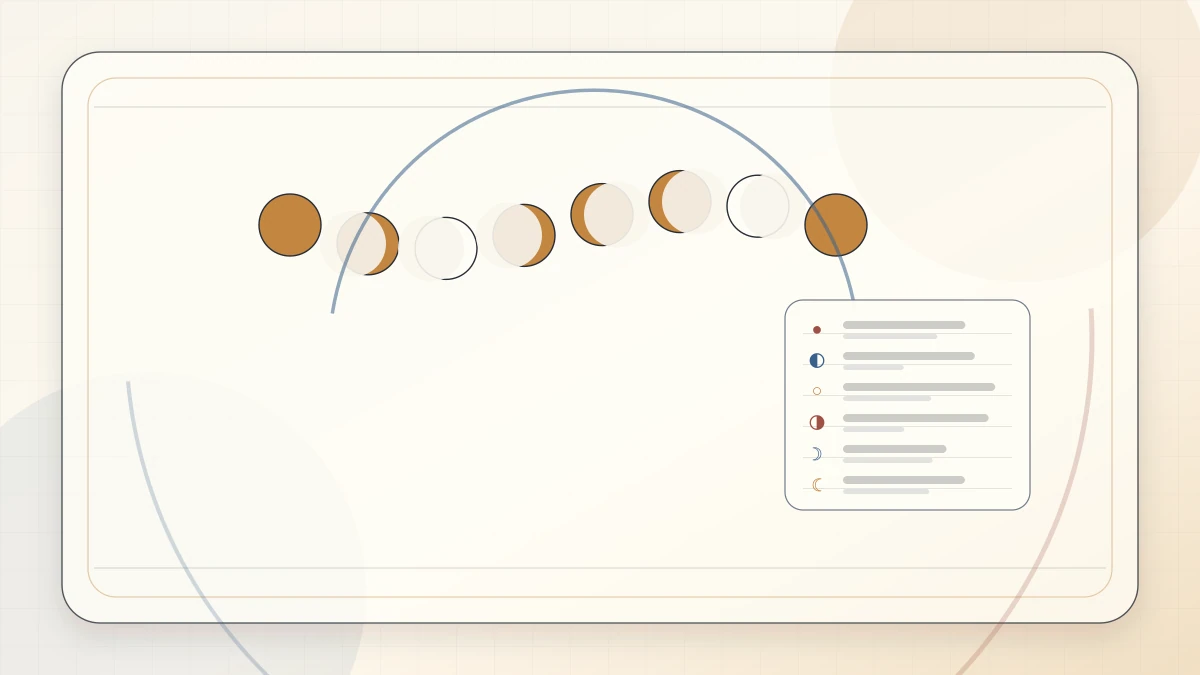
If you want to go beyond four points, these prompts follow the full cycle. Each phase lasts about 3.7 days.
- New Moon: what do I want to begin?
- Waxing crescent: what small thing can I do again tomorrow?
- First quarter: what decision have I been avoiding?
- Waxing gibbous: what needs fine-tuning?
- Full Moon: what is clear to me now?
- Waning gibbous: what could I share or teach?
- Last quarter: what am I ready to stop doing?
- Balsamic: what do I need to rest from?
A constructed example: ten minutes on a Sunday evening
Lena, a made-up person, has little spare time. She checks the phase on Sunday, sets a timer for ten minutes, and writes three lines: what happened this week, what she wants next week, and one task to schedule.
Four Sundays at ten minutes is 40 minutes a month, and over a year of 12 to 13 cycles that comes to about 8 or 9 hours. She changes nothing about the Moon and changes a good deal about her week, because she now has a regular pause.
A five-minute ritual in order
Use this whenever you want a short, repeatable version.
- Find a quiet spot and silence your phone.
- Check the phase and say it aloud or write it at the top of the page.
- Write for three minutes on one prompt, such as what do I want to finish or begin.
- Circle one sentence that matters most.
- Decide one small action and write when you will do it.
Safety notes for candles, baths and incense
None of these is required. If you use a candle, set it in a stable holder, keep it away from anything flammable such as curtains, paper and loose sleeves, keep it out of reach of children and pets, never leave it unattended and put it out fully when you finish. Never put candles near water or towels.
If you take a bath, check that the water is comfortably warm rather than very hot, avoid slipping, keep phones and other electrical devices away from the water, and do not treat the bath as care for any health concern. Incense or smoke needs ventilation, should be kept away from children and pets, and should be skipped by people with asthma or breathing problems. If a practice brings up painful feelings, stop and talk with someone you trust or a qualified professional.
Moon water, where people leave a jar of water out under the Moon, is a symbolic act, and there is no evidence that moonlight changes water. Do not drink water that has sat uncovered outdoors, and if you use a container for anything you might drink, keep it clean and food safe.
Common questions about Moon rituals
Do I need to see the Moon? No. The phase is the same everywhere on Earth, even on a cloudy night, though the Moon looks reversed in the Southern Hemisphere.
Do I have to do it at the exact moment of a phase? No. A day or two either side is fine, because the point is the habit, not the minute.
Can I be skeptical and still do this? Yes. Many people use the Moon cycle as a calendar for reflection and do not believe it affects anything.
What if I miss a month? Pick up at the next convenient point. A ritual that makes you feel behind has stopped doing its job.
What this does and does not establish
No ritual brings money, love, healing or luck, and candles, baths or incense need basic safety care if you choose to use them.
Related calculators
Use the matching tool when you want a direct chart or timing result after reading the guide.
Current Moon Phase Calculator
reader-focused-friendly exact current Moon phase page for a selected city and live local timestamp.
New Moon Calculator
Exact monthly New Moon lookup page for reset and intention-planning readers.
Full Moon Calculator
Exact monthly Full Moon lookup page for release, visibility, and completion timing readers.
Calculation references
- NASA: Moon phases
Reference for illuminated phases and physical geometry; not evidence for personal or ritual interpretations.
Related articles
Keep reading with nearby topics that deepen the same question from another angle.
Gibbous Moon Phase Meaning
A gibbous Moon is more than half lit but not yet full. The waxing gibbous grows toward the full Moon, and the waning gibbous shrinks away from it.
6 min read
Moon Phase vs Moon Sign Explained
Moon phase is the angle between the Moon and the Sun, which sets how much of the Moon looks lit. Moon sign is the zodiac sign the Moon is passing through, a new one about every 2.3 days.
6 min read
Moon Phases Explained for Beginners
Moon phases show how much of the Moon's sunlit half we can see as it circles Earth. One 29.5-day cycle splits into eight phases of about 3.7 days, each starting at a multiple of 45 degrees.
6 min read
New Moon Meaning and How to Set Intentions
A new Moon is the monthly moment when the Sun and Moon share the same degree. To set an intention, write one small, specific goal you control and schedule its first step.
6 min read
Keep exploring
Use the category page and the main hubs when you want the next layer of context.
Previous article
Gibbous Moon Phase Meaning
Next article
Moon Phase vs Moon Sign Explained