
Moon Phases
Gibbous Moon Phase Meaning
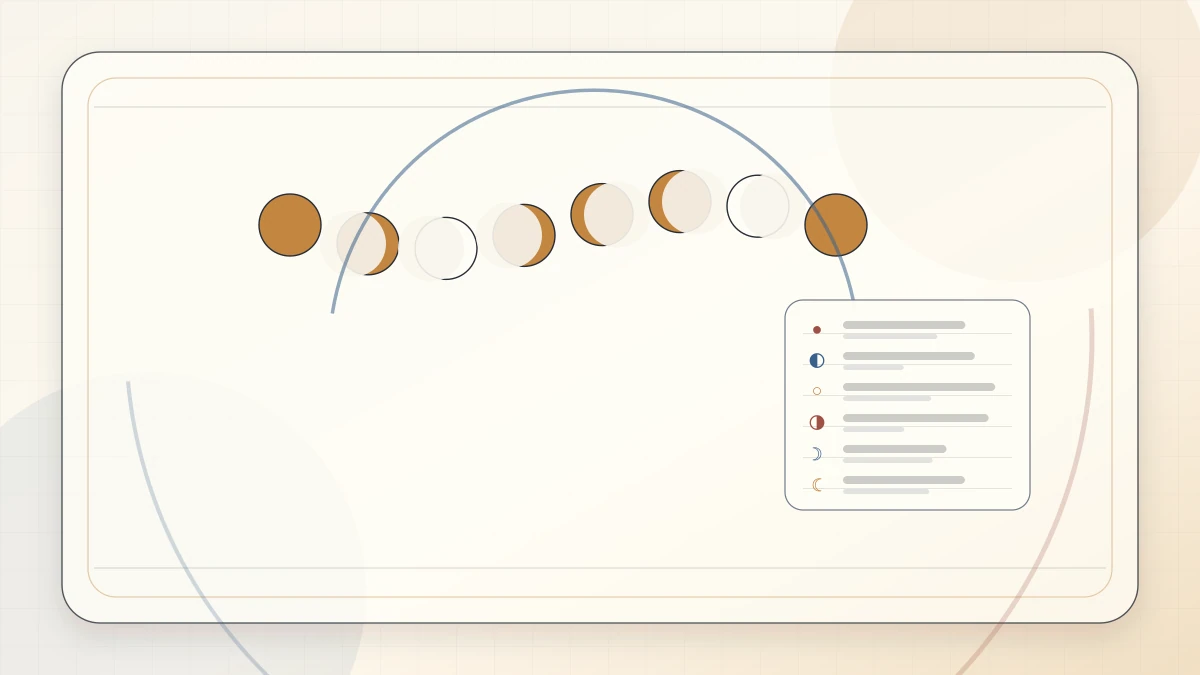
A gibbous Moon is more than half lit but not yet full. The waxing gibbous grows toward the full Moon, and the waning gibbous shrinks away from it.
Table of contents
- Example or practical exercise
- What gibbous means
- The angles and days of the gibbous phases
- How fast a gibbous Moon fills out
- Where and when you see a gibbous Moon
- A constructed gibbous Moon, step by step
- How people use the gibbous phases
- The shadow line on a gibbous Moon
- Common questions about the gibbous Moon
- A gibbous week plan to try
- What this does and does not establish
Example or practical exercise
With the Sun at 5 degrees of Gemini and the Moon 150 degrees ahead at 5 Scorpio, about 93 percent is lit and the full Moon is roughly 2.5 days away, so it is waxing gibbous.
What gibbous means
A gibbous Moon is more than half lit and less than full. The word comes from a Latin term for a hump, which suits the lopsided shape: a bright disc with one edge cut away by a curved shadow. Gibbous phases take up much of the cycle: by the strict definition, about half of it.
Like the crescent, it comes in two kinds. The waxing gibbous grows toward the full Moon, and the waning gibbous shrinks away from it. The shapes are mirror images, and the calendar direction is what tells them apart.
The angles and days of the gibbous phases
In strict terms, the waxing gibbous covers 90 to 180 degrees of separation and the waning gibbous covers 180 to 270. In eight-phase astrology the bands are 45 degrees wide. The waxing gibbous gets 135 to 180. On the waning side, 180 to 225 is counted as the full Moon phase, and the waning gibbous, often called the disseminating phase, gets 225 to 270. Counted in days, the eight-phase waxing gibbous runs from about day 11 to about day 15, and the waning gibbous from about day 18 to about day 22.
Both figures come from the same rough rate of 12.2 degrees a day. The calendar you use should say which scheme it follows, because the same Moon can be gibbous in one scheme and a quarter Moon in another.
How fast a gibbous Moon fills out
The surprise of the gibbous phase is how little changes near the end. The lit share rises steeply after first quarter and then flattens, so the last few nights before full look almost the same by eye.
| Moon ahead of the Sun by | Share of the disc lit | Time before the full Moon |
|---|---|---|
| 135 degrees | About 85 percent | About 3.7 days |
| 150 degrees | About 93 percent | About 2.5 days |
| 165 degrees | About 98 percent | About 1.2 days |
| 180 degrees | 100 percent | Exact full Moon |
Where and when you see a gibbous Moon
A waxing gibbous Moon rises in the afternoon, is well up in the east at sunset, and sets after midnight. You can often spot it in a daytime sky as a pale shape long before dark. In the Northern Hemisphere its lit side is the right one.
A waning gibbous Moon rises in the evening after sunset, climbs through the night, and sets after sunrise, so it hangs in the morning sky as well. Its lit side is the left one in the Northern Hemisphere. The pattern flips in the Southern Hemisphere.
A quick rule is to ask whether the Moon is up in the evening sky with a long night ahead of it, or heading down in the morning. Evening means waxing, morning means waning.
A constructed gibbous Moon, step by step
Put the Sun at 5 degrees of Gemini, which is longitude 65, because Gemini starts at 60. Let the Moon be 150 degrees ahead. Then 65 plus 150 is 215, and since Scorpio begins at 210, the Moon is at 5 degrees of Scorpio.
At 150 degrees about 93 percent of the disc is lit, and the full Moon is 30 degrees of separation away. At about 12.2 degrees a day that is roughly 2.5 days. Because the Moon is ahead of the Sun and still increasing its lead, this is a waxing gibbous.
Had the Moon been 210 degrees ahead, it would be at 275, or 5 degrees of Capricorn. It would again be about 93 percent lit, but now 2.5 days past full, and the direction of travel would be the opposite.
How people use the gibbous phases
In the eight-phase tradition the waxing gibbous is about refinement. A project is in motion, and the work is to adjust, polish and prepare before the full Moon arrives as the peak of the cycle. The waning gibbous is about sharing and passing on what has been learned, a stretch some astrologers call the disseminating phase.
Both are interpretive habits. They give a rhythm to a month of work, with a build stage, a refinement stage, a peak, and a sharing stage, but the Moon is not doing any of the work.
- Waxing gibbous: edit, rehearse, test and tidy what you plan to show.
- Waning gibbous: explain, teach, thank people and pass on what you learned.
The shadow line on a gibbous Moon
The boundary between the lit and unlit parts of the Moon is called the terminator. On a crescent it is a thin curve, at a quarter it is a straight line, and on a gibbous Moon it bulges back the other way, so the lit part is wider than a half circle.
Through binoculars, the terminator is where craters show best, because low sunlight throws long shadows. A gibbous Moon is a good one to look at this way, and a few minutes outside will teach you more about the phase than a table.
Common questions about the gibbous Moon
Is a gibbous Moon almost full? Often it looks that way. The shaded part is thin and the edge is hard to judge, and the Moon can be 98 percent lit while appearing full to most eyes.
How can I tell whether it is waxing or waning? Use the date. Check whether the next full Moon is ahead or behind in a calendar, or use the time of day when you see it.
Do the two gibbous phases differ for people born under them? Some natal-phase astrologers say so. The idea is an interpretive one, and it is not something you can test with a birth chart alone.
A gibbous week plan to try
Pick one project and give it the days between first quarter and full. Spend the first part of the window on one clear improvement and the rest on a rehearsal or a check with someone else. After the full Moon, use the waning gibbous to share the result.
The Moon does not make the plan succeed. What the plan gains is a clear start, a clear middle and a clear finish, all tied to a sky you can see.
What this does and does not establish
Refinement and sharing themes are interpretive habits, and because schemes draw the bands differently, one Moon can be gibbous in one calendar and a quarter Moon in another.
Related calculators
Use the matching tool when you want a direct chart or timing result after reading the guide.
Current Moon Phase Calculator
reader-focused-friendly exact current Moon phase page for a selected city and live local timestamp.
New Moon Calculator
Exact monthly New Moon lookup page for reset and intention-planning readers.
Full Moon Calculator
Exact monthly Full Moon lookup page for release, visibility, and completion timing readers.
Calculation references
- NASA: Moon phases
Reference for illuminated phases and physical geometry; not evidence for personal or ritual interpretations.
Related articles
Keep reading with nearby topics that deepen the same question from another angle.
Crescent Moon Phase Meaning
A crescent Moon has less than half of its visible disc lit. A waxing crescent follows the new Moon and grows; a waning crescent comes after last quarter and shrinks.
6 min read
Moon Phase Rituals for Beginners
A beginner's Moon ritual is a small repeated act: check the phase, take a few quiet minutes, and write or decide one thing. A notebook and a pen are all you need.
6 min read
Moon Phases Explained for Beginners
Moon phases show how much of the Moon's sunlit half we can see as it circles Earth. One 29.5-day cycle splits into eight phases of about 3.7 days, each starting at a multiple of 45 degrees.
6 min read
New Moon Meaning and How to Set Intentions
A new Moon is the monthly moment when the Sun and Moon share the same degree. To set an intention, write one small, specific goal you control and schedule its first step.
6 min read
Keep exploring
Use the category page and the main hubs when you want the next layer of context.
Previous article
Crescent Moon Phase Meaning
Next article
Moon Phase Rituals for Beginners