
Moon Phases
Crescent Moon Phase Meaning
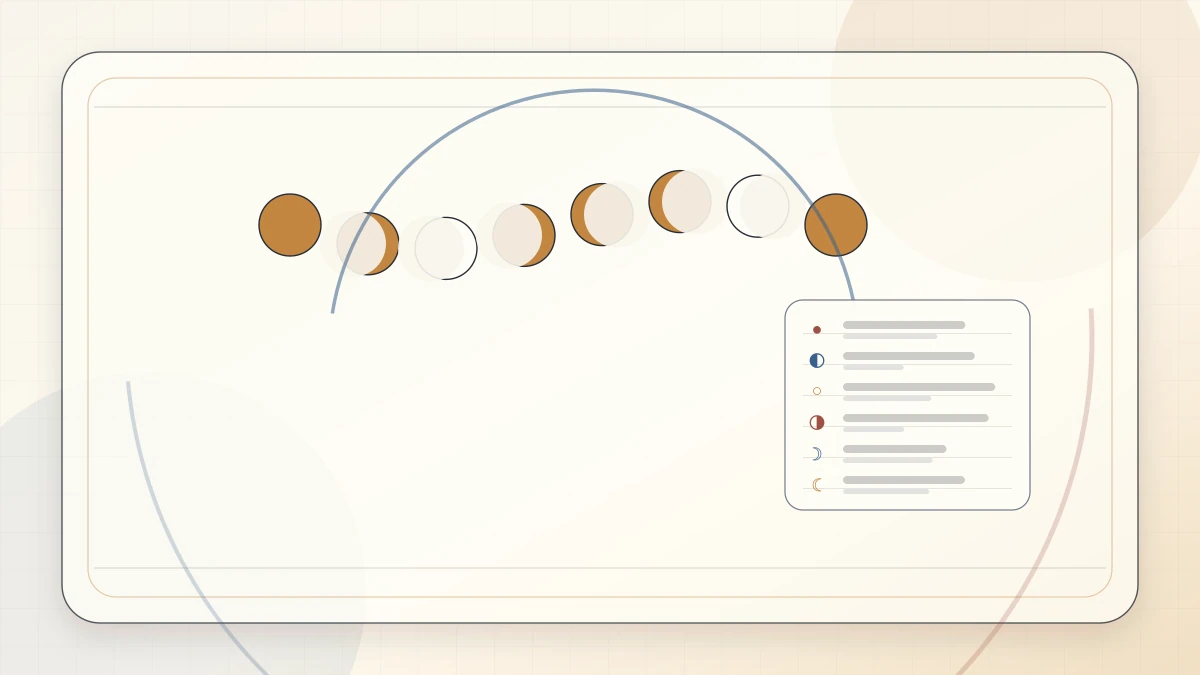
A crescent Moon has less than half of its visible disc lit. A waxing crescent follows the new Moon and grows; a waning crescent comes after last quarter and shrinks.
Table of contents
- Example or practical exercise
- What makes a Moon a crescent
- The angles behind a crescent
- How to tell a waxing crescent from a waning one
- Earthshine and the crescent in the sky
- A constructed crescent, from photo to phase
- How people read the crescent
- Common questions about the crescent Moon
- A short crescent habit you can try
- What this does and does not establish
Example or practical exercise
A Northern Hemisphere dusk photo shows a thin crescent low in the west, lit on the right, so it is waxing; with the Sun at 25 Taurus and the Moon 40 degrees ahead, it sits at 5 Cancer, about 12 percent lit.
What makes a Moon a crescent
A crescent is the Moon with less than half of its visible disc lit. The thin curve is the sunlit edge, seen from a steep angle because the Sun and the Moon are in nearly the same part of the sky. The nearer the Moon is to the Sun, the thinner the crescent.
A crescent can belong to either half of the cycle. A waxing crescent follows the new Moon and is growing toward first quarter. A waning crescent comes after last quarter and is shrinking toward the next new Moon. They can look nearly identical in a photo, which is the main reason the label gets confused.
The angles behind a crescent
In plain astronomy, the Moon is a waxing crescent while it is 0 to 90 degrees ahead of the Sun, and a waning crescent while it is 270 to 360 degrees ahead. The share of the disc lit is one half of one minus the cosine of that angle. At 45 degrees it is about 15 percent, and at 90 degrees exactly half.
Eight-phase astrology cuts the cycle into 45-degree bands, so its crescent covers only 45 to 90 degrees and the first band, 0 to 45, is the new Moon itself. The same Moon can therefore be a new Moon in one scheme and a crescent in another, and that is a matter of declared convention, not of error.
How to tell a waxing crescent from a waning one
Three clues will settle it, and any one is enough. The time of day matters most, then the side that is lit, and last the date in a calendar.
| Clue | Waxing crescent | Waning crescent |
|---|---|---|
| When you see it | Low in the west after sunset | Low in the east before sunrise |
| Lit side | The right side | The left side |
| Where the Sun is | Just below the western horizon | Just below the eastern horizon |
| Next change | A little fatter each night | A little thinner each night |
| Southern Hemisphere | The left side is lit | The right side is lit |
Earthshine and the crescent in the sky
On a young crescent you can sometimes make out the rest of the disc as a faint gray glow. That is earthshine: sunlight reflected from the Earth that lights the Moon's night side. It is brightest when the crescent is thinnest, because then the Earth, seen from the Moon, is close to full.
The horns of the crescent always point away from the Sun, and the lit curve faces it. Once you know that, you can work out where the Sun is even after it has set, which is a handy way to check a photo whose time you do not know.
A constructed crescent, from photo to phase
Imagine a photo taken at dusk by someone in the Northern Hemisphere. A thin crescent hangs low in the west with its lit side on the right. The time of day and the lit side both say waxing, so the Moon is between 0 and 90 degrees ahead of the Sun.
Put the Sun at 25 degrees of Taurus, which is longitude 55, and the Moon 60 degrees ahead. Then the Moon is at longitude 115, which is 25 degrees of Cancer, because Cancer starts at 90. At 60 degrees about a quarter of the disc is lit, the crescent is roughly five days old, and the angle sits inside the 45 to 90 degree crescent band of the eight-phase scheme.
A photo with no date, no place and no orientation could not give you that. The picture alone leaves open both the phase and the direction of travel.
How people read the crescent
In lunar traditions the waxing crescent is the stage of first steps: a plan has been named and the earliest actions are small, tentative and easy to drop. People often use it to prompt a fresh start on something modest, such as a first draft or a first practice session.
The waning crescent reads in the opposite direction, as winding down. Readers tend to link it with rest, closing and letting go. These are interpretive habits, and each can be useful as a prompt even if you set aside the idea that the Moon has any part in them.
- Waxing crescent prompt: What is one small step I can take this week?
- Waning crescent prompt: What can I put down before the next cycle?
- Either crescent: What do I notice when I go outside and look up?
Common questions about the crescent Moon
Is a crescent a new Moon? Not strictly. The new Moon is the instant the Moon passes the Sun, and the first crescent appears a day or two after it. Some calendars, however, label the first sliver a new Moon for convenience.
Why does my crescent look different from a picture online? The angle depends on your latitude, the season and the time of night. Near the equator the crescent can lie on its back like a bowl, while at higher latitudes it stands more upright.
Can I find the phase from the crescent alone? Only with a time of day or a lit side. Without them you have two possibilities, and a calendar for your date will pick the right one.
How long does a crescent last? In the eight-phase scheme the waxing crescent band (45 to 90 degrees) lasts about 3.7 days, and the closing balsamic band (315 to 360 degrees), the nearest match to a waning crescent, lasts about 3.7 days too. A stricter definition that counts everything under half lit gives each crescent about a week, from the new Moon to first quarter and from last quarter to the new Moon.
A short crescent habit you can try
On any clear evening or early morning in a crescent week, go outside for five minutes and look. Note the time, where the crescent sits, which side is lit, and whether you see earthshine. Then check a calendar.
If your guess matches, you have learned to read the sky. If it does not, you have found a detail worth a second look. Either way, the habit builds the one skill that makes every phase name easier to use.
What this does and does not establish
A crescent photo with no date, place or orientation cannot fix the phase, and the eight-phase scheme still counts anything under 45 degrees as the new phase.
Related calculators
Use the matching tool when you want a direct chart or timing result after reading the guide.
Current Moon Phase Calculator
reader-focused-friendly exact current Moon phase page for a selected city and live local timestamp.
New Moon Calculator
Exact monthly New Moon lookup page for reset and intention-planning readers.
Full Moon Calculator
Exact monthly Full Moon lookup page for release, visibility, and completion timing readers.
Calculation references
- NASA: Moon phases
Reference for illuminated phases and physical geometry; not evidence for personal or ritual interpretations.
Related articles
Keep reading with nearby topics that deepen the same question from another angle.
New Moon vs Full Moon Meaning
At new Moon the Moon lines up with the Sun and looks dark; at full Moon it sits opposite the Sun, fully lit. Tradition reads one as a beginning and the other as a review.
5 min read
Gibbous Moon Phase Meaning
A gibbous Moon is more than half lit but not yet full. The waxing gibbous grows toward the full Moon, and the waning gibbous shrinks away from it.
6 min read
Moon Phases Explained for Beginners
Moon phases show how much of the Moon's sunlit half we can see as it circles Earth. One 29.5-day cycle splits into eight phases of about 3.7 days, each starting at a multiple of 45 degrees.
6 min read
New Moon Meaning and How to Set Intentions
A new Moon is the monthly moment when the Sun and Moon share the same degree. To set an intention, write one small, specific goal you control and schedule its first step.
6 min read
Keep exploring
Use the category page and the main hubs when you want the next layer of context.
Previous article
New Moon vs Full Moon Meaning
Next article
Gibbous Moon Phase Meaning