
Moon Phases
New Moon vs Full Moon Meaning
At new Moon the Moon lines up with the Sun and looks dark; at full Moon it sits opposite the Sun, fully lit. Tradition reads one as a beginning and the other as a review.
Table of contents
- Example or practical exercise
- Where the Moon sits at new Moon and at full Moon
- New Moon and full Moon side by side
- A worked pair: the same axis in two signs
- Why tradition links new Moon to beginnings and full Moon to culmination
- A ten-minute sit-down at the new Moon
- A ten-minute sit-down at the full Moon
- Questions people ask about the two Moons
- How to compare the two for yourself over two cycles
- What this does and does not establish
Example or practical exercise
A constructed new Moon at 10 degrees of Taurus is followed about 14.8 days later by a full Moon at 25 degrees of Scorpio, opposite a Sun that has moved to 25 Taurus.
Where the Moon sits at new Moon and at full Moon
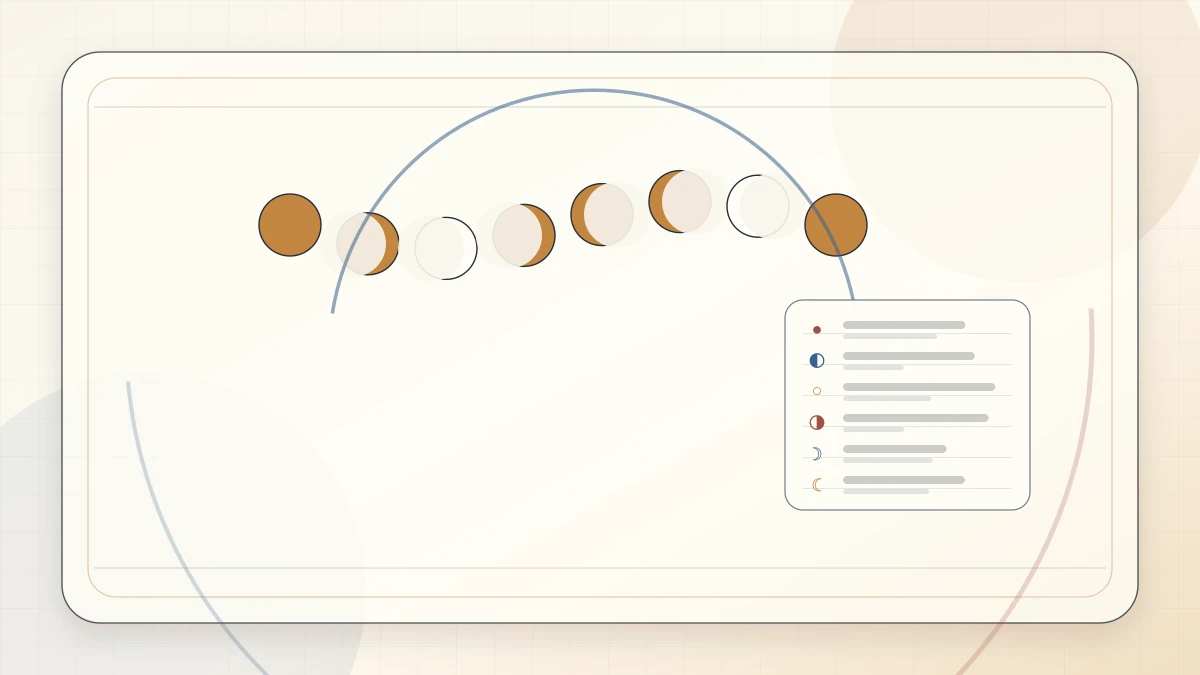
The Moon shines by reflected sunlight, so its phase depends on where it stands relative to the Sun as seen from Earth. At new Moon it lines up with the Sun, so the lit half faces away from us. At full Moon it is on the far side of Earth from the Sun, and we see the whole lit face.
Astrologers describe the same thing as an angle. The new Moon is a conjunction, with Moon and Sun at the same zodiac degree. The full Moon is an opposition, with the two 180 degrees apart. Every other phase is a stop between those two measurements.
New Moon and full Moon side by side
The table compares what you can observe with what tradition says. The first three rows are astronomy. The last three are interpretation, so treat them as prompts.
| Feature | New Moon | Full Moon |
|---|---|---|
| Sun-Moon angle | About 0 degrees | About 180 degrees |
| In the sky | Near the Sun, lost in its glare, rising and setting with it | Opposite the Sun, rising near sunset and setting near sunrise |
| Zodiac sign of the Moon | The same sign as the Sun | The sign opposite the Sun |
| Traditional theme | Beginnings, intention, planning | Culmination, visibility, review |
| A useful question | What do I want to try before the next full Moon? | What has become clear, and what will I keep? |
| A common trap | Treating a plan as if it were already done | Treating a strong feeling as a verdict |
A worked pair: the same axis in two signs
Take a constructed new Moon with the Sun and Moon both at 10 degrees of Taurus. The Sun moves about one degree a day, and the Moon reaches the point opposite the Sun in about 14.8 days, half of the 29.5-day cycle. By then the Sun has moved about 15 degrees, to roughly 25 degrees of Taurus.
The full Moon sits exactly opposite. Counting from the start of Aries, 25 degrees of Taurus is 55 degrees, and adding 180 gives 235 degrees, which is 25 degrees into Scorpio. So a new Moon in Taurus is followed by a full Moon in Scorpio.
Taurus and Scorpio are opposite signs, and astrologers read such a pair as one axis, with traditional themes of steady resources against intensity and shared things. You do not need to accept that reading to use the pattern. It simply shows that the two Moons in one cycle are linked, so a note from the first can be revisited at the second.
Why tradition links new Moon to beginnings and full Moon to culmination
The link is a metaphor drawn from light. After new Moon the lit part grows night by night, so the waxing half became a picture for building. At full Moon the light peaks, so it stands for something coming into view. After that the light shrinks, and the waning half became a picture for sorting and setting down.
The Moon does not change what happens on the ground. The idea earns its place as a planning device, because it gives you two fixed check points about two weeks apart. A fortnight is long enough for a small project to show some progress and short enough to remember what you intended.
A ten-minute sit-down at the new Moon
Keep it small and written down. The point is a plan you can check later, not a feeling you hope to keep.
- Write the date and, if you track it, the Moon’s sign.
- Write one thing you want to try before the next full Moon, small enough to start this week.
- Write one observable sign that you did try it, such as a page drafted or a call made.
- Put the page where you will see it again.
A ten-minute sit-down at the full Moon
At the full Moon you open the same page and compare it with what happened. Honesty matters more than tidiness here, so an entry that says nothing happened is a good entry.
- Reread the new Moon page without editing it.
- Write what actually happened, including nothing, if nothing did.
- Write one thing to continue and one thing to drop.
- Close the page. If the sky is clear, step outside and look at the Moon, because the light that night is hard to miss.
Questions people ask about the two Moons
Which one is stronger? Astrology has no unit for strength here. The full Moon is brighter and more noticeable, and the new Moon is quieter. Choose by what you need: a starting point or a review.
Do I have to act at the exact minute? No. The exact instant is a calendar convention. The Moon looks almost the same a day either side, and most people simply use the day.
Does the full Moon make people behave oddly? Old stories say so, and many people feel it. There is no good evidence of a reliable effect on mood or behavior, so treat any pattern you notice as something to check against a diary.
Can I skip one of them? Yes. Nothing is lost by missing a phase, and the next one arrives in about two weeks.
How to compare the two for yourself over two cycles
If you want to know whether the two Moons feel different to you, keep one line a day for two cycles, about 59 days. Write a number from one to five for how energetic you felt, and mark the new Moon and full Moon days.
At the end, look at the three days around each. If the numbers rise and fall the same way on other days, then the phase was not doing the work. If a pattern appears only around the Moons, it is still worth treating as a possibility rather than a finding, since two cycles is a small sample.
What this does and does not establish
The beginning and culmination themes are metaphors drawn from light, and there is no good evidence that either Moon affects mood or behavior.
Related calculators
Use the matching tool when you want a direct chart or timing result after reading the guide.
Current Moon Phase Calculator
reader-focused-friendly exact current Moon phase page for a selected city and live local timestamp.
New Moon Calculator
Exact monthly New Moon lookup page for reset and intention-planning readers.
Full Moon Calculator
Exact monthly Full Moon lookup page for release, visibility, and completion timing readers.
Calculation references
- NASA: Moon phases
Reference for illuminated phases and physical geometry; not evidence for personal or ritual interpretations.
Related articles
Keep reading with nearby topics that deepen the same question from another angle.
Crescent Moon Phase Meaning
A crescent Moon has less than half of its visible disc lit. A waxing crescent follows the new Moon and grows; a waning crescent comes after last quarter and shrinks.
6 min read
Moon Phases Explained for Beginners
Moon phases show how much of the Moon's sunlit half we can see as it circles Earth. One 29.5-day cycle splits into eight phases of about 3.7 days, each starting at a multiple of 45 degrees.
6 min read
New Moon Meaning and How to Set Intentions
A new Moon is the monthly moment when the Sun and Moon share the same degree. To set an intention, write one small, specific goal you control and schedule its first step.
6 min read
Full Moon Meaning and Emotional Release
A full Moon is the night the Moon sits opposite the Sun and shows its whole lit face. Emotional release here means a quiet review, such as dropping an expectation, not forcing strong feelings.
6 min read
Keep exploring
Use the category page and the main hubs when you want the next layer of context.
Previous article
What Makes a Relationship Feel Karmic in Astrology
Next article
Crescent Moon Phase Meaning