
Moon Phases
Moon Phase Self-Care Ideas
You can use the Moon's phases as free, optional reminders for ordinary self-care, picking one small idea, such as a walk or an early night, for each of four or eight checkpoints.
Table of contents
- Example or practical exercise
- A Moon calendar as a prompt for ordinary self-care
- Eight checkpoints with one simple idea each
- How the day counts work
- Setting it up in four steps
- A constructed month with a diary
- Match the idea to the energy you actually have
- Light, sleep and a few cautions
- Questions people ask about Moon phase self-care
- What this does and does not establish
Example or practical exercise
Mira logs four checkpoints a cycle for three cycles, 12 entries, and finds no link between her rest ratings of 2 to 4 and the phase, but feels best on days she walks.
A Moon calendar as a prompt for ordinary self-care
The Moon takes about 29.5 days to go from one new Moon to the next, and that regular rhythm makes it a handy calendar for checking in with yourself. The Moon does not change your body or your mood, and there is no good evidence that a phase reliably alters sleep, energy or feelings. The value of a phase-based routine is the pause it builds into the month.
These ideas are small, free and optional. They are not treatment, and they do not suggest that anyone is responsible for an illness or a low mood. If you feel unwell for more than a short while, speak with a doctor or qualified professional.
Eight checkpoints with one simple idea each
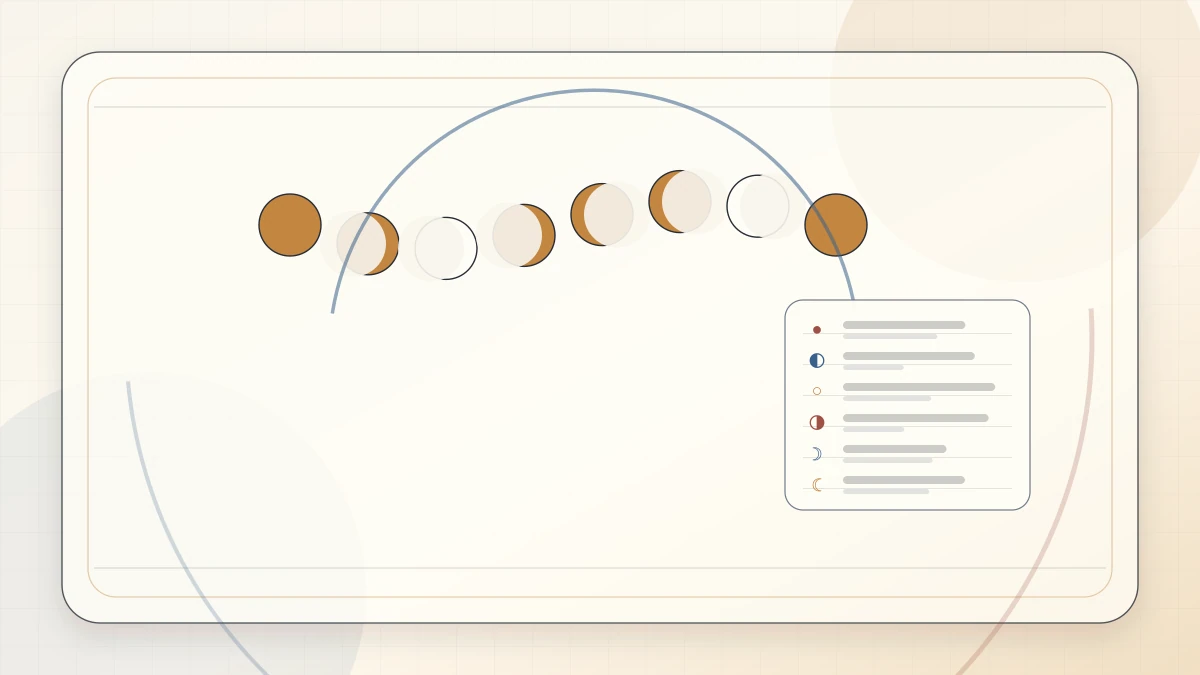
Each of the eight named phases lasts about 3.7 days. Pick one idea per checkpoint, and skip any that do not suit you.
| Phase | Rough point in the cycle | A simple idea |
|---|---|---|
| New Moon | Day 0 | Write down what you want from the month, in one sentence |
| Waxing crescent | About day 4 | Take a ten-minute walk and notice how you feel |
| First quarter | About day 7 | Review your workload and decide what can wait |
| Waxing gibbous | About day 11 | Tidy one small space that has been bothering you |
| Full Moon | About day 15 | Reach out to a friend or family member |
| Waning gibbous | About day 18 | Say thank you to someone, in person or in writing |
| Last quarter | About day 22 | Let go of one commitment or task you no longer want |
| Balsamic | About day 26 | Plan an early night and rest |
How the day counts work
Eight checkpoints in 29.5 days works out to about 3.7 days apart (29.5 divided by 8 is 3.69). Starting at day 0 on the new Moon, the checkpoints fall at about days 0, 4, 7, 11, 15, 18, 22 and 26. If eight is too many, use four, one at each quarter, about every 7.4 days.
A Moon calendar will give the exact times, and these are listed in a time zone, so the same phase can fall on different dates in different places. The phase is the same everywhere. In the Southern Hemisphere the lit side of the Moon appears reversed.
Setting it up in four steps
A routine that works is usually one you hardly notice.
- Choose how many checkpoints you want, four or eight.
- Pick one idea for each from the table, or swap in your own.
- Put the dates in a calendar you already use, with a short reminder.
- At each checkpoint, spend five to fifteen minutes on that idea and stop.
A constructed month with a diary
Mira is an invented person who wants to see whether any of this helps. She chooses four checkpoints, so about 7.4 days apart, and writes one line each time: what she did, how rested she felt from 1 to 5, and whether she would do it again.
After three cycles she has 12 entries (4 times 3). Her ratings range from 2 to 4, with no clear link to the phase. What she does notice is that she felt best on days when she took a walk, whatever the Moon was doing. She keeps the walk and drops the Moon, which is a perfectly reasonable result.
Match the idea to the energy you actually have
A phase name is a poor guide to how you feel on a given day. Some people are tired at a full Moon and some are not, and a gentle idea can suit a busy day while a bolder one suits a spare afternoon. When in doubt, begin from what you need and let the calendar only remind you to ask.
Most self-care ideas fall into four everyday needs, and you can use any of them at any checkpoint. None needs money, equipment or a special place.
- Rest: a short nap, an earlier bedtime, ten minutes with your eyes closed or time without a screen.
- Movement: a walk, some stretching, dancing in the kitchen or climbing the stairs on purpose.
- Connection: a message to a friend, a short call or a meal shared with someone.
- Planning: a look at next week, a list of three tasks, or a decision to say no to one thing.
Light, sleep and a few cautions
A full Moon can make a bedroom noticeably brighter. If light bothers you, curtains or an eye mask solve it far more reliably than any ritual. Studies on the Moon and sleep are small and mixed, and many have found nothing, so keep your own sleep diary if you wonder.
If you add a candle to an evening routine, use a stable holder, never leave it unattended, keep it away from anything flammable and from children and pets, and put it out fully when you finish. If you take a bath as part of the routine, keep the water comfortably warm rather than very hot and take care on slippery surfaces. A candle or a bath is optional, and nothing here requires spending money.
Questions people ask about Moon phase self-care
Do I have to follow every phase? No. A routine you skip is no better than none, so choose the checkpoints that suit your life. Many people keep only the new Moon and full Moon, about two check-ins a month, and find that enough.
Do I need a Moon app or a calendar? A printed or digital Moon calendar is enough, and the current Moon phase tool on this site shows today’s phase in a moment. You can also simply look up at the sky and judge roughly how much of the disc is lit.
What if a phase idea feels wrong for me? Change it. If a full Moon makes you want solitude rather than company, take solitude.
Can this replace therapy or medical care? No. It is a gentle habit and not a treatment, and it should sit beside professional support if you need it.
What if a prompt brings up painful feelings? Stop and put it down. Talk with someone you trust, or with a qualified professional if the feeling is heavy or does not pass.
What this does and does not establish
These ideas are not treatment and do not make anyone responsible for an illness; if you feel unwell for long, see a doctor or qualified professional.
Related calculators
Use the matching tool when you want a direct chart or timing result after reading the guide.
Current Moon Phase Calculator
reader-focused-friendly exact current Moon phase page for a selected city and live local timestamp.
New Moon Calculator
Exact monthly New Moon lookup page for reset and intention-planning readers.
Full Moon Calculator
Exact monthly Full Moon lookup page for release, visibility, and completion timing readers.
Calculation references
- NASA: Moon phases
Reference for illuminated phases and physical geometry; not evidence for personal or ritual interpretations.
Related articles
Keep reading with nearby topics that deepen the same question from another angle.
Moon Phases for Creativity and Focus
There is no good evidence that the Moon changes creativity or focus, but its four main phases can mark weekly stages: gather ideas, draft, step back and edit.
5 min read
How to Pair Moon Phases With Journaling Themes That Stay Fresh
Give each phase its own theme and a sharp question that asks for an action, evidence or a change of view, so entries do not shrink into repeated affirmations.
6 min read
Moon Phases Explained for Beginners
Moon phases show how much of the Moon's sunlit half we can see as it circles Earth. One 29.5-day cycle splits into eight phases of about 3.7 days, each starting at a multiple of 45 degrees.
6 min read
New Moon Meaning and How to Set Intentions
A new Moon is the monthly moment when the Sun and Moon share the same degree. To set an intention, write one small, specific goal you control and schedule its first step.
6 min read
Keep exploring
Use the category page and the main hubs when you want the next layer of context.
Previous article
Moon Phases for Creativity and Focus
Next article
How to Pair Moon Phases With Journaling Themes That Stay Fresh