
Moon Phases
Moon Phases for Creativity and Focus
There is no good evidence that the Moon changes creativity or focus, but its four main phases can mark weekly stages: gather ideas, draft, step back and edit.
Table of contents
- Example or practical exercise
- What is known about the Moon and creative work
- A four-stage creative rhythm on the lunar calendar
- What focus depends on far more than the Moon
- How to hand work from one stage to the next
- A constructed cycle: one short story from notes to final draft
- How to protect a creative session whatever the phase
- Common questions about creative work and the Moon
- Keep the parts that work, whatever the reason
- What this does and does not establish
Example or practical exercise
Kai keeps one of twelve story ideas, drafts 3,000 words at 600 a session over five days, then cuts the slow opening to finish a 2,400-word story by the next new Moon.
What is known about the Moon and creative work
There is no good evidence that the Moon’s phase reliably changes creativity or concentration. Claims that a full Moon boosts ideas or a new Moon sharpens focus come from tradition and personal experience, not from tested findings. This guide treats the Moon as a calendar you can use, not as a cause.
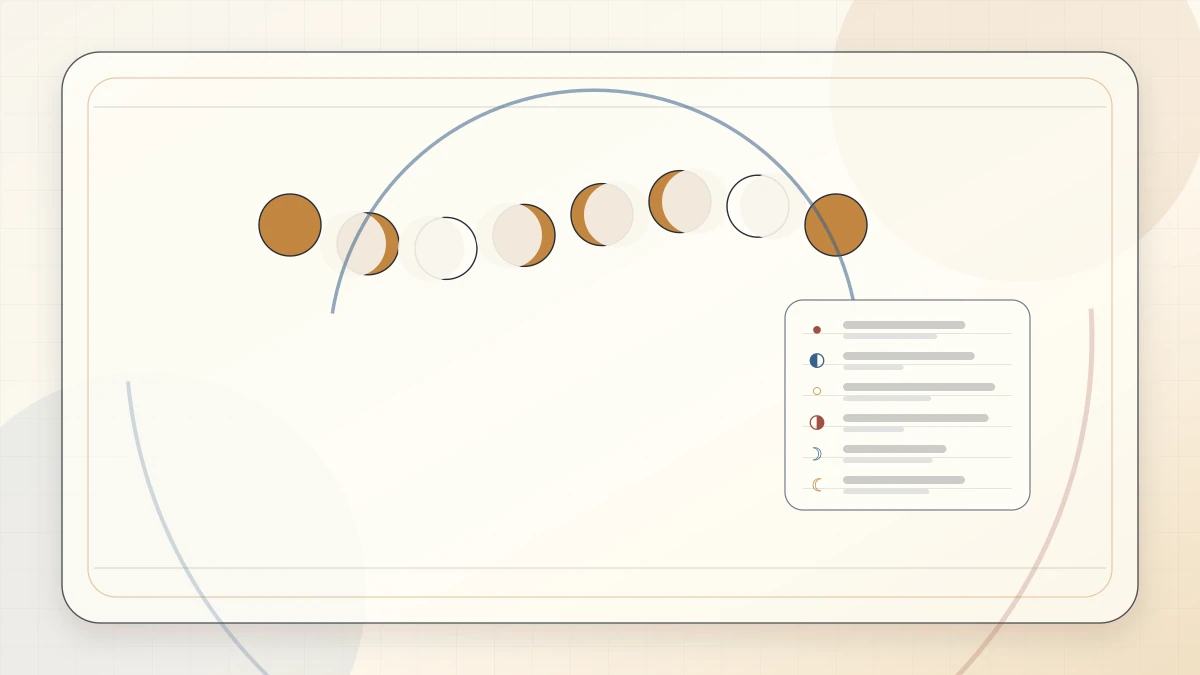
A calendar still has value. Creative work benefits from a rhythm that separates gathering ideas, making a rough draft, stepping back and polishing, and the Moon’s cycle offers four convenient checkpoints, about a week apart, to hang those stages on.
A four-stage creative rhythm on the lunar calendar
The table is one way to assign work to the phases. It is a structure to try, and you should expect to rearrange it.
| Stage | Phases | Work | What to record |
|---|---|---|---|
| Gather | New Moon to first quarter | Collect ideas, references and questions | How many ideas, and how many you wanted to keep |
| Draft | First quarter to full Moon | Make rough versions without editing | Pages or minutes produced |
| Step back | Full Moon to last quarter | Read, share and gather feedback | What others noticed first |
| Edit | Last quarter to new Moon | Cut, refine and finish | What you removed and what you finished |
What focus depends on far more than the Moon
Concentration depends on sleep, interruptions, the time of day, how clear the task is and how tired you are. A change of phase is small next to a noisy room or a late night. Before you try a lunar schedule, check that the basics are in place.
If trouble concentrating is persistent or worrying, a doctor or a qualified professional is the right person to ask. A diary cannot substitute for that.
How to hand work from one stage to the next
The stages only help if the boundaries between them are real. A short rule at each handoff stops drafting from sliding into editing, which is where many projects stall.
- End of gathering: choose one idea and write a one-sentence aim for it. Park the rest on a list for next cycle.
- End of drafting: stop at the boundary even if the draft is unfinished, and mark weak spots with a bracket instead of fixing them.
- Stepping back: leave the draft alone for at least two days, then give it to one reader with one question, such as where they got bored.
- Editing: cut first and polish second, and decide in advance what finished means, such as a word limit or a run-through with no stops.
A constructed cycle: one short story from notes to final draft
Kai is invented. In the gathering week Kai jots down twelve story ideas and keeps one, about a neighbor who repairs old radios. The drafting week has a target of 3,000 words. Kai writes on five of the seven days at 600 words a session, and 5 times 600 reaches 3,000, with two brackets marking scenes that feel thin.
After the full Moon the draft rests for two days, and then one friend reads it and says the opening is slow. In the editing week Kai cuts the first scene and trims elsewhere, taking the story from 3,000 words to 2,400. That is 600 words removed, a 20 percent cut, and the story is finished by the next new Moon. The stages gave each kind of attention its own week; the Moon only marked the weeks.
If you want to test whether your focus itself rises and falls with the phase, use the diary test in our guide to whether the Moon phase changes the mood of the month, with a one-to-five focus score in place of the mood rating. Write down your one question before you start, so you do not search the data afterward for something that fits.
How to protect a creative session whatever the phase
Whatever the Moon is doing, a few ordinary conditions help most people start creative work. Choose a fixed time and a fixed place, so that starting does not depend on mood. Keep sessions short at first, twenty to forty minutes, with a clear stopping point.
Decide the task before you sit down: draft two pages, sketch three small studies, rehearse one passage. Put the phone out of reach, and write any stray thought on a side page for later rather than following it. These habits do more for most people than any calendar, and they combine easily with a lunar rhythm if you enjoy one.
Treat the first week of any new routine as setup, since you are learning the routine as well as the work. A dip in the second week often says more about novelty fading than about the sky.
Common questions about creative work and the Moon
Is the full Moon good for ideas? Some people say it is. There is no good evidence of a reliable effect, so check it with your own diary rather than taking it on trust.
Should I avoid the new Moon for focused work? There is no reason to. If you are in the middle of a project, keep working. Stopping for a phase would add delay without evidence of benefit.
What if my diary shows a pattern? Treat it as a lead. Two cycles is a small sample, so try another two before you rearrange your schedule around it.
Does the Moon sign matter? Astrologers link signs to styles of work, for example Gemini to writing and Virgo to editing. These are symbolic prompts, not measured effects, and they are optional.
Keep the parts that work, whatever the reason
A schedule that gives you a draft stage and an edit stage helps because it separates two kinds of attention, not because of the sky. If the lunar rhythm makes it easier to start and to stop, keep it. If it feels like a rule you must obey, drop it and keep the stages. The craft is yours either way.
What this does and does not establish
Concentration depends far more on sleep, interruptions and task clarity than on any phase, and persistent focus trouble belongs with a doctor or professional.
Related calculators
Use the matching tool when you want a direct chart or timing result after reading the guide.
Current Moon Phase Calculator
reader-focused-friendly exact current Moon phase page for a selected city and live local timestamp.
New Moon Calculator
Exact monthly New Moon lookup page for reset and intention-planning readers.
Full Moon Calculator
Exact monthly Full Moon lookup page for release, visibility, and completion timing readers.
Calculation references
- NASA: Moon phases
Reference for illuminated phases and physical geometry; not evidence for personal or ritual interpretations.
Related articles
Keep reading with nearby topics that deepen the same question from another angle.
Moon Phases and Mood Carefully Explained
Research on the Moon and mood has found mixed, mostly small results and no reliable effect. A phase journal can still give your mood check-ins a regular rhythm.
6 min read
Moon Phase Self-Care Ideas
You can use the Moon's phases as free, optional reminders for ordinary self-care, picking one small idea, such as a walk or an early night, for each of four or eight checkpoints.
6 min read
Moon Phases Explained for Beginners
Moon phases show how much of the Moon's sunlit half we can see as it circles Earth. One 29.5-day cycle splits into eight phases of about 3.7 days, each starting at a multiple of 45 degrees.
6 min read
New Moon Meaning and How to Set Intentions
A new Moon is the monthly moment when the Sun and Moon share the same degree. To set an intention, write one small, specific goal you control and schedule its first step.
6 min read
Keep exploring
Use the category page and the main hubs when you want the next layer of context.
Previous article
Moon Phases and Mood Carefully Explained
Next article
Moon Phase Self-Care Ideas