
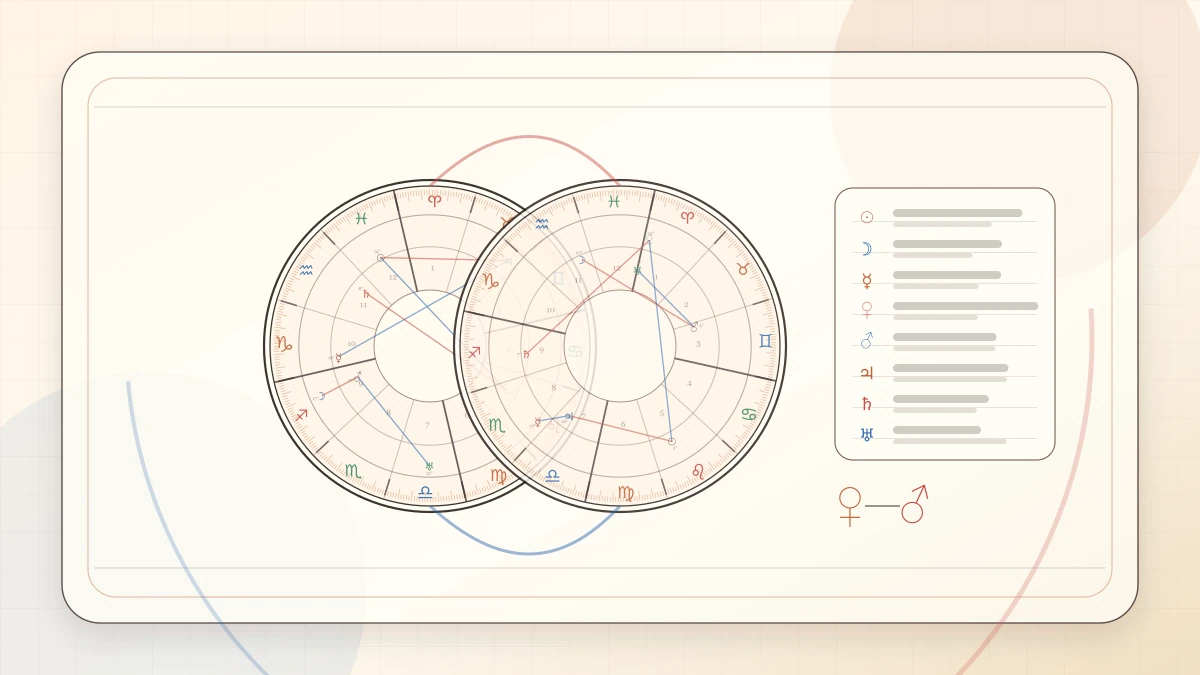
Love Compatibility
Red Flags in Synastry Without Fatalism
A challenging synastry contact is a topic to discuss, not a red flag. Real red flags are behaviors such as threats, control, isolation or pressure to ignore a no.
Table of contents
- Example or practical exercise
- Why the phrase red flag can mislead in astrology
- Contacts astrologers call challenging, and the question each opens
- How to talk about a challenging contact
- What to watch for in real behavior
- What it looks like in practice: a constructed pair and a behavior log
- Four reading rules that keep challenging contacts in proportion
- If you feel unsafe: safety first
- Common questions about difficult contacts
- What this does and does not establish
Example or practical exercise
X's Mars at 14 Gemini squares Y's Saturn at 12 Pisces, yet over six weeks they kept 11 of 12 plans and talked through each of four disagreements within a day.
Why the phrase red flag can mislead in astrology
A red flag, in everyday speech, is a sign of trouble. Applied to synastry, the comparison of two charts, the phrase suggests that a certain contact tells you something is wrong with the relationship or with the other person. It does not. A chart does not show abuse, danger or a person's intentions. Behavior does.
Astrologers do call some contacts challenging, meaning they tend to bring friction or intensity that two people have to handle. That is a reading prompt, much like a question on a list. Treating a prompt as a warning can make people anxious about a harmless relationship, and treating a smooth chart as a safeguard can make people overlook behavior that deserves attention.
Contacts astrologers call challenging, and the question each opens
These are traditional associations, and they vary between astrologers. The point of the third column is to turn each contact into a conversation.
| Contact | Why it is called challenging | A question to discuss |
|---|---|---|
| Mars and Saturn, tense | Drive meets restriction; feedback can feel like blocking | How do we handle pace, and how do we give feedback? |
| Moon and Pluto | Intense feeling, with strong needs around closeness and privacy that two people have to negotiate | How much closeness and how much privacy does each of us want? |
| Sun and Pluto | Strong effect on identity; power themes | How are decisions made, and does each of us keep a voice? |
| Venus and Saturn | Affection and reserve; fear of rejection | How do we say we care, and what do we do when one feels held back? |
| Moon and Uranus | Independence against steadiness; sudden changes | How do we handle surprises and the need for room? |
| Venus and Neptune | Idealization and vagueness about who the other is | Do we know each other as we are, not as we imagine? |
How to talk about a challenging contact
A contact becomes useful when it opens a conversation both people want. These steps keep it from becoming a charge.
- Share the contact as a topic, not a diagnosis: “The chart suggests we might talk about how we give feedback.”
- Ask whether it matches anything real, and accept a no.
- Name a concrete habit you could try, such as asking before offering advice.
- Review after a few weeks and drop the topic if it has no real counterpart.
- Do not use the contact to excuse behavior or to blame anyone for it.
What to watch for in real behavior
These patterns matter whatever any chart says, and a favorable chart does not soften them. A list cannot diagnose anyone, but it shows what to notice.
- Threats, intimidation or physical force, however small.
- Checking your phone, location or messages, or controlling who you see.
- Pressure to ignore a no, including about sex, money or plans.
- Humiliating you in front of others, or blaming you for their reactions.
- Cutting you off from friends, family or support.
- Repeated promises to change with no change in behavior.
What it looks like in practice: a constructed pair and a behavior log
Person X has Mars at 14 degrees Gemini and Person Y has Saturn at 12 Pisces. Both are constructed. Gemini begins at 60, so X's Mars is at 74; Pisces begins at 330, so Y's Saturn is at 342. The gap is 342 minus 74, which is 268, so 360 minus 268 gives 92: a square within a 2-degree orb. Astrologers call it a classic challenging contact.
Now look at behavior. Over six weeks the two made 12 plans and kept 11. They disagreed about pace on 4 occasions, and each time they talked it through within a day. The square suggests where friction might arise. The log shows how they actually handle it. If instead one of them had threatened the other, or checked the other's phone and discouraged their friends, those facts would matter no matter what any chart contact said.
Four reading rules that keep challenging contacts in proportion
Astrologers who write about difficult contacts usually add some form of these checks.
- Look at orb first: a contact 1 or 2 degrees from exact carries more weight than one at 5.
- Look at the whole chart pair, since easy contacts sit beside every tense one.
- Ask whether the theme already shows up in real life before giving it weight.
- Remember that each person can respond to the same contact in very different ways.
If you feel unsafe: safety first
If you are afraid of someone, or if their behavior makes you doubt your own judgment, put your safety first. A chart is not the place to decide what to do. Talk with someone you trust, such as a friend or relative, and contact a local support service in your area; staff there can talk through options and plans with you. If you are in immediate danger, call the emergency number where you live.
Never use favorable synastry to minimize harm you have experienced. Never use difficult synastry to accuse someone of abuse, either. In both directions, behavior is the evidence.
Common questions about difficult contacts
Does every couple have difficult contacts? Almost always. With ten planets in each chart there are many possible contacts, and some of them are squares or oppositions in nearly every pair. Their presence says very little.
Do more difficult contacts mean a worse relationship? Not in any dependable way. Counting aspects is a poor method, because context, orbs and the people's own habits change the weight.
Is it fair to ask a partner about a contact? Yes, as a topic, and only if both people are comfortable. Do not use it to pressure anyone into agreeing, and drop it if the other person would rather not discuss charts at all.
Can a contact be exact and still unimportant? Yes. Orb measures closeness, not importance, and a tight contact between planets that rarely play a role in your daily life may mean little.
What if the chart looks wonderful but I feel uneasy? Take the unease seriously, look at behavior and ask someone you trust. Your experience counts for more than a chart.
What this does and does not establish
Never let a favorable chart minimize harm or a difficult one accuse someone; if you feel afraid, contact a local support service or the emergency number.
Related calculators
Use the matching tool when you want a direct chart or timing result after reading the guide.
Birth Chart Compatibility Calculator
Higher-trust compatibility report built from two verified natal charts and exact synastry analysis.
Synastry Chart Calculator
Compare two birth charts for relationship patterns, emotional rhythm, attraction, and communication themes.
Zodiac Compatibility Calculator
Broad sign-to-sign compatibility page tuned for lifestyle readers.
Calculation references
- Swiss Ephemeris: positions, angles and house-system conventions
Technical reference for calculation conventions. It does not certify an interpretation or mean every live tool uses this engine.
Related articles
Keep reading with nearby topics that deepen the same question from another angle.
Moon Sign Meaning in Love, Emotions, and Daily Life
Your Moon sign describes what you need to feel safe: your moods, instincts, habits and the kind of comfort that settles you, which shows most clearly at home and in close relationships.
6 min read
How to Read Your Birth Chart: A Beginner's Guide
Read your birth chart in five steps: find the Sun, Moon and Rising sign, count the elements, note crowded houses, locate the chart ruler, then read the two or three closest aspects.
6 min read
Best Zodiac Matches for Long-Term Relationships: What the Lists Leave Out
No sign is the best long-term match for another; match lists disagree because each uses a different rule. Element and modality pairings work best as topics for a couple to discuss.
6 min read
How to Read Saturn in Synastry
Saturn contacts in synastry are read through commitment, restriction and seriousness. Which theme shows up depends on the planet Saturn touches, the angle and how both people respond.
7 min read
Keep exploring
Use the category page and the main hubs when you want the next layer of context.
Previous article
Best Zodiac Matches for Long-Term Relationships: What the Lists Leave Out
Next article
How to Read Saturn in Synastry