
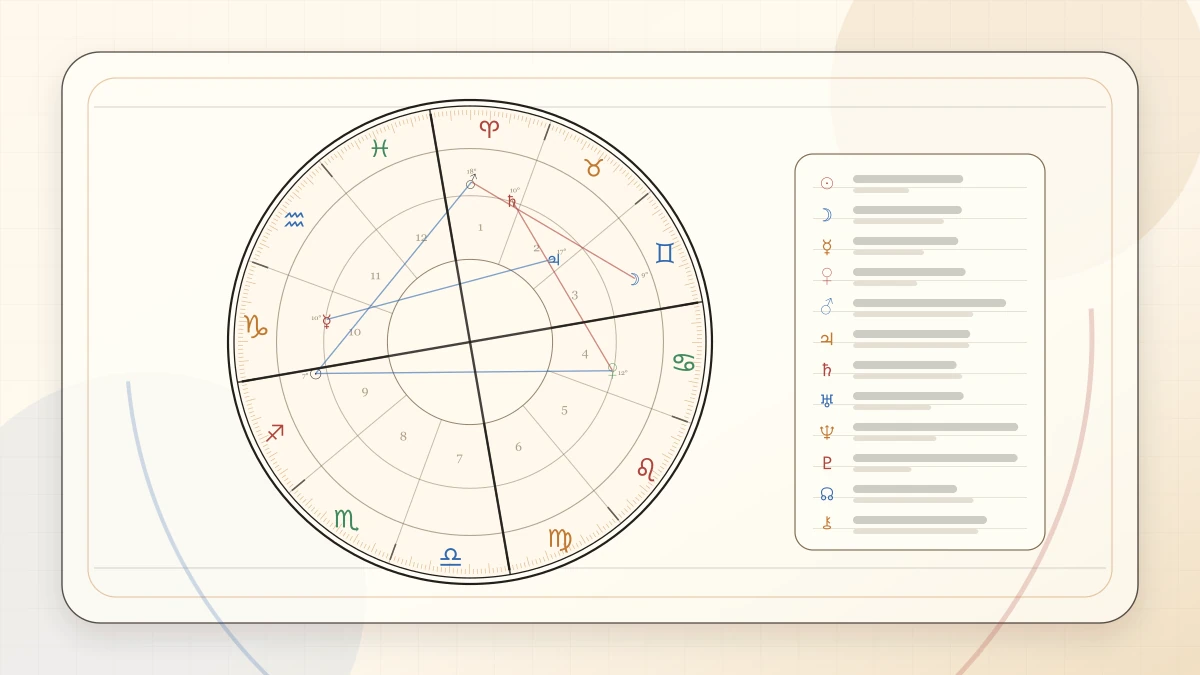
Houses, Aspects, and Planets
Tenth House Meaning in Career
The tenth house sits at the top of the chart and covers your public role: what you are known for, your reputation and the direction you are visibly working toward.
Table of contents
- Example or practical exercise
- What the tenth house covers
- Tenth house versus Midheaven: a distinction beginners often miss
- The sign on the tenth house and what it adds
- The ruler of the tenth house
- Planets in the tenth house
- Turning the tenth house into questions about work values
- A constructed example: Libra rising in two house systems
- A one-week log of your public role
- What this does and does not establish
Example or practical exercise
In a constructed chart with Libra rising at 12 degrees and the Midheaven at 28 degrees Gemini, whole-sign houses make Cancer the tenth house, while a Placidus-type system starts the tenth in Gemini.
What the tenth house covers
The tenth house sits at the top of the chart. In astrology a house is one of twelve areas of life, and the tenth is tied to public role: what you are known for, the standing you hold with people who do not know you personally, and the direction you are visibly working toward. It lies opposite the fourth house, which covers home, roots and what is private.
It is also an angular house, one of the four (first, fourth, seventh and tenth) that sit on the chart's main axes. Traditionally these are the most visible houses, which is why the tenth is the first place astrologers look for questions about reputation. It describes themes of public role, not a list of jobs.
Tenth house versus Midheaven: a distinction beginners often miss
The Midheaven, or MC, is a point: the zodiac degree at the highest place on the meridian, the line running overhead from south to north. The tenth house is an area. People often use the two words as if they were the same, and in some systems they nearly are.
In Placidus-type systems, which split the chart into houses of unequal size, the Midheaven is the cusp, the starting edge, of the tenth house. In whole-sign houses, the tenth house is a complete sign, counted nine signs after the Rising sign, and the Midheaven can land in the ninth, tenth or eleventh house. Astrologers disagree about which system is better, so this guide describes both.
| House system | What the tenth house is | Where the Midheaven sits |
|---|---|---|
| Placidus-type (quadrant) | A house that begins at the Midheaven, with a size that varies by latitude | At the start of the tenth house |
| Whole-sign | One full sign, nine signs on from the Rising sign | In the ninth, tenth or eleventh house |
The sign on the tenth house and what it adds
The sign on the tenth house, or on its cusp in a quadrant system, colors the style of public life. It is a description of manner, not a job title. A broad way to read it is by element.
- Fire: a public style that is energetic, visible and quick to take initiative.
- Earth: a style that is steady, practical and built on results others can check.
- Air: a style that is communicative, connected and interested in ideas and networks.
- Water: a style that is attuned to people's feelings, careful about atmosphere and protective of the group.
The ruler of the tenth house
Each sign has a ruling planet, so the sign on the tenth house points to a planet. Traditional astrology uses the ancient rulers (Mars for Aries and Scorpio, Saturn for Capricorn and Aquarius, and so on), and modern astrologers add Uranus, Neptune and Pluto to some signs. Say which set you are using.
Then look at where that ruler is in your chart. Its sign describes the how, and its house describes the where: the area of life that feeds your public role. A tenth-house ruler in the sixth house, for example, links reputation to daily work and routine.
Planets in the tenth house
A planet in the tenth brings its function into public view. A conjunction to the Midheaven can be read the same way when it falls within about five to eight degrees, though there is no single official orb. An empty tenth is common and unremarkable; look to the ruler instead.
- Sun: identity tied to visible role and recognition.
- Moon: reputation shaped by care, mood and public sensitivity.
- Mercury: communication as part of public identity.
- Venus: an emphasis on appeal, harmony and shared values.
- Mars: drive and initiative aimed at visible goals, sometimes with friction.
- Jupiter: a wish to grow, teach or expand reach.
- Saturn: a serious, slow-building relationship with responsibility and standards.
- Outer planets: themes of change, ideals or intensity, usually shared with an age group.
Turning the tenth house into questions about work values
A chart cannot assign an occupation or predict promotion. What it can do is raise good questions. Work through these, writing short answers.
- What sign is on my tenth house, and what manner of public role does it suggest?
- Where is its ruler, and what area of life supports my public work?
- Which planets sit in the tenth, and what does each stand for in my working life?
- What do I want to be known for, in two sentences?
- Which of my answers can I check against actual skills and evidence?
A constructed example: Libra rising in two house systems
Take a constructed chart, not a real person. The Rising sign is Libra at 12 degrees, which is 192 degrees on the zodiac (Libra starts at 180). The Midheaven is at 28 degrees Gemini, which is 88 degrees (Gemini starts at 60), so the Midheaven is about 104 degrees before the Ascendant.
In whole-sign houses, Libra is first, Scorpio second, Sagittarius third, Capricorn fourth, Aquarius fifth, Pisces sixth, Aries seventh, Taurus eighth, Gemini ninth and Cancer tenth. The tenth house is Cancer, and the Midheaven, in Gemini, falls in the ninth.
In a Placidus-type system the tenth begins at the Midheaven, 28 degrees Gemini. The two systems therefore name different signs for the public role: Cancer in whole-sign, Gemini in a quadrant system. A reader would note both and ask what each suggests about reputation, for instance care and belonging against communication and ideas. Neither answer is a job. Both become questions to bring to real experience.
A one-week log of your public role
The questions above work best when they are tested against ordinary days. This log takes about ten minutes a day for a week and uses no prediction at all.
- Day one: write two sentences on what you would like to be known for, without naming a job title.
- Day two: list three things people regularly ask you for help with.
- Day three: note one moment you felt recognized and one when your work went unseen, and what differed.
- Day four: ask one person you trust what they rely on you for, and write down the answer without arguing.
- Day five: compare days one to four, and underline anything that appears twice.
- Day six: read your tenth-house sign and its ruler, and mark which lines fit your list and which do not.
- Day seven: choose one small action that matches what you underlined, such as offering to lead a short task.
What this does and does not establish
A chart cannot assign you an occupation or predict a promotion; it raises questions to check against your actual skills and experience.
Related calculators
Use the matching tool when you want a direct chart or timing result after reading the guide.
Career Astrology Calculator
Saved-chart practical career page built from Midheaven, Sun, Saturn, and tenth-house structure.
Midheaven / MC Sign Calculator
Exact Midheaven sign verification from full birth-chart math for practical career and visibility questions.
Best Career By Birth Chart Calculator
Read career direction from the Midheaven, Sun, Saturn, and tenth-house structure.
Calculation references
- Swiss Ephemeris: positions, angles and house-system conventions
Technical reference for calculation conventions. It does not certify an interpretation or mean every live tool uses this engine.
Related articles
Keep reading with nearby topics that deepen the same question from another angle.
How to Read Your Birth Chart: A Beginner's Guide
Read your birth chart in five steps: find the Sun, Moon and Rising sign, count the elements, note crowded houses, locate the chart ruler, then read the two or three closest aspects.
6 min read
Sun, Moon, and Rising Signs Explained
Your Sun sign describes what you are aiming to be, your Moon sign what you need to feel settled, and your Rising sign how you meet the world and how it first meets you.
6 min read
Ninth House Meaning and Beliefs
The ninth house covers the long view: far travel, higher learning, publishing, philosophy, religion and the beliefs you use to make sense of life. Where the third house is near, the ninth is far.
6 min read
Eleventh House Meaning and Friendship
The eleventh house covers friends, groups, networks and hopes for the future: the people you choose and the communities you join, as distinct from family or partners.
6 min read
Keep exploring
Use the category page and the main hubs when you want the next layer of context.
Previous article
Ninth House Meaning and Beliefs
Next article
Eleventh House Meaning and Friendship