
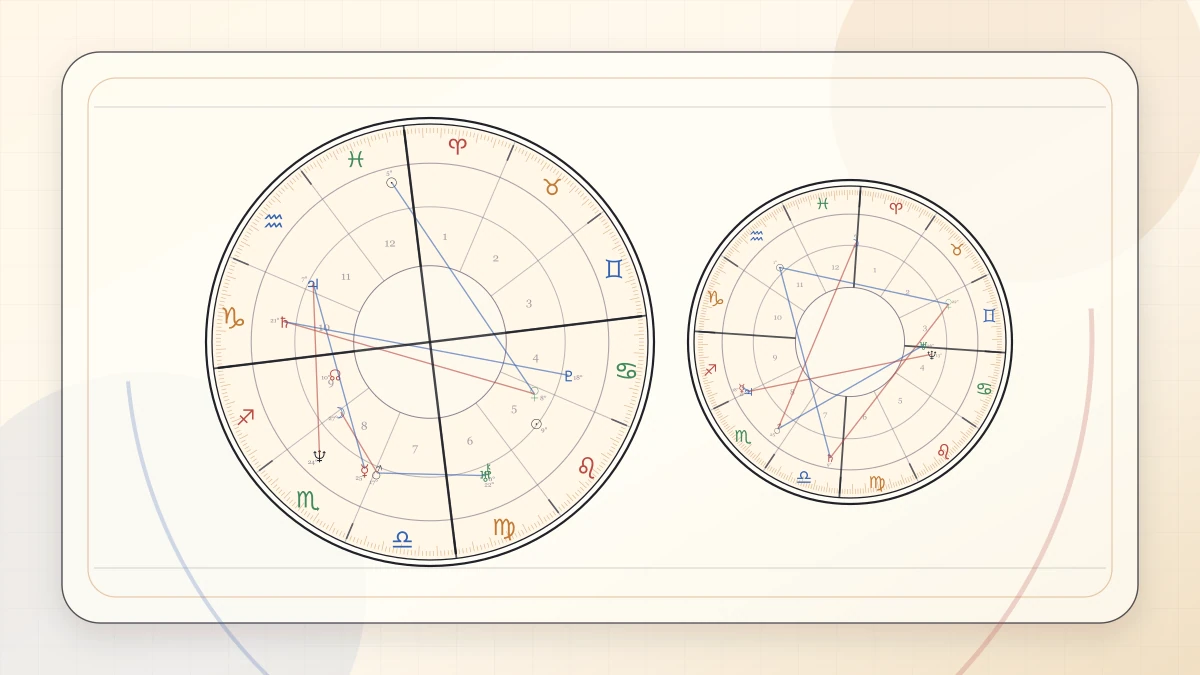
Planetary Transits
Transit Triggers vs Long-Term Cycles
A long-term cycle is a slow transit that sets a theme for months or years; a trigger is a brief fast contact that falls inside it. The model keeps slow and fast timing apart.
Table of contents
- Example or practical exercise
- The backdrop-and-trigger model in plain terms
- Which bodies play which role, and for how long
- A constructed example: Saturn as backdrop, Mars as trigger
- What astrologers say about triggers
- The main weakness of the model, and how to guard against it
- Can one planet be both backdrop and trigger?
- A note-keeping method that keeps the two layers apart
- Common questions about triggers and cycles
- What this does and does not establish
Example or practical exercise
With natal Sun at 12 degrees Gemini, transit Saturn near 12 Virgo forms a four-month square, and Mars reaches 12 Virgo on Day 11, adding an eight-day square inside it.
The backdrop-and-trigger model in plain terms
Astrologers often describe transits in two layers. A long-term cycle is a slow transit or a cycle marker, such as Saturn crossing a natal planet or a return, which sets a theme lasting months or years. A trigger is a brief contact from a fast body that falls inside that period and marks a short stretch within it.
A stage gives the picture: the backdrop is the scenery that stays up all season, and the trigger is the light that picks out one corner for an evening. This is an interpretive model, not a law of nature. Its use is to keep slow and fast timing apart, so that a one-day contact is not read as a year-long chapter.
Which bodies play which role, and for how long
Roles follow speed. The table uses a window of 4 degrees (an orb of 2 either side) and average speeds to show how long each body stays in that window on one pass. Retrograde turns can add passes for the planets from Mercury outward.
| Body | Average pace | Time in a 4-degree window | Usual role |
|---|---|---|---|
| Moon | About 13 degrees a day | About 7 hours | Trigger |
| Sun | About 1 degree a day | About 4 days | Trigger |
| Mercury and Venus | About a degree a day, uneven | Days to a few weeks | Trigger |
| Mars | About half a degree a day | About 8 days | Trigger |
| Jupiter | About 30 degrees a year | About 7 weeks | Middle layer |
| Saturn | About 12 degrees a year | About 4 months | Backdrop |
| Uranus | About 4.3 degrees a year | About 11 months | Backdrop |
| Neptune | About 2.2 degrees a year | About 1.8 years | Backdrop |
| Pluto | About 1.5 degrees a year | About 3 years, widely variable | Backdrop |
A constructed example: Saturn as backdrop, Mars as trigger
Take a constructed natal Sun at 12 degrees Gemini, which is 72 degrees on the zodiac (Gemini begins at 60). A square lies 90 degrees away, at 162 degrees, which is 12 degrees Virgo (Virgo begins at 150).
Suppose transit Saturn is at 11.5 degrees Virgo on Day 1 of your notes. Saturn moves about 12.2 degrees a year, or about 0.033 degrees a day, so by Day 11 it has moved about 0.33 degrees to 11.83, a sixth of a degree short of exact and roughly five days away. With an orb of 2 degrees either side, the whole Saturn contact spans about 4 months.
Now add a constructed Mars at 7 degrees Virgo on Day 1. Mars moves about half a degree a day, so it needs 5 degrees and reaches 12 degrees Virgo on Day 11, making its own square to the natal Sun on the day Saturn is nearly exact. Mars’s window is about 8 days, a small piece of the 4-month Saturn window.
Two things are measured here, a backdrop and a trigger, each with its own dates. The model does not say that Mars caused or released anything on Day 11. It says only that a short contact fell inside a long one.
What astrologers say about triggers
Those who use the language of triggers describe the fast contact as a moment when the slow theme becomes visible: a conversation, a decision or a mood that brings the long-term question to the surface. They watch the fast bodies, and especially the Moon, for timing inside a longer period.
Many other astrologers drop the language of cause and say only that fast contacts color a day. Both groups agree on a practical point: a short contact adds timing and tone to a theme that was already present, and does not create events from nothing.
The main weakness of the model, and how to guard against it
The weak point is that fast contacts are everywhere. The Moon alone forms an aspect to one of your natal points on most days, so after any event you can find a trigger that fits. That is hindsight, not evidence.
A guard is to decide before the week begins which contacts count, and to note the days when a contact passed with nothing to match. A model that can never fail is not telling you much, so the days that do not fit are your most useful entries.
Can one planet be both backdrop and trigger?
Yes, because the roles are relative. Jupiter covers about 2.5 degrees a month, so it spends about 7 weeks in a 4-degree window. Against a Moon contact, that is a long backdrop. Against a Saturn square that lasts 4 months, it is a trigger that might sit inside it for part of that time.
The useful habit is to name the pair every time: this contact is the backdrop, that one is the trigger, and here is why. Without a named pair, the words stop meaning anything.
A note-keeping method that keeps the two layers apart
Keep two lists on one page and never merge them.
- List the backdrops: slow transits and cycle markers touching your chart, each with an approximate start and end.
- List the triggers: the fast contacts of the week, with their exact days.
- Write observations by date, in plain words, before you look at the transits.
- At the end of the week, match observations to contacts and write down the mismatches too.
- Record how many triggers had no matching event, next to the ones that did.
Common questions about triggers and cycles
Is a trigger the same as an exact aspect? A trigger is any short contact you choose to watch. It need not be exact; many people use an orb of about a degree for fast planets.
Can I use triggers without a backdrop? Yes, but then you are simply following daily transits. The model matters when you want to know whether a short contact sits inside a longer one.
Does a trigger prove a long cycle is active? No. Do not report a trigger as the certain activation of a predicted event. A coincidence of dates is a coincidence.
How many triggers should I watch? A few. A short list keeps the record honest.
What this does and does not establish
Fast contacts happen almost daily, so a trigger found after an event is hindsight, and a matching date never shows that a cycle caused anything.
Related calculators
Use the matching tool when you want a direct chart or timing result after reading the guide.
Current Transits Calculator
Exact current-sky snapshot for a selected city, built for repeat-use daily astrology readers.
Retrograde Calendar
Exact retrograde-period page for year-based planning, editorial planning, and current-sky timing checks.
Transit to Natal Calculator
Exact current-sky comparison against one verified natal chart for more personal practical transit guidance.
Calculation references
- Swiss Ephemeris: positions, angles and house-system conventions
Technical reference for calculation conventions. It does not certify an interpretation or mean every live tool uses this engine.
Related articles
Keep reading with nearby topics that deepen the same question from another angle.
What a Venus Transit Can Mean in Love
A Venus transit is the fast-moving Venus touching a point in your chart for a few days. Astrologers read it as a passing mood of affection, attraction or values, shaped by the point it meets.
6 min read
Mercury Retrograde Meaning and a Practical Checklist
Mercury retrograde is a few weeks, three or four times a year, when Mercury appears to drift backward as seen from Earth. Astrologers read it as a time to review, revise and double-check.
6 min read
How to Read Current Transits Without Overreacting to Every Aspect
Choose your question first, list the slow-planet contacts within a tight orb, then add fast ones only for timing. A Saturn contact lasting months outweighs a Moon contact lasting hours.
6 min read
Saturn Return Explained
A Saturn return is when Saturn comes back to the degree it held at your birth, about every 29.5 years. Astrologers read it as a checkpoint for responsibility and the structures you have built.
6 min read
Keep exploring
Use the category page and the main hubs when you want the next layer of context.
Previous article
What a Venus Transit Can Mean in Love
Next article
Jupiter Meaning in Astrology