
Love Compatibility
Venus and Mars in Synastry Explained
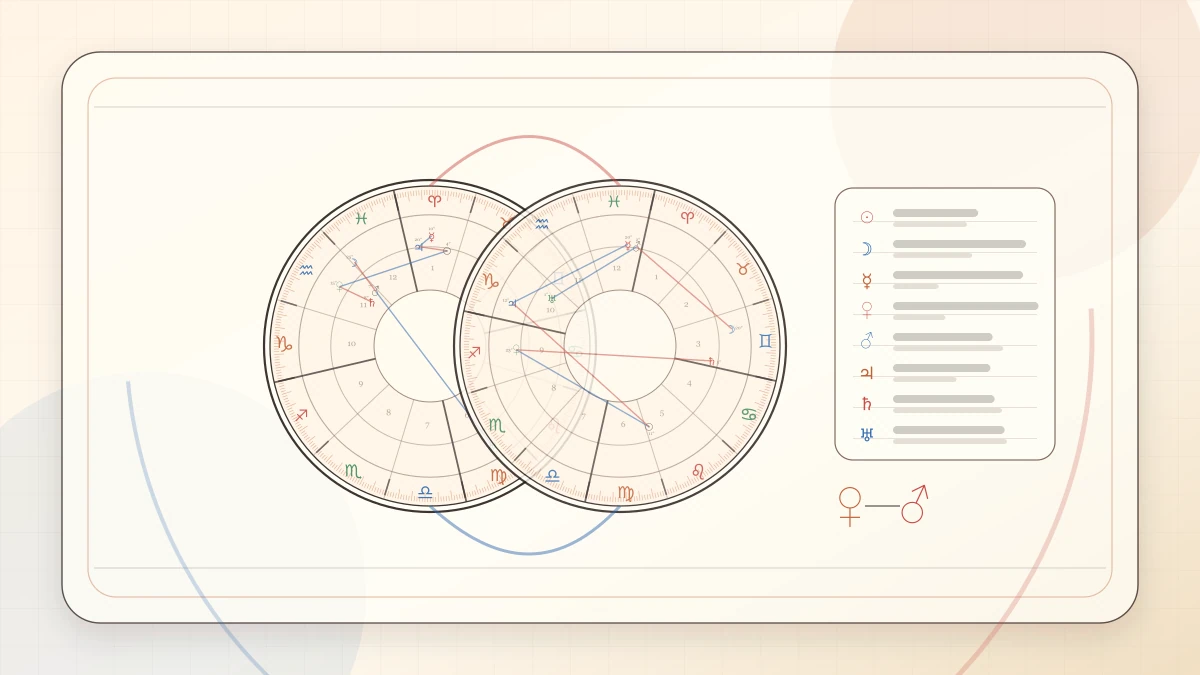
Venus and Mars contacts compare what one person values with how the other acts. They describe a pull of chemistry, which is a separate question from day-to-day cooperation.
Table of contents
- Example or practical exercise
- What Venus and Mars contacts compare
- Venus-Mars, Venus-Venus and Mars-Mars: three questions
- How the aspects are traditionally described
- A constructed pair, worked through degree by degree
- Reading what the arithmetic found
- Why attraction and cooperation are separate questions
- Questions worth asking about your own contacts
- When only one person feels the pull
- Questions readers ask about Venus-Mars contacts
- What this does and does not establish
Example or practical exercise
With a 5-degree limit, Nia's Mars at 4 Leo conjoins Omar's Venus at 1 Leo, their Marses form a square, and neither Venus-Venus nor Nia's Venus to Omar's Mars makes a contact.
What Venus and Mars contacts compare
In synastry, a contact is an aspect between a planet in one person’s chart and a planet in the other’s. Venus and Mars contacts get special attention because the tradition gives Venus the themes of affection, taste and what you value, and gives Mars the themes of drive, desire and initiative. Together they are the standard vocabulary for chemistry.
Three kinds of contact are worth separating. Venus-Mars means one person’s Venus meets the other’s Mars. Venus-Venus means two Venuses meet. Mars-Mars means two Marses meet. Each asks a different question.
Venus-Mars, Venus-Venus and Mars-Mars: three questions
A Venus-Mars contact describes a pull between what one person values and how the other acts. Traditionally this is the classic attraction pairing, and it works in both directions: A’s Venus with B’s Mars and A’s Mars with B’s Venus are different contacts.
A Venus-Venus contact asks whether two people enjoy similar things and show care in similar ways. A Mars-Mars contact asks whether they share a pace and how they handle disagreement, since Mars is the planet of friction as well as of drive. An aspect between the same planets is smooth or tense depending on its type, not on how much you like the person.
How the aspects are traditionally described
| Contact | Aspect | Traditional description |
|---|---|---|
| Venus-Mars | Conjunction (0 degrees) | Strong, direct pull; one person’s action lands right on the other’s preferences |
| Venus-Mars | Trine or sextile (120 or 60) | Easy fit between what one wants and how the other acts |
| Venus-Mars | Square or opposition (90 or 180) | Strong pull with friction, such as misread signals or pushing too hard |
| Venus-Venus | Conjunction, trine or sextile | Shared taste and a similar way of showing care |
| Venus-Venus | Square or opposition | Different ideas of what affection or comfort should look like |
| Mars-Mars | Conjunction, trine or sextile | Similar pace; a sense of acting together |
| Mars-Mars | Square or opposition | Competing pace; arguments that heat up quickly |
A constructed pair, worked through degree by degree
Nia and Omar are invented for this example. Nia has Venus at 22° Gemini and Mars at 4° Leo. Omar has Venus at 1° Leo and Mars at 8° Scorpio. A common synastry limit for personal planets is 3 to 5 degrees, so this example uses 5 and says so.
Nia’s Mars to Omar’s Venus: 4° Leo is 124 and 1° Leo is 121. The gap is 3 degrees, a conjunction within the limit. Nia’s Venus to Omar’s Mars: 22° Gemini is 82 and 8° Scorpio is 218. The gap is 136, which is 16 from a trine, so there is no contact.
Venus to Venus: 82 and 121 differ by 39, and the nearest major aspect, a sextile at 60, is 21 away, so there is none. Mars to Mars: 124 and 218 differ by 94, which is 4 from a square, so this is one.
Reading what the arithmetic found
One Venus-Mars contact, Nia’s Mars on Omar’s Venus, is the attraction theme in a single direction: Nia’s way of acting meets Omar’s sense of what feels good. A fair reading asks whether Omar likes that pace, instead of assuming he does.
Mars to Mars is a square between two fixed signs, Leo and Scorpio. The tradition reads it as two people who each dig in, so disagreements can become contests over who yields. The missing Venus-Venus contact says nothing negative; it only means neither has an automatic shared taste, and they will need to ask each other.
Direction matters here. When Nia’s Mars touches Omar’s Venus, Nia is usually described as the one who feels the pull to act, and Omar as the one who is sought out. Whether that is welcome depends on the two of them. The reverse contact, Omar’s Mars on Nia’s Venus, would be a separate item, and this pair does not have it.
Why attraction and cooperation are separate questions
A strong Venus-Mars contact describes a pull. It does not describe whether two people enjoy each other’s company on an ordinary Tuesday, handle money talks or keep promises. A square can bring heat without ease, and a trine can feel pleasant without much spark. Neither one measures the quality of a relationship.
It also does not justify ignoring clear differences in values or treatment because the chemistry seems strong. If something about the way you are treated worries you, chart language does not settle it; talking with someone you trust, or a qualified professional, can.
Questions worth asking about your own contacts
- Which of us usually suggests plans, and does the other enjoy that pace?
- What does each of us do to show affection, and does it land the way it was intended?
- When we disagree, who speeds up and who slows down?
- Where do our tastes overlap, and where do we need to ask instead of guessing?
- Which contact on the chart describes something we have actually noticed, and which one doesn’t fit at all?
When only one person feels the pull
A Venus-Mars contact belongs to two charts, not to two people’s feelings. The same conjunction can sit between two people who are both drawn to each other, or between two people where one is interested and the other simply enjoys the company. The chart cannot tell you which, and it never tells you what the other person wants.
So treat a contact as a reason to pay attention, not as permission. Interest is something you ask about directly and accept the answer to, including a no or a not yet. Pressing on because the chemistry looks strong on paper is not romance; it is ignoring the person in front of you.
One technical note: contacts are measured in degrees, so Venus at the very end of one sign can touch Mars at the very start of the next. Why that matters, with worked numbers, is explained in our guide to zodiac compatibility vs synastry.
Questions readers ask about Venus-Mars contacts
Is Venus always one partner and Mars the other? No. Both planets are in everyone’s chart, whatever a person’s gender, and the contacts are read the same way for any pair. The pairing comes from the planets’ meanings and their mythology, not from who is expected to do what.
Can friends or coworkers have Venus-Mars contacts? Yes, and the aspect can appear as an easy enjoyment of each other’s drive with no romance at all. The tradition reads the pull as chemistry, and whether it becomes anything more is a choice.
How many contacts do I need? There is no number. One tight contact is enough to talk about, and a chart with none is not a worse chart. Look at what the contacts you do have describe, and compare that with how the two of you actually behave.
What this does and does not establish
A chart never tells you what another person wants; interest is something you ask about directly, and a no or a not yet must be accepted.
Related calculators
Use the matching tool when you want a direct chart or timing result after reading the guide.
Birth Chart Compatibility Calculator
Higher-trust compatibility report built from two verified natal charts and exact synastry analysis.
Synastry Chart Calculator
Compare two birth charts for relationship patterns, emotional rhythm, attraction, and communication themes.
Zodiac Compatibility Calculator
Broad sign-to-sign compatibility page tuned for lifestyle readers.
Calculation references
- Swiss Ephemeris: positions, angles and house-system conventions
Technical reference for calculation conventions. It does not certify an interpretation or mean every live tool uses this engine.
Related articles
Keep reading with nearby topics that deepen the same question from another angle.
Moon Sign Meaning in Love, Emotions, and Daily Life
Your Moon sign describes what you need to feel safe: your moods, instincts, habits and the kind of comfort that settles you, which shows most clearly at home and in close relationships.
6 min read
How to Read Your Birth Chart: A Beginner's Guide
Read your birth chart in five steps: find the Sun, Moon and Rising sign, count the elements, note crowded houses, locate the chart ruler, then read the two or three closest aspects.
6 min read
How to Read Moon Contacts in Synastry
A Moon contact compares one person's emotional baseline with a planet in the other's chart. Read each one for emotional fit, checking direction, aspect type and the birth time.
6 min read
Mercury in Synastry: A Communication Guide
Mercury in synastry compares how two people think, talk and listen. Its sign shows a conversational style, and its contacts show where words flow easily or get crossed.
6 min read
Keep exploring
Use the category page and the main hubs when you want the next layer of context.
Previous article
How to Read Moon Contacts in Synastry
Next article
Mercury in Synastry: A Communication Guide