
Love Compatibility
Composite Chart Basics for Beginners
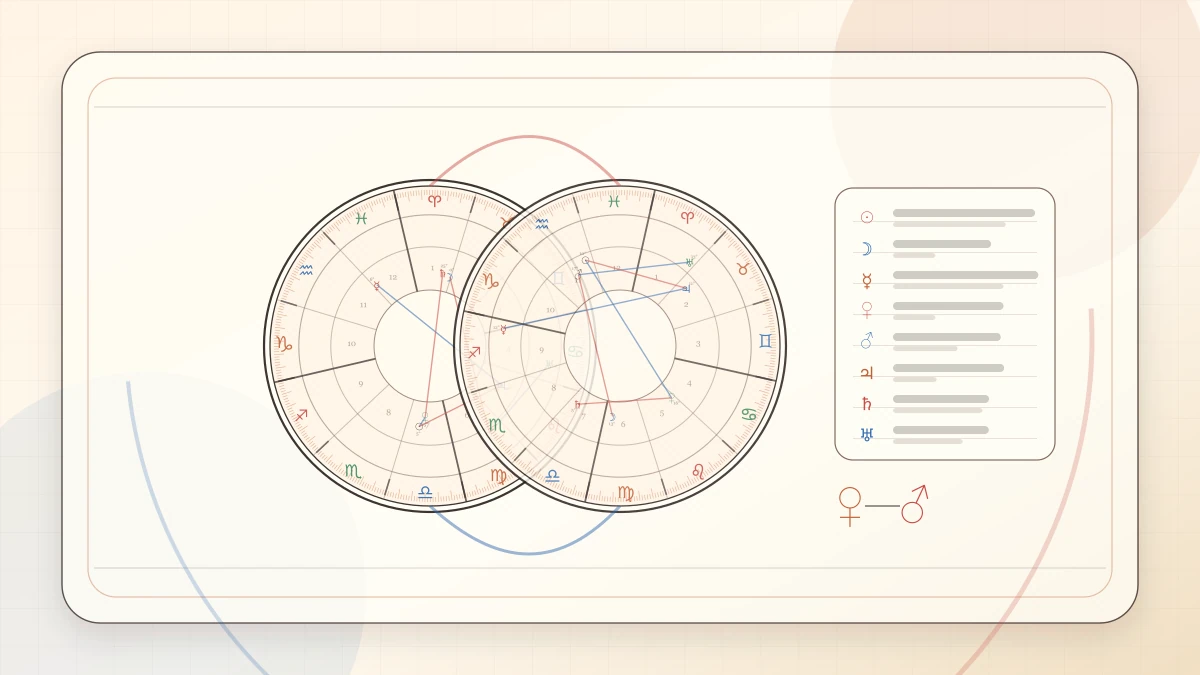
A composite chart is one chart built from the midpoints between two people's planets. It is read as the relationship's own character, starting with its Sun, Moon and Ascendant.
Table of contents
- Example or practical exercise
- What a composite chart is and why astrologers use one
- What you need to build a composite chart
- What the composite Sun, Moon and Ascendant describe
- A constructed couple’s three composite points
- Reading the example without over-reading it
- Why a composite chart is symbolic, not a real moment
- How to use a composite chart in a conversation
- A second example: when the composite Sun and Moon pull apart
- Questions readers ask about composite charts
- What this does and does not establish
Example or practical exercise
Morgan and Lee's composite has the Sun at 20 Leo, the Moon at 11 Virgo and the Ascendant at 19 Aries, and the Sun and Ascendant form a trine within 1 degree.
What a composite chart is and why astrologers use one
A composite chart is a single chart built from two people’s birth charts. For each planet, astrologers find the midpoint between its position in one chart and its position in the other, and the resulting set of midpoints becomes a new chart for the relationship itself.
It exists because synastry, which compares two charts, can leave a reader with a long list of separate contacts and no sense of the whole. The composite offers one picture to read the way you would read a birth chart: by Sun, Moon and Ascendant first.
What you need to build a composite chart
At minimum you need both birth dates, which are enough for a composite Sun and a composite Moon in most cases. For the composite Ascendant and the houses you also need both birth times and places. Programs differ on method: some average the two Ascendants directly, while others build the angles from the midpoint of the two Midheavens.
Most programs take each midpoint the short way around the circle. You do not need to do the arithmetic yourself to read a composite; if you want to check it, including the case that wraps past 0 degrees Aries and the rare exact opposition, it is worked step by step in our guide to synastry vs composite charts. This guide starts from a finished composite and is about reading it.
What the composite Sun, Moon and Ascendant describe
| Composite point | What it stands for | A question it raises |
|---|---|---|
| Sun | The relationship’s central purpose and what gives it energy | What do we keep coming back to doing together? |
| Moon | How the relationship feels safe and processes emotion | What helps us feel steady when things are hard? |
| Ascendant | How the relationship comes across and how it starts things | What do others notice first about us as a pair? |
A constructed couple’s three composite points
Morgan and Lee are invented for this example. Morgan has the Sun in Gemini, the Moon in Cancer and Pisces rising. Lee has the Sun in Libra, the Moon in Scorpio and Taurus rising. A chart program set to short-arc midpoints gives their composite the Sun at 20° Leo, the Moon at 11° Virgo and the Ascendant at 19° Aries.
Before reading, jot down three things for each point: its sign, its element and modality, and any close aspect to the other two points. Leo is fixed fire, Virgo mutable earth and Aries cardinal fire. That short list is the raw material for everything in the next section.
Reading the example without over-reading it
A composite Sun in Leo suggests a relationship that centers on warmth, play and being appreciated. A composite Moon in Virgo suggests comfort found through usefulness, routine and attention to small things. A composite Ascendant in Aries suggests a pair that comes across as direct and quick to start.
The Sun at 20° Leo is 140 degrees around the zodiac and the Ascendant at 19° Aries is 19, so they are 121 degrees apart, a trine within 1 degree. Read it as a theme: the relationship’s purpose and its outward style may line up. With whole-sign houses counted from Aries, the Sun falls in the fifth house and the Moon in the sixth, which invites questions about creativity, pleasure and daily upkeep. Treat those as questions, not facts about Morgan and Lee.
Notice one more thing: Morgan’s Gemini Sun and Lee’s Libra Sun are both air signs, yet the composite Sun lands in fire. A composite is not an average personality, and it can fall in a sign neither person has. Reading it as the relationship’s own character, instead of a blend of Morgan and Lee, keeps that from being confusing.
Why a composite chart is symbolic, not a real moment
No sky ever looked like a midpoint chart. The composite is a constructed symbol, and the relationship it describes was never born at a particular minute. That is different from a birth chart, which records the actual sky at an actual time.
For that reason, do not treat the composite as a natal chart for other calculations, and be wary of any claim that it predicts how long a relationship lasts or whether it succeeds. Different programs can also give different Ascendants for the same pair, which is another reason to hold the details loosely.
How to use a composite chart in a conversation
- Read the composite Sun sign and, if you have houses, the house it falls in.
- Read the composite Moon sign in the same way, and ask each other whether it matches how comfort works between you.
- Read the composite Ascendant as outward style, and check it against how friends describe you as a pair.
- Note any close aspect among the three, as in the trine above, and ask whether the theme fits.
- Discard any line that does not match your experience, and keep the ones that start a useful conversation.
A second example: when the composite Sun and Moon pull apart
The first couple had a trine among their points. Here is a constructed composite with tension instead: the Sun at 8° Capricorn and the Moon at 10° Aries. Capricorn starts at 270, so the Sun sits at 278, and the Moon sits at 10. Going the short way around through 0 degrees, the distance is 360 minus 268, or 92 degrees, a square within 2.
Read each point first, then the angle between them. A Capricorn Sun suggests a relationship organized around building something and taking responsibility. An Aries Moon suggests that the pair feels safest when it can act quickly and keep some independence. The square asks a fair question: does the work of the shared plan leave room for the spontaneity that makes the two of them feel at ease?
A square in a composite is a topic, not a fault line. Both signs are cardinal, so this pair may like starting things and may need to agree on which project comes first. One caution on reliability: if either original pair of planets was close to an exact opposition, a small change in birth time can move the composite point to the opposite sign, so hold such a point loosely.
Questions readers ask about composite charts
Can I build one for a friend, a sibling or a business partner? Yes. The method only needs two sets of positions, and composites are read for any pair. The symbolism needs adjusting to the kind of relationship, since a composite Venus means something different for coworkers than for partners.
Do I need both birth times? For the Sun and most planets, no, because the dates are enough. The Moon moves about 13 degrees a day, so a missing time leaves the composite Moon uncertain by several degrees, and the angles and houses cannot be built at all.
Does the composite change over time? The composite itself is fixed by the two birth charts. Astrologers do compare it with current planet positions, but that is a separate technique.
What this does and does not establish
A composite is a symbol, not a real sky, so it cannot serve as a natal chart or predict how long a relationship lasts.
Related calculators
Use the matching tool when you want a direct chart or timing result after reading the guide.
Birth Chart Compatibility Calculator
Higher-trust compatibility report built from two verified natal charts and exact synastry analysis.
Synastry Chart Calculator
Compare two birth charts for relationship patterns, emotional rhythm, attraction, and communication themes.
Zodiac Compatibility Calculator
Broad sign-to-sign compatibility page tuned for lifestyle readers.
Calculation references
- Swiss Ephemeris: positions, angles and house-system conventions
Technical reference for calculation conventions. It does not certify an interpretation or mean every live tool uses this engine.
Related articles
Keep reading with nearby topics that deepen the same question from another angle.
Moon Sign Meaning in Love, Emotions, and Daily Life
Your Moon sign describes what you need to feel safe: your moods, instincts, habits and the kind of comfort that settles you, which shows most clearly at home and in close relationships.
6 min read
How to Read Your Birth Chart: A Beginner's Guide
Read your birth chart in five steps: find the Sun, Moon and Rising sign, count the elements, note crowded houses, locate the chart ruler, then read the two or three closest aspects.
6 min read
How to Read Synastry Without Turning Every Aspect Into a Verdict
Synastry lays one birth chart over another and reads the angles between their planets. Read each contact as a question two people can discuss, never as a verdict on the pair.
6 min read
Big Three Compatibility Guide
Big Three compatibility compares two people's Sun, Moon and Rising signs: their aims, emotional habits and outward manner. The Rising sign needs an exact birth time.
6 min read
Keep exploring
Use the category page and the main hubs when you want the next layer of context.
Previous article
How to Read Synastry Without Turning Every Aspect Into a Verdict
Next article
Big Three Compatibility Guide