
Love Compatibility
How to Read Synastry Without Turning Every Aspect Into a Verdict
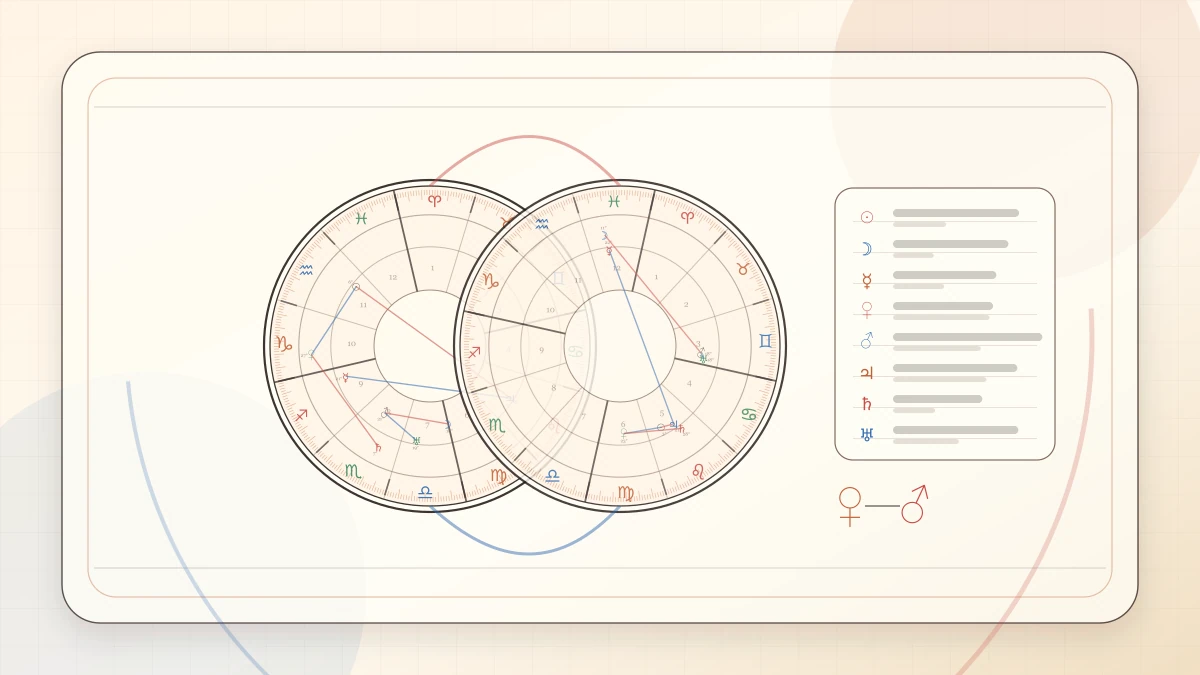
Synastry lays one birth chart over another and reads the angles between their planets. Read each contact as a question two people can discuss, never as a verdict on the pair.
Table of contents
- Example or practical exercise
- What synastry compares
- Why synastry orbs are usually tighter
- The contacts astrologers read first
- House overlays: where one person’s planets land
- A constructed pair, with the arithmetic
- A short order for reading without verdicts
- Composite charts are a different technique
- Rewriting a synastry verdict as a question
- Questions readers ask about synastry
- What this does and does not establish
Example or practical exercise
In a constructed pair, A's Sun at 10 Leo opposes B's Moon at 12 Aquarius, A's Venus trines B's Mars and A's Moon conjoins B's Saturn, each within 2 degrees.
What synastry compares
Synastry is the practice of laying one person’s birth chart over another’s and reading the aspects between them. An aspect is an angle between two planets, such as a square (90 degrees) or a trine (120 degrees). In synastry the two planets belong to different people, so each contact says something about how two sets of tendencies meet.
The aim is to describe, not to rank. A contact can show where two people feel at ease, where they stimulate each other and where they rub, and what questions to ask each other. It cannot say whether a relationship will last or whether it is good for either person. If a relationship leaves you afraid or controlled, a chart is not the place to look; talk with someone you trust or a local support service.
Why synastry orbs are usually tighter
An orb is how far from exact an aspect can be and still count. In a single birth chart astrologers commonly allow 6 to 8 degrees. Between two charts there are many more possible pairings, so a wide orb would make almost every planet touch every other one. Many astrologers therefore tighten synastry orbs to about 3 to 5 degrees, with the closest contacts carrying the most weight.
There is no official orb, so pick a limit and apply it to both people. A contact within 1 degree is read as especially strong, and a Moon contact deserves an extra check of the birth time, because the Moon moves about 13 degrees a day.
The contacts astrologers read first
With a few dozen contacts available, it helps to start with the ones the tradition treats as central. Work down this list and stop when you have enough to discuss.
| Contact | What it is said to describe |
|---|---|
| Sun with Moon | How one person’s identity meets the other’s emotional needs |
| Venus with Mars | Attraction, affection and how desire is expressed |
| Moon with Saturn | Feeling steady or restricted: reliability, caution, distance |
| Ascendant or Descendant with a planet | First impressions and the sense of meeting an equal |
House overlays: where one person’s planets land
A house overlay is the house of one person’s chart in which the other’s planet falls. Each overlay has a direction: A’s Venus in B’s fifth house is a different observation from B’s Venus in A’s fifth house. Look at both directions.
To place it, count whole-sign houses from the first person’s Rising sign. In this example, one person has Aries rising, so Aries is the first house, Taurus the second and Gemini the third. If the other person’s Venus is at 5 degrees of Gemini, it lands in the first person’s third house, the area of conversation, learning and short trips.
Read that overlay as a theme: the second person’s way of offering warmth tends to show up in the first person’s everyday talk and curiosity. The tradition gives overlays less weight than close aspects, and a planet near the edge of a house is the least certain, so check the birth time before you lean on one.
A constructed pair, with the arithmetic
Take two made-up people. Person A has the Sun at 10 degrees of Leo and Venus at 18 degrees of Virgo, and a Moon at 25 degrees of Scorpio. Person B has the Moon at 12 degrees of Aquarius, Mars at 20 degrees of Capricorn and Saturn at 27 degrees of Scorpio.
Convert each placement to degrees around the zodiac, where Leo starts at 120, Virgo at 150, Scorpio at 210, Capricorn at 270 and Aquarius at 300. A’s Sun is at 130 and B’s Moon at 312, a gap of 182. The shorter way around is 360 minus 182, or 178, which is an opposition with an orb of 2. A’s Venus is at 168 and B’s Mars at 290, a gap of 122, a trine with an orb of 2. A’s Moon is at 235 and B’s Saturn at 237, a conjunction with an orb of 2.
In reading terms: the Sun-Moon opposition invites talk of how each person’s identity and needs complement or pull against each other. The Venus-Mars trine suggests an easy flow of affection and drive. The Moon-Saturn conjunction asks how comfortably one person’s feelings sit with the other’s caution. These are questions, not forecasts.
A short order for reading without verdicts
Use these steps whenever you open a pair of charts.
- List the contacts inside your chosen orb and sort them by closeness.
- Read the priority contacts first, then the house overlays in both directions.
- Write each finding as a question the two people could discuss.
- Check the list against what you already know about the relationship, and give more weight to what you observe than to a pattern in the charts.
Composite charts are a different technique
A composite chart is not synastry. It blends two charts into a single chart, usually by taking the midpoint between each pair of matching planets, and then reads that chart as a description of the relationship itself. Synastry stays with two separate charts and the contacts between them.
The two methods answer different questions and can disagree. Treat them as separate lenses rather than adding them up into a score. How a composite is built and when to use each method is set out in our guide to synastry vs composite charts.
Rewriting a synastry verdict as a question
Verdicts creep in easily. The fix is mechanical: keep the planets and the theme, drop the forecast, and hand the question to the two people. Measure each contact in degrees, not by sign; why that matters is explained in our guide to zodiac compatibility vs synastry.
| Verdict-style line | A question to ask instead |
|---|---|
| “Your Moon-Saturn contact means coldness.” | When one of us is upset, does the other’s carefulness feel steadying or distant? |
| “Venus trine Mars means you are made for each other.” | Do we both enjoy the pace at which things move between us? |
| “Mars square Mars means constant fights.” | How do we each push, and what helps us cool down? |
Questions readers ask about synastry
What if I do not know my partner’s birth time? Compare the planets and leave out the houses. The Sun, Mercury, Venus and Mars move only a degree or two in a day, and the Moon, at about 13 degrees a day, is usable unless it sits near a sign edge. House overlays and contacts to the Ascendant need the time, so skip them.
How many contacts should a pair have? There is no right number. Two charts always produce many contacts inside a 5-degree orb, so counting them says little. Look at which planets are involved and how tight each contact is.
Can I read a pair without the other person knowing? You can, but the result is a guess about them. Share it as a set of questions and let them answer.
What this does and does not establish
No contact can say whether a relationship will last or is good for you; if you feel afraid or controlled, talk with someone you trust or a local support service.
Related calculators
Use the matching tool when you want a direct chart or timing result after reading the guide.
Birth Chart Compatibility Calculator
Higher-trust compatibility report built from two verified natal charts and exact synastry analysis.
Synastry Chart Calculator
Compare two birth charts for relationship patterns, emotional rhythm, attraction, and communication themes.
Zodiac Compatibility Calculator
Broad sign-to-sign compatibility page tuned for lifestyle readers.
Calculation references
- Swiss Ephemeris: positions, angles and house-system conventions
Technical reference for calculation conventions. It does not certify an interpretation or mean every live tool uses this engine.
Related articles
Keep reading with nearby topics that deepen the same question from another angle.
Moon Sign Meaning in Love, Emotions, and Daily Life
Your Moon sign describes what you need to feel safe: your moods, instincts, habits and the kind of comfort that settles you, which shows most clearly at home and in close relationships.
6 min read
How to Read Your Birth Chart: A Beginner's Guide
Read your birth chart in five steps: find the Sun, Moon and Rising sign, count the elements, note crowded houses, locate the chart ruler, then read the two or three closest aspects.
6 min read
Mars Sign Compatibility and Attraction
Mars sign compatibility compares how two people pursue what they want and how they argue. It describes pace and conflict style, not whom anyone will desire.
6 min read
Composite Chart Basics for Beginners
A composite chart is one chart built from the midpoints between two people's planets. It is read as the relationship's own character, starting with its Sun, Moon and Ascendant.
6 min read
Keep exploring
Use the category page and the main hubs when you want the next layer of context.
Previous article
Mars Sign Compatibility and Attraction
Next article
Composite Chart Basics for Beginners