
Houses, Aspects, and Planets
East Point Meaning in Astrology
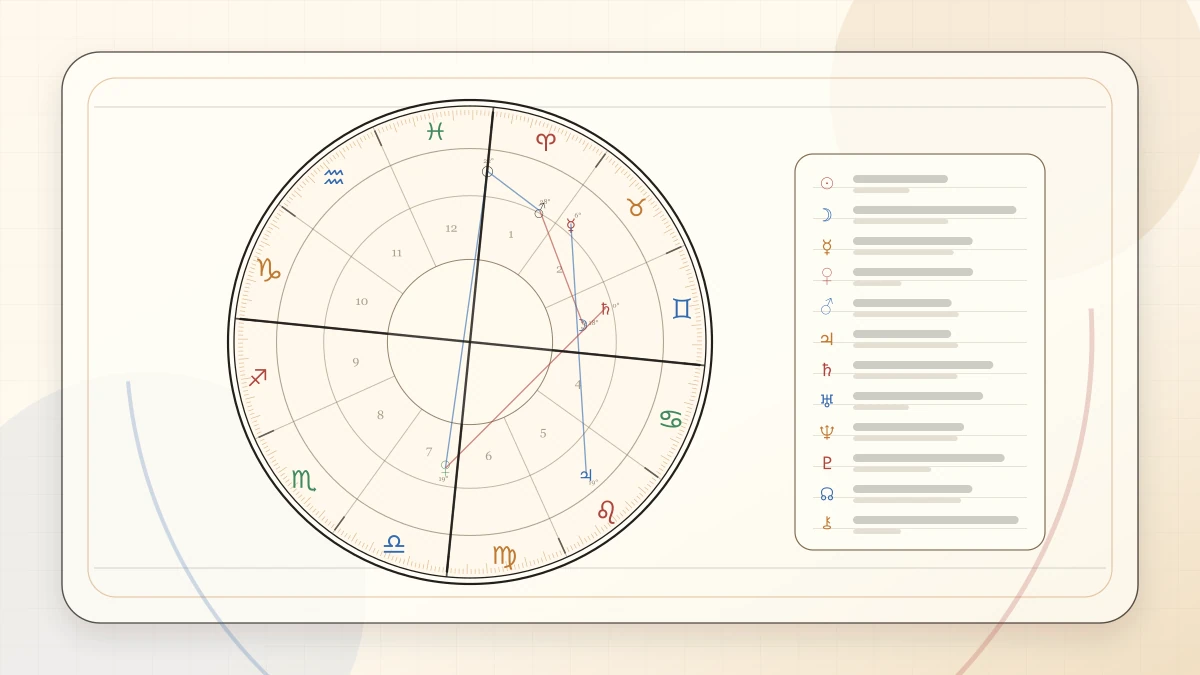
The East Point, or Equatorial Ascendant, is the zodiac degree that would rise in the east at the equator at the sidereal time of your birth. It matches the Ascendant only at the equator.
Table of contents
- Example or practical exercise
- What the East Point is
- How the East Point is calculated, step by step
- A worked example: how latitude moves the Ascendant but not the East Point
- What birth data the East Point needs
- How astrologers read the East Point
- When does the East Point fall in a different sign from the Ascendant?
- Aspects and houses for the East Point
- Why the East Point sits 90 degrees from the Midheaven
- What the East Point cannot tell you
- How to find the East Point in your chart
- Common questions about the East Point
- What this does and does not establish
Example or practical exercise
With an RAMC of 110 degrees, the East Point stays at 21.6 degrees Libra at every latitude, while the Ascendant moves from 21.6 Libra at the equator to 12.4 Libra at 60 degrees north.
What the East Point is
The East Point, also called the Equatorial Ascendant, is a calculated point. It is not a planet or a body. It is the zodiac degree that would be rising in the east if you were standing on the equator at the same sidereal time as your birth.
At the equator it coincides with the Ascendant. Everywhere else the two part company, and the gap grows with latitude. Most astrologers treat it as a secondary version of the Ascendant, and many ignore it.
How the East Point is calculated, step by step
A key figure is the RAMC, the right ascension of the Midheaven, which is the local sidereal time in degrees. It tells which part of the celestial equator is on the meridian at the moment. Sidereal time moves 15 degrees an hour, so 110 degrees is 7 hours 20 minutes.
- Find the RAMC for the birth date, time and longitude.
- Add 90 degrees. That gives the East Point’s position along the celestial equator.
- Convert that equator position to a degree of the zodiac along the ecliptic.
A worked example: how latitude moves the Ascendant but not the East Point
In a constructed chart with RAMC 110 degrees, the Midheaven is at about 108.5 degrees, or 18.5 degrees Cancer. Add 90 and the East Point’s equator position is 200 degrees. After conversion to the ecliptic it comes out near 201.6 degrees, about 21.6 degrees Libra.
That does not change with latitude. The Ascendant does. The table shows the same RAMC at three latitudes.
| Latitude | Ascendant | East Point | Gap |
|---|---|---|---|
| 0 degrees | 201.6 (21.6 Libra) | 201.6 (21.6 Libra) | 0 degrees |
| 40 degrees north | 196.0 (16.0 Libra) | 201.6 (21.6 Libra) | about 5.7 degrees |
| 60 degrees north | 192.4 (12.4 Libra) | 201.6 (21.6 Libra) | about 9.2 degrees |
What birth data the East Point needs
It needs a birth date and time, plus a birth place. Latitude does not change the East Point, but longitude does, because longitude is needed to turn clock time into local sidereal time.
Like the Ascendant, it moves around the zodiac in about a day, roughly a degree every four minutes on average. An uncertain birth time therefore carries over into the point.
How astrologers read the East Point
The reading is modern. Astrologers who use it describe it as a point of first impression, how you appear when you first walk into a room, or as the way a person’s outward style appears before the horizon Ascendant is considered. Others see it as the Ascendant as seen from a more abstract geometry.
It has little tradition behind it. There is no ancient text built around it, and it cannot certify anything about a person’s outward personality. Read it, if at all, as a fine detail beside the real Ascendant.
When does the East Point fall in a different sign from the Ascendant?
Only when the Ascendant is within the gap of a sign boundary. In the table above, 16 degrees Libra and 21.6 degrees Libra share a sign. If the Ascendant had been at 27 degrees of a sign, a gap of about 6 degrees would have pushed the East Point into the next sign.
So the answer depends on the degree of the Ascendant, the latitude and the sidereal time. For most people at middle latitudes the two sit in the same sign or in neighboring signs.
Aspects and houses for the East Point
Astrologers who use the East Point mostly look at conjunctions, within about one to three degrees. A planet that close is read as sharing some of the East Point’s first-impression role. In houses, it falls close to the Ascendant, usually in the 12th or 1st house.
Why the East Point sits 90 degrees from the Midheaven
The Midheaven is the zodiac degree at the highest point of the sky, and the RAMC marks where it falls along the celestial equator. The East Point is simply the point on the equator a quarter circle later, which is the 90 degrees added in the steps above.
That is the whole logic of the point. It keeps the Midheaven’s time-keeping but drops the local horizon, which is why it ignores latitude. In the example, the Midheaven is at 108.5 degrees, and the East Point at 201.6 is about 93.2 degrees later on the ecliptic, a little more than 90 because the ecliptic is tilted against the equator.
What the East Point cannot tell you
It cannot describe your outward personality. The Ascendant is the established point for that, and the East Point is an optional variation. Anyone who says the East Point overrides the Ascendant is stating a personal view, not a rule of astrology.
Because definitions and methods of handling latitude vary, it helps to know which convention your chart program uses. Two programs can differ slightly for the same birth data.
How to find the East Point in your chart
Choose a chart program or an ephemeris that lists the East Point, sometimes under the name Equatorial Ascendant.
- Enter the birth details exactly as for your main chart.
- Locate “East Point” or “Equatorial Ascendant” in the list of points.
- Record its sign and degree, and compare it with your Ascendant.
- Check for a planet within about two degrees.
- Keep the Ascendant as the main point, and use the East Point as an extra detail.
Common questions about the East Point
Is the East Point the same as the Ascendant? No. They agree only at the equator. Everywhere else they differ, and the Ascendant remains the point defined by your actual horizon.
Is it the same as the Vertex? No. The East Point comes from the celestial equator and sits in the east. The Vertex comes from the prime vertical and sits in the west. Some books pair them, but they are separate constructions.
Do I need to use it? No. Many astrologers never do. If it seems to add something to your reading, keep it, and if not, leave it out. The Ascendant, Sun and Moon give you far more to work with.
What this does and does not establish
The East Point cannot describe your outward personality or replace the Ascendant, and chart programs may calculate it slightly differently.
Related calculators
Use the matching tool when you want a direct chart or timing result after reading the guide.
12 Houses Calculator
Complete 12-house overview page for readers who want the full natal house framework before drilling into one exact placement.
House Placement Calculator
Manual placement page that combines one known planet and one known house into a reusable interpretation page.
Planet Meaning Finder
Plain-English planet reference page for beginner chart readers.
Calculation references
- Swiss Ephemeris: positions, angles and house-system conventions
Technical reference for calculation conventions. It does not certify an interpretation or mean every live tool uses this engine.
Related articles
Keep reading with nearby topics that deepen the same question from another angle.
Vertex Meaning in Astrology
The Vertex is a calculated point, not a body, found from chart geometry and listed with the Antivertex opposite it. Astrologers who use it read it as a point of encounters.
6 min read
Black Moon Lilith Meaning in Astrology
Black Moon Lilith is a calculated point, usually the lunar apogee, where the Moon's orbit is farthest from Earth. It is not a planet or a moon, and mean and true versions can disagree.
6 min read
The 12 Houses Explained
The twelve houses split a birth chart into twelve areas of life, measured from the horizon at your birthplace. A planet's sign shows how it behaves, and its house shows where that behavior appears.
6 min read
Conjunction, Square, Trine, and Opposition Explained
The major aspects are angles between two planets: conjunction at 0 degrees, square at 90, trine at 120 and opposition at 180, with the sextile at 60. Planets in aspect modify each other.
6 min read
Keep exploring
Use the category page and the main hubs when you want the next layer of context.
Previous article
Vertex Meaning in Astrology
Next article
Black Moon Lilith Meaning in Astrology