
Love Compatibility
How to Compare Two Birth Charts
To compare two birth charts, gather accurate data, use one zodiac and one house system for both, list close contacts, look for repeated themes and check overlays both ways.
Table of contents
- Example or practical exercise
- What comparing two charts involves
- The six steps in order
- Step one in detail: gathering accurate data
- Steps two to four: contacts, orbs and repeated themes
- A one-page worksheet
- A constructed comparison: Dana and Lee
- Common errors, and how to finish without a verdict
- Ending with questions, not a ruling
- Questions readers ask about comparing charts
- What this does and does not establish
Example or practical exercise
Dana's Sun at 20 Virgo trines Lee's Moon at 23 Capricorn, Lee's Mercury squares Dana's Moon, and a 7-degree Venus-Mars gap is dropped as too loose for a 5-degree orb.
What comparing two charts involves
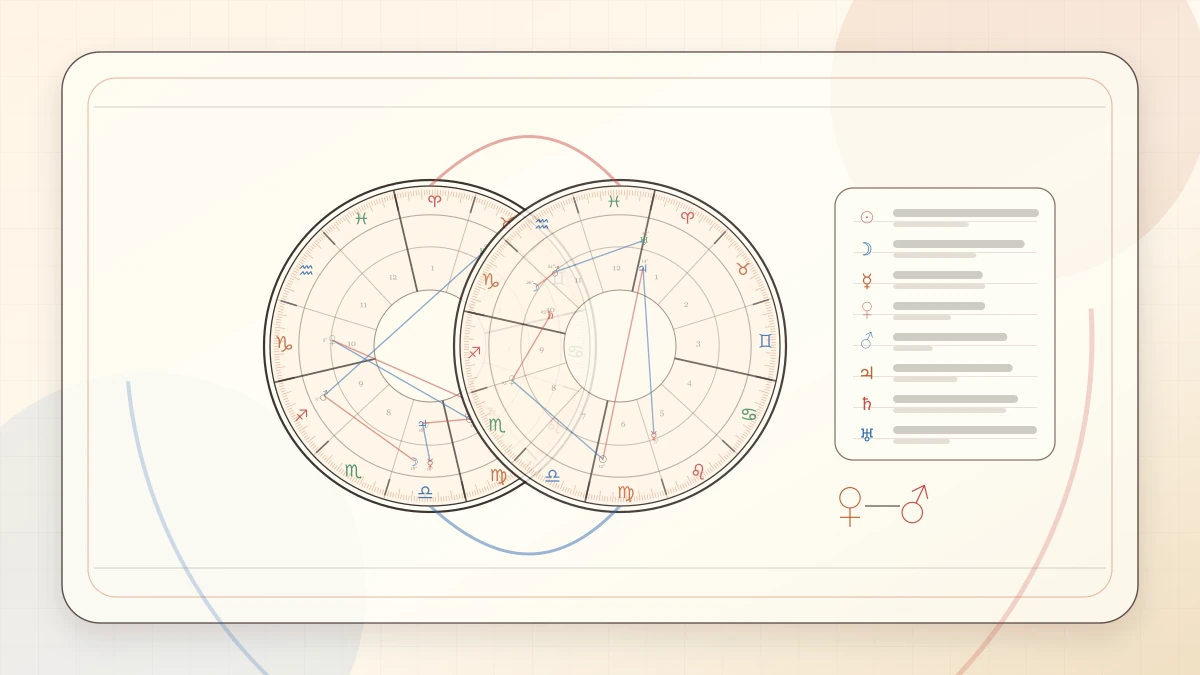
Comparing two birth charts means laying one person’s planets beside the other’s and noting where they meet. The usual technique is synastry: the aspects between the two sets of planets and the houses each person’s planets fall in. A composite chart, built from the midpoints between two people’s planets, is an optional extra and a symbolic one.
The method below works with a short list, not a pile of data, and is meant to be taken one step at a time. It is designed to end in questions rather than in a verdict.
The six steps in order
- Gather accurate data for both people and decide on one zodiac type and one house system.
- List the key contacts, using the Sun, Moon, Mercury, Venus, Mars and Saturn at first.
- Tighten the orbs and drop the loose contacts.
- Look for repeated themes: the same planet, house or sign showing up more than once.
- Check the house overlays in both directions.
- Add the composite chart last, as a summary of the pair.
Step one in detail: gathering accurate data
Most errors in chart comparison begin before any reading. Gather the same inputs for both people and note how reliable each one is.
| Input | Why it matters | If you do not have it |
|---|---|---|
| Birth date | Fixes the Sun, Mercury, Venus, Mars and the slower planets | Do not compare; the planets cannot be placed |
| Birth time | Sets the Ascendant and houses, and decides the Moon’s sign near a sign line | Leave out Rising signs, houses and overlays, and compare planets only |
| Birthplace | Sets the horizon, and therefore the Ascendant and houses | Mark any house or Rising result as approximate |
| Zodiac type | Tropical and sidereal place planets in different signs | Use the same type for both charts; tropical is more common in Western astrology |
| House system | Changes which house a planet falls in | Pick one, write it down and use it for both people |
Steps two to four: contacts, orbs and repeated themes
For each pair of planets, write down the angle between them and its distance from exact. Synastry orbs of about 3 to 5 degrees are common for personal planets, with no single official limit, so choose one and apply it to both people. A reasonable shorthand is tight within 2 degrees, moderate from 2 to 4 and loose beyond that.
Remember that an aspect can cross a sign line. A planet at 29° of one sign and another at 3° of the next are 4 degrees apart and still in a conjunction. Then look across the list for repeats. One contact is a detail; the same planet appearing in three contacts is a theme.
A one-page worksheet
Copy these lines onto a page and fill each one in. If a line has no answer, leave it blank instead of guessing.
- Names, birth dates, birth times (exact, rounded or unknown) and birthplaces.
- Zodiac type and house system used for both charts.
- Sun, Moon and Rising sign for each person, with Rising marked unconfirmed if the time is uncertain.
- Up to ten contacts, each written as A’s planet, angle, B’s planet and orb.
- Contacts within 2 degrees, marked tight.
- Planets or themes that appear in more than one contact.
- A’s planets in B’s houses, and B’s planets in A’s houses.
- Composite Sun, Moon and Venus signs, added last.
- Three questions for the two people to discuss.
- One sentence on what you would still check against real life.
A constructed comparison: Dana and Lee
Take two invented people, Dana and Lee. Dana’s Sun is at 20° Virgo, or 170 degrees, and Lee’s Moon is at 23° Capricorn, or 293. The gap is 123 degrees, 3 degrees from a trine. Dana’s Venus is at 2° Libra, or 182 degrees, and Lee’s Mars is at 25° Virgo, or 175. That is 7 degrees apart, too loose for a 5-degree orb, so we drop it.
Lee’s Mercury is at 12° Leo, which is 120 plus 12, or 132. Dana’s Moon is at 14° Scorpio, or 224 degrees, so Lee’s Mercury is 92 degrees from it, 2 degrees from a square. That contact is worth naming plainly: how Lee talks and how Dana feels. Only one contact touches Lee’s Mercury here, so it is a single prompt for conversation, not yet a repeated theme.
For overlays, suppose Lee has Cancer Rising. Whole-sign houses count Cancer 1, Leo 2, Virgo 3, Libra 4, Scorpio 5, so Dana’s Scorpio planets fall in Lee’s fifth house. For the composite, Dana’s Venus is at 182 degrees and Lee’s Venus at 24° Virgo is 174. The midpoint is 178, which is 28° Virgo. The summary is a trine of comfort, a square of talk against feeling, and questions about how each prefers to discuss feelings.
Common errors, and how to finish without a verdict
These mistakes account for most bad comparisons. Check your page against the list before you draw anything from it.
- Mixing tropical and sidereal positions between the two charts.
- Treating a guessed birth time as exact.
- Widening an orb to find a contact you hoped for.
- Counting easy and hard contacts to produce a score.
- Reading each contact alone instead of in repeated themes.
- Letting the composite chart override what the two charts show.
- Treating the result as a verdict on the couple.
Ending with questions, not a ruling
Finish by writing three questions that the two people could actually discuss, such as “How do we each like to be comforted?” Share the page, and let the two people say which lines fit. A chart comparison is a conversation starter, and the people have the last word.
Questions readers ask about comparing charts
What if one of us has no birth time? Compare the planets from the birth date alone, and leave out Rising signs, houses, overlays and the composite angles. The Moon is the one to check: it moves about 13 degrees a day, so if it sits near a sign line, either sign may be possible and you should mark it uncertain.
Do I include the outer planets? Uranus, Neptune and Pluto stay in a sign for years, so people born close together share them, and a contact between two outer planets says little about one particular pair. A contact from an outer planet to a personal planet, such as Pluto to a Moon, carries more specific information.
Can I use the same steps for a friend, a parent or a colleague? Yes. The method is a way of organizing questions about any two people, and the same cautions apply: choose one orb, mark uncertain data, and let the people involved say which lines fit.
What this does and does not establish
A comparison is a conversation starter, not a verdict, and mixing tropical and sidereal positions or guessing a birth time can create false contacts.
Related calculators
Use the matching tool when you want a direct chart or timing result after reading the guide.
Birth Chart Compatibility Calculator
Higher-trust compatibility report built from two verified natal charts and exact synastry analysis.
Synastry Chart Calculator
Compare two birth charts for relationship patterns, emotional rhythm, attraction, and communication themes.
Zodiac Compatibility Calculator
Broad sign-to-sign compatibility page tuned for lifestyle readers.
Calculation references
- Swiss Ephemeris: positions, angles and house-system conventions
Technical reference for calculation conventions. It does not certify an interpretation or mean every live tool uses this engine.
Related articles
Keep reading with nearby topics that deepen the same question from another angle.
Moon Sign Meaning in Love, Emotions, and Daily Life
Your Moon sign describes what you need to feel safe: your moods, instincts, habits and the kind of comfort that settles you, which shows most clearly at home and in close relationships.
6 min read
How to Read Your Birth Chart: A Beginner's Guide
Read your birth chart in five steps: find the Sun, Moon and Rising sign, count the elements, note crowded houses, locate the chart ruler, then read the two or three closest aspects.
6 min read
Zodiac Compatibility vs Synastry
Zodiac compatibility compares sign labels, usually Sun signs, while synastry compares the exact degrees of planets in two charts. Synastry is more specific but needs more precise birth details.
6 min read
Karmic Relationship Astrology, Explained Carefully
A karmic reading points to contacts such as the lunar nodes, Saturn, Pluto and Chiron and reads them as familiarity or repeated lessons. There is no evidence for past lives, and these contacts are very common.
6 min read
Keep exploring
Use the category page and the main hubs when you want the next layer of context.
Previous article
Zodiac Compatibility vs Synastry
Next article
Karmic Relationship Astrology, Explained Carefully