
Love Compatibility
Zodiac Compatibility vs Synastry
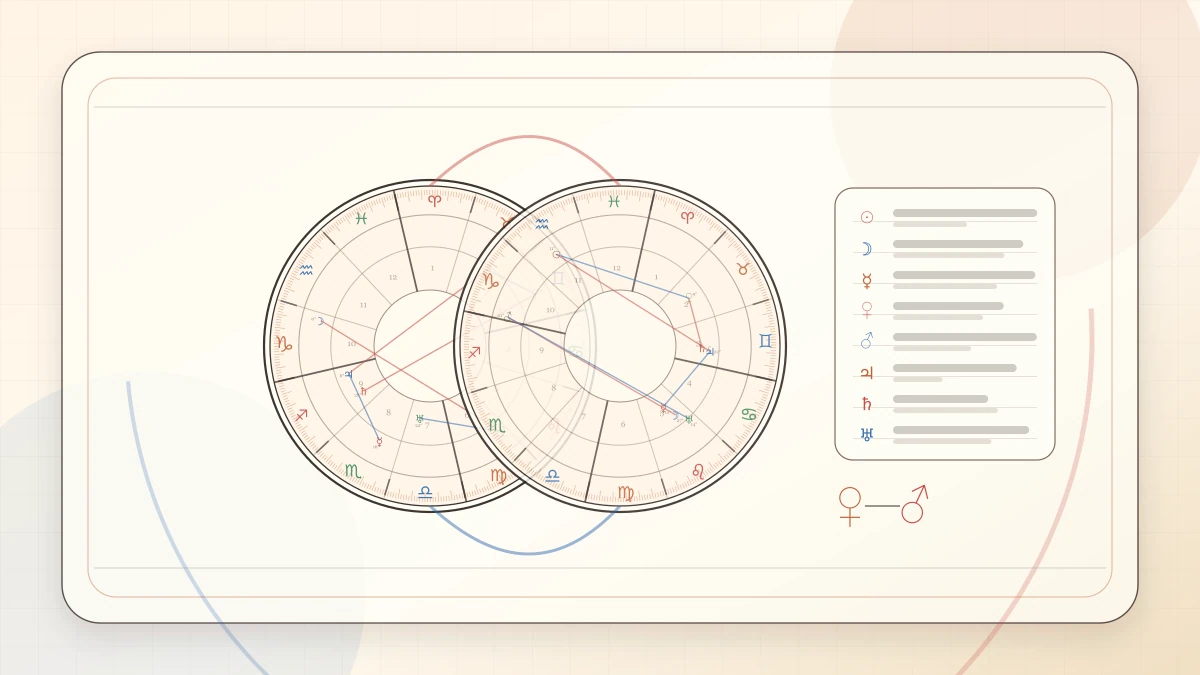
Zodiac compatibility compares sign labels, usually Sun signs, while synastry compares the exact degrees of planets in two charts. Synastry is more specific but needs more precise birth details.
Table of contents
- Example or practical exercise
- Two methods that share a vocabulary but not a precision
- The two methods side by side
- What sign matching actually compares
- What synastry adds: degrees, orbs and houses
- When your sign itself is uncertain
- What both methods share
- A sign match without a close aspect: a constructed example
- A close aspect between different elements: the reverse case
- Which method should you use?
- Common questions about signs versus synastry
- What this does and does not establish
Example or practical exercise
Kai's Moon at 2 Aries and Noor's Moon at 28 Leo look like a fire trine by sign, yet they sit 146 degrees apart, 26 degrees from an exact trine.
Two methods that share a vocabulary but not a precision
Zodiac compatibility and synastry both ask how two people might fit, and both use signs and planets. The difference is the resolution. Zodiac compatibility compares labels, usually the Sun signs of two people. Synastry compares exact positions, the degree of each planet in each chart, and sometimes where one person's planets fall in the other's houses.
It is a little like comparing postal districts with street addresses. A district tells you something about where two people are, and cannot tell you whether they live next door.
The two methods side by side
The table compares what each method needs and what it can and cannot do.
| Question | Zodiac compatibility | Synastry |
|---|---|---|
| What does it compare? | Signs, usually Sun signs | Exact degrees of planets, and optionally houses |
| What do you need? | Two birth dates | Two birth dates; birth times and places for houses and the angles |
| How precise is it? | To the nearest sign, thirty degrees wide | To the degree, with an orb |
| What does it use? | Element, modality, sign distance | Aspects between planets in the two charts |
| What does it miss? | Everything except one planet's sign | Behavior, intentions and consent |
What sign matching actually compares
Three things come out of two signs: the element each belongs to, the modality each belongs to, and how far apart the signs are. The distance gets a name based on the angle: sextile at 60 degrees (two signs apart), square at 90 (three apart), trine at 120 (four apart, always the same element) and opposition at 180 (six apart). The full table of distances, with the counting rule, is in our guide Zodiac Compatibility: How to Read Love Matches.
That is a respectable amount of structure, and it has one big limit. A Sun sign is one planet's position, and a person has ten or more. Matching Sun signs compares one placement from each chart and leaves the rest of both charts unread.
What synastry adds: degrees, orbs and houses
Synastry measures the angle between each planet in one chart and each planet in the other, then asks whether the angle matches an aspect within an orb, the allowed wiggle room. Orbs of 3 to 5 degrees are common for personal planets, though there is no official number.
It can also place one person's planets in the other's houses, which needs birth times. This brings in more of the chart, and also more room for over-reading. A busy synastry chart produces many contacts, and people can find a story in any set of them.
When your sign itself is uncertain
The Sun moves about 1 degree a day, so it changes sign at a particular moment, and that moment falls at a different clock time from year to year. Someone born on a sign-change day may need a birth time and place to learn which sign the Sun was in. Sign matching with only a date can therefore be wrong for people born near the boundary.
Synastry does not escape this, since the Moon changes sign about every 2.3 days and the Rising sign about every two hours. The more precise the method, the more precise the birth details it asks for.
A sign match without a close aspect: a constructed example
Kai has the Moon at 2 degrees Aries, which is 2 degrees on the wheel. Noor has the Moon at 28 degrees Leo, which is 120 + 28 = 148 degrees. Both are fire signs, and the signs are four apart, a trine by sign. The angle between the two Moons is 148 - 2 = 146 degrees.
A trine is 120 degrees, so 146 is 26 degrees away from it, far outside any usual orb. By degrees there is no close aspect between those Moons, although by sign they look like a match. The sign method says yes and synastry says no major aspect, because they measure different things.
A close aspect between different elements: the reverse case
Now take Venus in Gemini and Mars in Cancer. Quinn's Venus is at 29 degrees Gemini, which is 60 + 29 = 89 degrees. Sage's Mars is at 1 degree Cancer, which is 90 + 1 = 91 degrees. The gap is only 2 degrees, a conjunction.
Gemini is an air sign and Cancer a water sign, so a sign-level match might call them unrelated. Their planets are nearly on the same spot, so an astrologer reading synastry would flag the contact. Whether it matters is a question for the two people, and the degrees only raise it.
Astrologers call a contact like this an out-of-sign, or dissociate, aspect, and they differ on how much weight it deserves, since the two planets sit in signs that do not have the aspect’s usual relationship; here they are neighbors that share neither element nor modality. Whichever view you take, the two cases in this guide give a simple habit for any comparison: find the degrees first, then read the signs, and say which method a conclusion rests on.
Which method should you use?
It depends on what you have and what you want to ask.
- If you only have a birth date for each person, use sign matching and call it that. Do not present a sign-only match as a comparison of full birth charts.
- If you have both birth times and places, synastry lets you ask finer questions about specific planets.
- If you want a single answer to whether a couple will last, neither method provides it.
- Whichever you choose, treat results as prompts for a conversation and compare them with how the two of you behave.
Common questions about signs versus synastry
Is synastry more accurate? It is more specific, which is not the same as more validated. Neither method has good evidence as a predictor of relationship outcomes, and both are best used for reflection.
Why do the two sometimes disagree? They measure different things, so a pair can look close by sign and distant by degree, or the other way around.
Where should I begin? Start with the placements that matter most to you, such as the Moon for emotional comfort or Venus for affection, and read those in both charts.
What this does and does not establish
Neither method has good evidence as a predictor of relationship outcomes, and neither can observe how two people actually treat each other.
Related calculators
Use the matching tool when you want a direct chart or timing result after reading the guide.
Birth Chart Compatibility Calculator
Higher-trust compatibility report built from two verified natal charts and exact synastry analysis.
Synastry Chart Calculator
Compare two birth charts for relationship patterns, emotional rhythm, attraction, and communication themes.
Zodiac Compatibility Calculator
Broad sign-to-sign compatibility page tuned for lifestyle readers.
Calculation references
- Swiss Ephemeris: positions, angles and house-system conventions
Technical reference for calculation conventions. It does not certify an interpretation or mean every live tool uses this engine.
Related articles
Keep reading with nearby topics that deepen the same question from another angle.
Moon Sign Meaning in Love, Emotions, and Daily Life
Your Moon sign describes what you need to feel safe: your moods, instincts, habits and the kind of comfort that settles you, which shows most clearly at home and in close relationships.
6 min read
How to Read Your Birth Chart: A Beginner's Guide
Read your birth chart in five steps: find the Sun, Moon and Rising sign, count the elements, note crowded houses, locate the chart ruler, then read the two or three closest aspects.
6 min read
Friendship Compatibility in Astrology
Friendship compatibility in astrology looks at Sun, Moon, Mercury, Venus and Jupiter contacts and the eleventh house, asking about respect, comfort, conversation and encouragement rather than romance.
6 min read
How to Compare Two Birth Charts
To compare two birth charts, gather accurate data, use one zodiac and one house system for both, list close contacts, look for repeated themes and check overlays both ways.
6 min read
Keep exploring
Use the category page and the main hubs when you want the next layer of context.
Previous article
Friendship Compatibility in Astrology
Next article
How to Compare Two Birth Charts