
Timing Guides
Lunar Return Guide for Monthly Themes
A lunar return is the moment the Moon comes back to its exact birth degree, about every 27.3 days, and astrologers read a chart for that moment as a theme for the month ahead.
Table of contents
- Example or practical exercise
- What a lunar return is
- How a lunar return differs from a new Moon and a solar return
- How to find and cast your lunar return
- How to read the lunar return Moon’s house and sign
- A constructed example with real arithmetic
- Aspects, angles and the return Rising sign
- Why a lunar return is not a monthly horoscope
- A monthly reflection routine
- How the same Moon lands in a different house each month
- Questions readers ask about lunar returns
- What this does and does not establish
Example or practical exercise
With natal Moon at 12 degrees Capricorn and a first return on Day 1 at 6:00 a.m., the next falls on Day 28 at about 1:12 p.m.; with Taurus rising, the Moon sits in the 9th house.
What a lunar return is
A lunar return is the moment the Moon comes back to the exact zodiac degree it held at your birth. It takes about 27.3 days, so you have about 13 each year (365 divided by 27.3 is a little over 13). A chart cast for that moment is read for the month ahead.
It is a personal technique. The Moon always returns to your natal sign, but the house, the Rising sign and the aspects in the chart change each time, and those are what astrologers read.
How a lunar return differs from a new Moon and a solar return
Three cycles are often confused. The table separates them.
| Feature | Lunar return | New Moon | Solar return |
|---|---|---|---|
| What recurs | Moon at its natal degree | Moon meets the Sun | Sun at its natal degree |
| Interval | About 27.3 days | About 29.5 days | About a year |
| Same for everyone? | No, personal | Yes, shared | No, personal |
| Moon phase at that moment | Any phase | Always new | Any phase |
| Read for | The next month | A fresh cycle | The year ahead |
How to find and cast your lunar return
A lunar return depends on your natal Moon degree, so birth time matters. The Moon moves about 0.55 degrees an hour, so an hour of error in birth time moves the return moment by about an hour.
- Get your natal Moon’s sign, degree and minute from the birth chart calculator on this site.
- Choose the month you want to read and find the moment the transiting Moon reaches that degree.
- Cast a chart for that moment.
- Pick a location. Astrologers disagree: some use the birthplace, others where you are living at the time. Choose one and keep to it.
- Read the Moon’s house, the Rising sign and the aspects to the Moon.
How to read the lunar return Moon’s house and sign
The Moon’s sign is always your natal sign, so it sets a familiar tone. The house is new each time and says where the month’s attention tends to gather. Whole-sign houses are used here, counting signs from the return chart’s Rising sign.
| Group | Houses | Typical tone |
|---|---|---|
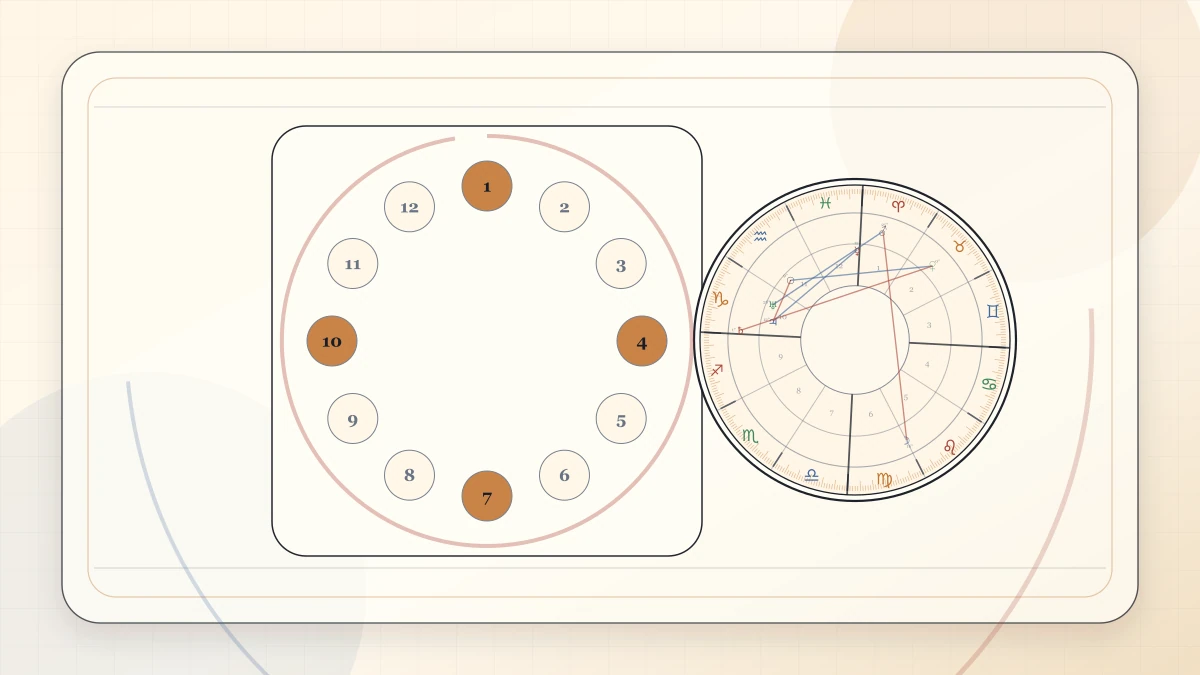
| Angular | 1, 4, 7, 10 | Visible and active: self, home, partners, work |
| Succedent | 2, 5, 8, 11 | Building and valuing: resources, pleasure, shared matters, hopes |
| Cadent | 3, 6, 9, 12 | Adjusting and learning: talk, routines, study, rest |
A constructed example with real arithmetic
This person is made up. Natal Moon is at 12 degrees of Capricorn, which is 282 degrees (270 plus 12). Say the transiting Moon reaches that degree on Day 1 at 6:00 a.m. The next return is 27.3 days later: 27 days takes us to Day 28 at 6:00 a.m., and 0.3 day is 7.2 hours, so Day 28 at about 1:12 p.m. The one after lands on Day 55 at about 8:24 p.m.
Notice how each return slips later in the clock and does not match a calendar month. Suppose the Rising sign of that first chart is Taurus. In whole-sign houses, Capricorn is then the 9th, so the Moon sits in the house of learning, beliefs and far horizons: a month that may ask what you want to study or understand.
Aspects, angles and the return Rising sign
After the Moon’s house, look at what touches it. A conjunction, square, opposition, trine or sextile from another planet in the return chart colors the month. Orbs vary by astrologer; some use about 3 to 5 degrees for the Moon in a return chart, and there is no official figure.
The return Rising sign sets the house layout, so it shifts every month. Planets close to one of the four angles are said to be more noticeable. Compare the return chart with your birth chart, too: a return planet landing on a natal point repeats an old theme in a new setting.
Why a lunar return is not a monthly horoscope
A calendar-month horoscope is written for everyone with a given Sun sign. A lunar return is built from your own Moon and a specific moment and place. It also starts and ends at the return times, so one return may span the end of one calendar month and the start of the next.
Treat it as a lens for the weeks ahead and not a schedule of events. It cannot know what will happen, and an inaccurate birth time can move the return moment by hours.
A monthly reflection routine
This is a planning habit. The Moon does not change outcomes, and a return chart cannot predict every event before the next one. The value is a regular pause.
- Note the return Moon’s house and its closest aspects.
- Write the house’s subject in one line, such as “learning and beliefs.”
- List two things you want to attend to and one thing to leave alone.
- Midway through the month, reread your notes and adjust.
- At the next return, compare what you planned with what actually happened.
How the same Moon lands in a different house each month
The return Moon is always in your natal sign, but the Rising sign of the return chart changes with the time of day and the place. This table keeps the natal Moon in Capricorn, as in the example above, and lets the Rising sign vary. It uses whole-sign houses: count from the Rising sign as 1 up to Capricorn.
| Rising sign | House of the Moon | Area the house names |
|---|---|---|
| Aries | 10th | Work and public role |
| Taurus | 9th | Learning, belief and distance |
| Gemini | 8th | Shared matters and change |
| Cancer | 7th | Partnership |
| Leo | 6th | Routines and daily work |
| Virgo | 5th | Pleasure and creativity |
| Libra | 4th | Home and family |
| Scorpio | 3rd | Everyday talk and errands |
| Sagittarius | 2nd | Resources and values |
| Capricorn | 1st | Self and presentation |
| Aquarius | 12th | Rest and the hidden |
| Pisces | 11th | Friends and hopes |
Questions readers ask about lunar returns
Can I find a lunar return without my birth time? Only roughly. The Moon moves about 13 degrees a day, so a natal Moon placed at noon can be off by up to about 6 degrees either way, which moves the return by up to about 12 hours. In 12 hours the Rising sign changes to roughly the opposite one, so the houses become unreliable.
Does the phase of the return Moon matter? Some astrologers add it as another layer, reading a waxing Moon as building and a waning one as releasing. Others leave it out. Neither habit is standard, so pick one and say which.
What this does and does not establish
A return chart is a lens for the weeks ahead, not a schedule of events, and an inaccurate birth time can move the return by hours.
Related calculators
Use the matching tool when you want a direct chart or timing result after reading the guide.
Current Transits Calculator
Exact current-sky snapshot for a selected city, built for repeat-use daily astrology readers.
Solar Return Calculator
Exact birthday-year return chart for a selected city and one verified natal chart.
Transit Opportunity Themes
Explore seven chronological local-noon samples and their computed sky contacts. Opportunity themes are interpretations; these samples do not establish a best day.
Calculation references
- Swiss Ephemeris: positions, angles and house-system conventions
Technical reference for calculation conventions. It does not certify an interpretation or mean every live tool uses this engine.
Related articles
Keep reading with nearby topics that deepen the same question from another angle.
How to Read Current Transits Without Overreacting to Every Aspect
Choose your question first, list the slow-planet contacts within a tight orb, then add fast ones only for timing. A Saturn contact lasting months outweighs a Moon contact lasting hours.
6 min read
Moon Phases Explained for Beginners
Moon phases show how much of the Moon's sunlit half we can see as it circles Earth. One 29.5-day cycle splits into eight phases of about 3.7 days, each starting at a multiple of 45 degrees.
6 min read
Solar Return Chart Guide: How to Read the Year Without Overpredicting It
A solar return chart is cast for the moment the Sun returns to its exact birth position, once a year near your birthday, and read as a yearly theme for planning rather than a forecast of events.
6 min read
Eclipses and Yearly Timing: A Practical Guide
Eclipses come in seasons about 173 days apart, with four to seven a year; list each from an almanac, then treat visibility and any chart contact as separate questions from the event itself.
6 min read
Keep exploring
Use the category page and the main hubs when you want the next layer of context.
Previous article
Solar Return Chart Guide: How to Read the Year Without Overpredicting It
Next article
Eclipses and Yearly Timing: A Practical Guide