
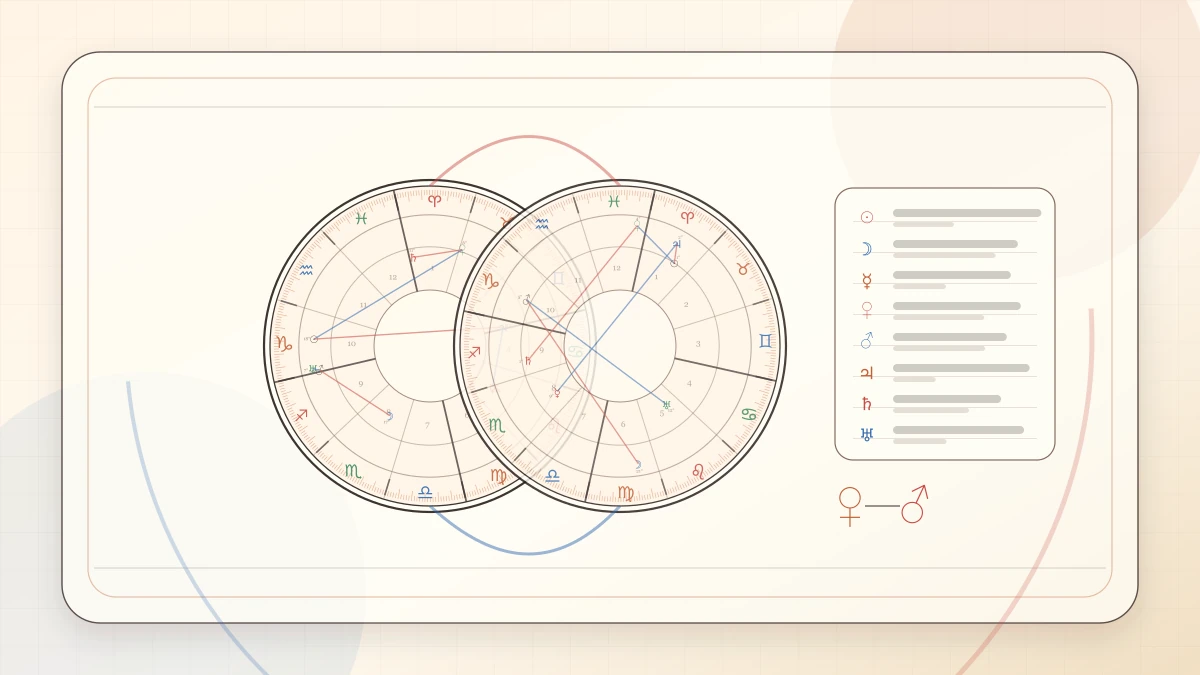
Love Compatibility
Marriage Indicators in Astrology: A Careful Guide
Marriage indicators are chart features read as being about partnership, mainly the seventh house, its ruler and Venus. They are places to look, and schools weight them differently.
Table of contents
- Example or practical exercise
- What a marriage indicator is, and what it is not
- The traditional places astrologers look
- How to find your seventh house and its ruler
- A constructed chart, read as questions
- Traditional, modern and Vedic approaches are not the same
- Why a chart cannot say whether or when you will marry
- What a chart can discuss and what it cannot settle
- Questions worth asking yourself, with or without a chart
- Common questions about marriage and astrology
- What this does and does not establish
Example or practical exercise
In a constructed chart with Sagittarius rising, the seventh-house ruler Mercury at 20 Virgo conjoins Venus at 17 Virgo in the tenth house, prompting questions about partnership and public role.
What a marriage indicator is, and what it is not
A marriage indicator is a chart feature that an astrologer reads as being about partnership and commitment. The word sounds stronger than the practice deserves. In most traditions it means a place to look, not a sign that something will happen. This guide describes the places to look, who uses which, and why none of them can tell you whether, when or whom anyone will marry.
Marriage is also a legal and cultural arrangement, and its rules and customs differ from country to country and from family to family. A chart can describe themes of partnership. It has no say in a legal status, a ceremony or a family’s expectations, and for anything with legal consequences a qualified professional is the right person to ask.
The traditional places astrologers look
Schools weight these differently, so a careful reading says which ones it uses. The list below is a common core, not a single official method.
| Indicator | What is examined | Why it is used |
|---|---|---|
| Seventh house | The sign on its cusp and any planets inside it | The house traditionally given to one-to-one partnership, opposite the first house, which is you |
| Ruler of the seventh | That planet’s sign, house and aspects | It is read as the narrator of the house, showing where partnership meets other life areas |
| Venus | Its sign, house and aspects | The planet of affection and agreement, read as a relationship signature in most traditions |
| Jupiter | Its sign, house and aspects | The planet of generosity and growth; some older texts give it a spouse role that depends on the chart owner’s gender, an assumption many modern astrologers drop |
| Sun and Moon | Their signs and the angle between them | A symbolic pair of purpose and need, read for what a person looks for in a bond |
| Descendant | The degree on the western horizon | It opens the seventh house in most house systems |
How to find your seventh house and its ruler
You need a birth time for this, because the Rising sign depends on it. Then follow the steps in order.
- Find your Rising sign in a birth chart calculator.
- Count six signs forward from it. That sign marks the seventh house. Whole-sign and quadrant systems agree on this sign, because the Descendant sits exactly opposite the Ascendant, though they can disagree about which planets fall inside the house.
- Look up the traditional ruler of that sign and say whether you used a traditional or a modern ruler.
- Find the ruler’s sign and house in your chart.
- List the ruler’s aspects within an orb you choose in advance, such as six degrees.
- Repeat the sign, house and aspect check for Venus, and write each finding as a theme or a question, never as an outcome.
A constructed chart, read as questions
Take a constructed chart with Sagittarius rising. Counting whole-sign houses, Capricorn is second, Aquarius third, Pisces fourth, Aries fifth, Taurus sixth and Gemini seventh. Gemini’s ruler is Mercury. Suppose Mercury sits at 20 degrees Virgo, which is 150 + 20 = 170 degrees, in the tenth house, and Venus sits at 17 degrees Virgo, which is 150 + 17 = 167 degrees, also in the tenth.
The gap is 170 - 167 = 3 degrees, a conjunction with an orb of 3. A reader would not say this chart marries. They would ask how partnership connects to public role, since the ruler of the seventh sits in the tenth, and how closely conversation and affection are tied together there. That is a description to discuss, not a marriage certificate.
Traditional, modern and Vedic approaches are not the same
Traditional Western astrology leans on the seventh house, its ruler and Venus. Some ancient texts also use calculated points called lots, including one named for marriage, but authors disagree on the formulas, so none is given here.
Modern astrology mostly reads relationship themes. It adds the asteroid Juno, named for the Roman goddess of marriage, and often turns to synastry, the comparison of two charts. Both are secondary symbols that many astrologers skip, and a chart program or ephemeris that includes them is needed.
Vedic astrology uses the sidereal zodiac, so its sign positions differ from the tropical ones usually used in Western charts. It has its own marriage method, including a divisional chart called the navamsa and a system of timing periods. It is a separate craft and is not covered here.
Why a chart cannot say whether or when you will marry
Astrologers do use timing techniques, such as transits to the seventh ruler or a solar return chart for the year, and some people find them meaningful. But there is no good evidence that any of these indicators predicts marriage, and a flexible technique can be matched to nearly any year after the fact.
People marry under every kind of chart and many do not marry at all, for reasons that include money, health, laws, faith, family and choice.
What a chart can discuss and what it cannot settle
A fair reading keeps these two columns separate.
| A chart can offer | A chart cannot settle |
|---|---|
| Vocabulary for how you approach commitment | Whether you will ever marry |
| Questions about what you need from a partner | When, or to whom |
| Topics two people may want to talk through | Whether a marriage will last or be happy |
| A reason to notice your own assumptions | Legal, cultural, family or financial arrangements |
Questions worth asking yourself, with or without a chart
Whatever indicators you read, the useful work is usually in the answers you write yourself. Try these on paper first, and stop and talk with someone you trust if any of them is painful.
- What does commitment look like on an ordinary day, in actions rather than words?
- How do I want decisions made when we disagree?
- What do I expect about household work, family and where we live, and have I said it aloud?
- Which of my expectations come from my family or culture, and which are mine?
Common questions about marriage and astrology
Does an empty seventh house mean I will not marry? No. With about ten planets spread over twelve houses, several houses are empty in most charts, and an empty house is read through its ruler. It says nothing about whether you will have a partner or marry.
Does Saturn in the seventh house mean a late or difficult marriage? Tradition ties Saturn to seriousness and caution, and that is a theme, not a forecast. Some astrologers read Saturn there as a careful approach to commitment and Venus there as an easier one, but neither reading is a forecast about any person.
Can two charts show whether a couple should marry? They can show topics, such as how each person handles closeness, and nothing more. If something between you hurts, a chart is not the place to settle it. Behavior, consent and respect outrank any contact, and the decision belongs to the two people.
Do these ideas apply to same-sex or unmarried partners? Yes. The seventh house concerns partnership in general, and its themes do not depend on legal status or gender.
What this does and does not establish
There is no good evidence that any indicator predicts whether, when or whom anyone will marry, and legal questions belong with a qualified professional.
Related calculators
Use the matching tool when you want a direct chart or timing result after reading the guide.
Birth Chart Compatibility Calculator
Higher-trust compatibility report built from two verified natal charts and exact synastry analysis.
Synastry Chart Calculator
Compare two birth charts for relationship patterns, emotional rhythm, attraction, and communication themes.
Zodiac Compatibility Calculator
Broad sign-to-sign compatibility page tuned for lifestyle readers.
Calculation references
- Swiss Ephemeris: positions, angles and house-system conventions
Technical reference for calculation conventions. It does not certify an interpretation or mean every live tool uses this engine.
Related articles
Keep reading with nearby topics that deepen the same question from another angle.
Moon Sign Meaning in Love, Emotions, and Daily Life
Your Moon sign describes what you need to feel safe: your moods, instincts, habits and the kind of comfort that settles you, which shows most clearly at home and in close relationships.
6 min read
How to Read Your Birth Chart: A Beginner's Guide
Read your birth chart in five steps: find the Sun, Moon and Rising sign, count the elements, note crowded houses, locate the chart ruler, then read the two or three closest aspects.
6 min read
Breakup Transits and Relationship Reflection
After a breakup, a transit can serve as a symbolic prompt for reflection, but it never explains why a relationship ended or what another person felt or chose.
6 min read
Twin Flame vs Soulmate Astrology, Carefully Explained
Soulmate comes from Greek myth and Romantic love, and twin flame from modern popular spirituality. Neither term comes from astrology, and no chart can show who either person is.
6 min read
Keep exploring
Use the category page and the main hubs when you want the next layer of context.
Previous article
Breakup Transits and Relationship Reflection
Next article
Twin Flame vs Soulmate Astrology, Carefully Explained