
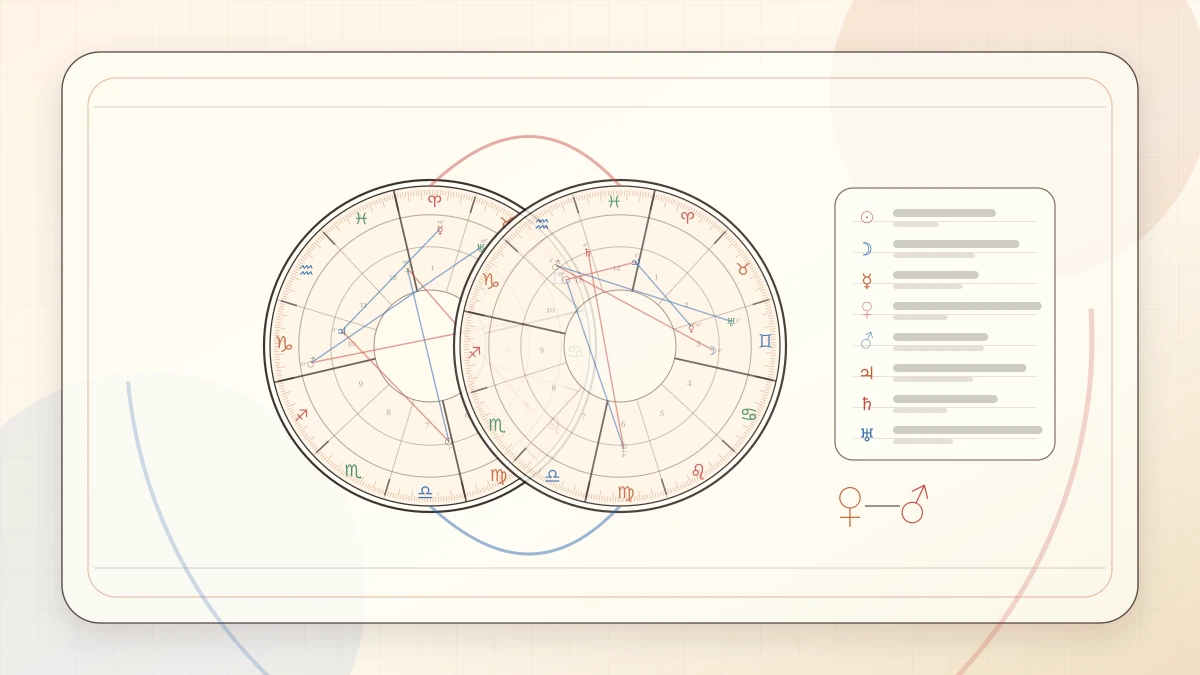
Love Compatibility
Twin Flame vs Soulmate Astrology, Carefully Explained
Soulmate comes from Greek myth and Romantic love, and twin flame from modern popular spirituality. Neither term comes from astrology, and no chart can show who either person is.
Table of contents
- Example or practical exercise
- Where the soulmate idea comes from
- Soulmate, twin flame and karmic: what each word claims
- What astrology itself says about partners
- What the evidence does and does not support
- Why the labels appeal, and what they leave out
- How to translate a label into plain words
- What the translation gives Dana
- Why an intense bond is not the same as a healthy one
- Common questions about twin flames and soulmates
- What this does and does not establish
Example or practical exercise
Dana calls a man she met ten weeks ago her twin flame, then counts four canceled plans out of fourteen and turns the label into two questions she can discuss with him.
Where the soulmate idea comes from
The oldest source people cite is a speech in Plato’s Symposium, written in ancient Greece. A comic playwright in the dialogue says that humans were once round creatures with four arms and four legs, were split in two, and have searched for their missing half ever since. It is a myth told at a dinner party, and Plato treats it as one voice among several, not as a doctrine.
The English word “soulmate” is much younger. It appears in print by the early nineteenth century and grew popular alongside the Romantic idea that one person can complete another. “Twin flame” is newer still. It belongs to modern popular spirituality, spread through books and then widely through social media, and it usually claims that one soul is divided between two bodies. Neither phrase comes from astronomy, and neither comes from the working vocabulary of traditional astrology.
Soulmate, twin flame and karmic: what each word claims
These labels are often used as if they were interchangeable, and they are not. The table sets out what each one claims in popular use, where it comes from and whether a chart can show it.
| Label | Popular claim | Where it comes from | Can a chart show it? |
|---|---|---|---|
| Soulmate | A person you are deeply suited to, sometimes said to be destined | Greek myth, Romantic love and modern spirituality | No. Astrology compares charts but cannot name a destined partner. |
| Twin flame | One soul split across two bodies, a single mirror-like partner | Modern popular spirituality, spread online | No. There is no method and no evidence. |
| Karmic relationship | A bond said to repeat lessons from earlier lives | A loose borrowing of the Sanskrit word karma, meaning action, which in Hindu, Buddhist and Jain thought concerns actions and their consequences | No. A chart shows contacts, not past lives. |
| Kindred spirit | Someone who feels quickly familiar | Everyday speech | The feeling is real; the explanation is usually ordinary. |
What astrology itself says about partners
Older relationship astrology looked at the seventh house of partnership, its ruler, Venus, Mars, the Moon and the Sun. Modern astrologers added synastry, the comparison of two charts, and composite charts. These are ways of describing a pair’s themes. None was built to identify a destined or paired soul, and the soulmate and twin flame vocabulary entered astrology later, from outside it.
Some modern astrologers do use the language of nodes and karma. When a reading says “twin flame,” though, the phrase is the reader’s overlay and not something the planets contain. A chart cannot show who your twin flame or soulmate is.
What the evidence does and does not support
There is no scientific evidence for twin flames or for fated partners, and there is no test by which a chart could show them. Belief in rebirth is part of several religious traditions, and nothing here is meant to dispute it; the point is only that a chart contains no way to show who someone was before. Astronomy describes where the planets are. Astrology is an interpretive tradition that attaches symbolic meanings to those positions. Anyone who tells you with certainty that a particular person is your twin flame is stating a belief, not a finding.
Ordinary explanations are more down to earth. People tend to bond with those they meet repeatedly (familiarity), who resemble them in values and humor (similarity), and who respond warmly when they speak (responsiveness). Those forces can produce a powerful sense of recognition without any cosmic explanation.
Why the labels appeal, and what they leave out
A label gives a feeling a shape. After a connection that startles you, “soulmate” explains why it felt so strong, and it turns an uncertain situation into a story with meaning. That comfort is real, and nothing here asks you to give up a belief that matters to you.
The cost is what the story leaves out. A destiny story has no place for an ordinary question like whether this person returns your messages, and it can make effort look like fate and trouble look like a test.
How to translate a label into plain words
Here is a constructed example. Dana, who is not a real person, tells a friend that a man she met ten weeks ago is her twin flame. Asked what she means, she names three things: she felt known at once, conversation never runs out, and he sometimes goes quiet for days. Her steps could look like this.
- Say what the word means to you in one plain sentence, such as “I felt understood very quickly.”
- List what he has actually done, apart from how it felt.
- Count it. In ten weeks Dana can count four canceled plans out of fourteen, which is 4 divided by 14, or a little under 30 percent.
- Mark which parts of the label describe feelings and which describe conduct.
- Ask a friend who knows you well what they have noticed.
What the translation gives Dana
Dana’s list proves nothing either way. It turns “twin flame” into two questions she can work with: why do the quiet stretches feel so charged, and what would she like him to do about them? That is more useful than a label, and it can be discussed with him directly.
Why an intense bond is not the same as a healthy one
A very intense start, a sense of having known someone before, or a pattern of parting and reuniting can all be taken as proof of a unique, fated bond. That story can keep a person in a relationship that is hurting them, because leaving starts to feel like betraying destiny.
A label describes a feeling; it cannot vouch for anyone’s conduct. What shows whether a bond is good for you is how the person acts over months: gentle when it is inconvenient, steady from week to week, truthful, accepting of your no and careful to ask before assuming. If you are frightened, controlled or hurt, your safety comes before any word for the bond, so reach out to someone you trust or a local support service. Destiny never obliges anyone to stay. A simple log for testing the feeling against events is in our guide What Makes a Relationship Feel Karmic in Astrology.
Common questions about twin flames and soulmates
Can astrology tell me who my soulmate is? No. It can compare two charts and offer themes to discuss, but it has no method for identifying a destined person, and no evidence that one exists.
Is a twin flame different from a soulmate? In popular writing, a soulmate is usually someone deeply suited to you, while a twin flame is said to be one soul split in two. Writers define them differently, so ask what a particular person means.
What are “runner” and “chaser”? These are informal labels from online communities for two people in an on-and-off pattern. They are not astrological terms, and they work best as a prompt to look at behavior rather than a role to accept.
Can I enjoy these ideas and still use astrology sensibly? Yes. Hold them as stories, and check them against how you are actually treated.
What this does and does not establish
An intense bond is not proof of a healthy one, destiny never obliges anyone to stay, and if you feel frightened or controlled, reach out to someone you trust.
Related calculators
Use the matching tool when you want a direct chart or timing result after reading the guide.
Birth Chart Compatibility Calculator
Higher-trust compatibility report built from two verified natal charts and exact synastry analysis.
Synastry Chart Calculator
Compare two birth charts for relationship patterns, emotional rhythm, attraction, and communication themes.
Zodiac Compatibility Calculator
Broad sign-to-sign compatibility page tuned for lifestyle readers.
Calculation references
- Swiss Ephemeris: positions, angles and house-system conventions
Technical reference for calculation conventions. It does not certify an interpretation or mean every live tool uses this engine.
Related articles
Keep reading with nearby topics that deepen the same question from another angle.
Moon Sign Meaning in Love, Emotions, and Daily Life
Your Moon sign describes what you need to feel safe: your moods, instincts, habits and the kind of comfort that settles you, which shows most clearly at home and in close relationships.
6 min read
How to Read Your Birth Chart: A Beginner's Guide
Read your birth chart in five steps: find the Sun, Moon and Rising sign, count the elements, note crowded houses, locate the chart ruler, then read the two or three closest aspects.
6 min read
Marriage Indicators in Astrology: A Careful Guide
Marriage indicators are chart features read as being about partnership, mainly the seventh house, its ruler and Venus. They are places to look, and schools weight them differently.
6 min read
Can Astrology Help With Relationship Timing?
Astrology cannot tell you when you will meet someone or when a talk will go well. It can offer a symbolic calendar and prompts that help you notice your own readiness.
6 min read
Keep exploring
Use the category page and the main hubs when you want the next layer of context.
Previous article
Marriage Indicators in Astrology: A Careful Guide
Next article
Can Astrology Help With Relationship Timing?