
Houses, Aspects, and Planets
Moon Meaning in Astrology
The Moon describes needs, habits and comfort: the foods, rhythms, places and company that feel familiar. Astrologers say it shows most clearly when you are tired, stressed or at home.
Table of contents
- Example or practical exercise
- What your Moon asks for when you are tired
- How the Moon is found and why the birth time matters
- Your birth Moon phase: how far ahead of the Sun the Moon is
- The Moon in each sign and what comfort tends to look like
- The Moon in the houses, read as six pairs
- Common Moon aspects, and an overworked versus underworked Moon
- A constructed chart: Rowan’s birth Moon phase
- A week of Moon notes
- What this does and does not establish
Example or practical exercise
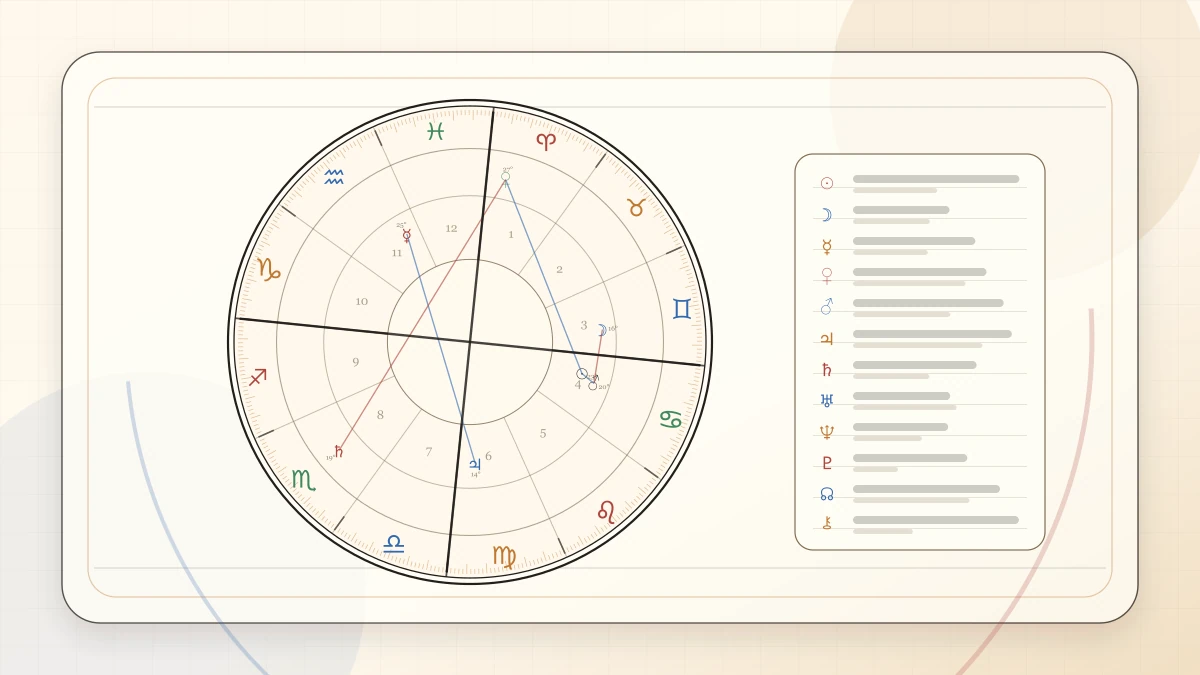
Rowan's Moon at 10 degrees Gemini is 75 degrees ahead of his Sun at 25 degrees Pisces, an early waxing birth phase, and 62 degrees from his Venus at 8 degrees Aries, a sextile.
What your Moon asks for when you are tired
The Moon is the part of a chart tied to needs, habits and comfort. Astrologers read it as what feels familiar: the foods, rhythms, surroundings and kinds of company you move toward without deciding to. Because astrologers see it as a reaction that comes before thought, they say it shows up most clearly when you are tired, stressed or at home.
Traditionally the Moon is linked to home, family, memory and the body’s daily rhythms. Read these as themes to reflect on. A Moon placement does not diagnose a feeling, a habit or a way of attaching to people.
How the Moon is found and why the birth time matters
The Moon is the fastest body in the chart. It moves about 13 degrees a day, spends about 2.3 days in each sign on average and circles the whole zodiac in about 27.3 days. The cycle of phases takes longer, about 29.5 days from new Moon to new Moon, because the Sun has moved on in the meantime and the Moon needs roughly two extra days to catch up with it.
That speed is why a birth date does not always settle the Moon sign. On the day the Moon crosses a sign line, the birth time decides which sign applies. The Moon, like the Sun, never turns retrograde.
Your birth Moon phase: how far ahead of the Sun the Moon is
To find the phase you were born under, subtract the Sun’s position along the zodiac from the Moon’s, and add 360 if the answer is negative. A result of 90 is a first quarter Moon and 180 is a full Moon. Reading the phase as a style of emotional pace is a modern idea, not an ancient rule.
| Moon ahead of the Sun by | Stage | Traditional flavor |
|---|---|---|
| 0 to 90 degrees | New Moon to first quarter | Feelings are fresh and still forming; a pull toward beginnings |
| 90 to 180 degrees | First quarter to full Moon | Building and adjusting toward a visible result |
| 180 to 270 degrees | Full Moon to last quarter | Sharing and making sense of what has come into view |
| 270 to 360 degrees | Last quarter to new Moon | Releasing, resting and preparing a fresh start |
The Moon in each sign and what comfort tends to look like
In the traditional dignity system the Moon is at home in Cancer, exalted in Taurus, in detriment in Capricorn and in fall in Scorpio. Those labels describe how readily the Moon is thought to express itself, not how well anyone copes, and many modern astrologers give them less weight.
| Moon sign | Dignity | What comfort tends to look like |
|---|---|---|
| Aries | None | Movement, directness and a chance to act on a feeling |
| Taurus | Exalted | Physical ease, steady routines and pleasant surroundings |
| Gemini | None | Talking it over, variety and a change of scene |
| Cancer | At home | A sheltered space and people who feel like family |
| Leo | None | Warmth, appreciation and room to play |
| Virgo | None | Order, useful tasks and tidying what can be tidied |
| Libra | None | Harmony, company and a sense of fairness |
| Scorpio | Fall | Privacy, depth and being trusted with the real story |
| Sagittarius | None | Fresh air, humor and a wider view |
| Capricorn | Detriment | Competence and structure; feelings may come out late |
| Aquarius | None | Space, friends and room to think before sharing |
| Pisces | None | Quiet, music or art, and time to let feelings drift |
The Moon in the houses, read as six pairs
The house of your Moon shows where you look for security. Houses sit in opposite pairs, so each pair below describes one need seen from two sides.
- Houses 1 and 7: feeling settled in yourself, or settled through one-to-one company.
- Houses 2 and 8: comfort in what you own and keep, or in what you share and trust to others.
- Houses 3 and 9: security in familiar talk and routes, or in a bigger picture and belief.
- Houses 4 and 10: a private base versus a visible role; which one feels like home.
- Houses 5 and 11: comfort in play and creative affection, or in friends and groups.
- Houses 6 and 12: ease in useful routine, or in solitude and quiet.
Common Moon aspects, and an overworked versus underworked Moon
The Moon connects to everything because it moves so fast. Contact with Venus is read as ease in showing affection, with Mars as quick reactions, with Jupiter as generous moods, and with Mercury as a need to put feelings into words. A Moon-Saturn contact is read as a serious or guarded way of seeking comfort, and it raises the question of whether a routine supports you or confines you.
An overworked Moon tends to take other people’s moods personally and to cling to what is familiar even after it stops helping. An underworked Moon tends to brush needs aside until they surface sideways. Treat both as tendencies, and take heavy or lasting distress to someone you trust or a qualified professional.
A constructed chart: Rowan’s birth Moon phase
Rowan is invented for this example. His Sun is at 25° Pisces, which is 330 plus 25, or 355 degrees. His Moon is at 10° Gemini, which is 60 plus 10, or 70 degrees. Subtracting gives 70 minus 355, or negative 285, and adding 360 gives 75. The Moon is 75 degrees ahead of the Sun, inside the 0 to 90 band, so he was born in the early waxing phase.
His Venus is at 8° Aries, or 8 degrees. The gap from the Moon is 70 minus 8, or 62 degrees, which is 2 degrees from a sextile. A Gemini Moon reaches for talk and variety, the early phase adds a pull toward beginnings, and the sextile with Venus suggests affection comes without much effort. One reading, among others.
A week of Moon notes
Nothing in the sky changes the outcome of your week, so the value here is paying attention. Try this for seven days.
- Each evening, write one thing that made you feel settled and one that wore you down.
- Look up your Moon sign and compare the comfort described for it with your notes.
- Mark where the match is poor; your Sun, Rising sign and upbringing matter too.
- Choose one small habit that suits what you noticed and keep it for a week.
What this does and does not establish
A Moon placement cannot diagnose your feelings, habits, attachment style or health; take lasting distress to someone you trust or a qualified professional.
Related calculators
Use the matching tool when you want a direct chart or timing result after reading the guide.
Current Moon Phase Calculator
reader-focused-friendly exact current Moon phase page for a selected city and live local timestamp.
New Moon Calculator
Exact monthly New Moon lookup page for reset and intention-planning readers.
Full Moon Calculator
Exact monthly Full Moon lookup page for release, visibility, and completion timing readers.
Calculation references
- Swiss Ephemeris: positions, angles and house-system conventions
Technical reference for calculation conventions. It does not certify an interpretation or mean every live tool uses this engine.
Related articles
Keep reading with nearby topics that deepen the same question from another angle.
How to Read Your Birth Chart: A Beginner's Guide
Read your birth chart in five steps: find the Sun, Moon and Rising sign, count the elements, note crowded houses, locate the chart ruler, then read the two or three closest aspects.
6 min read
Sun, Moon, and Rising Signs Explained
Your Sun sign describes what you are aiming to be, your Moon sign what you need to feel settled, and your Rising sign how you meet the world and how it first meets you.
6 min read
Sun Meaning in Astrology
In Western astrology the Sun stands for identity: the self you are building, what you want to be recognized for and the effort that feels most like you. Its sign, house and aspects add detail.
6 min read
Mercury Meaning in Astrology
Mercury describes how you think, speak, learn and exchange information. It shows the style of your mind, such as thinking aloud or working one step at a time, not how intelligent you are.
6 min read
Keep exploring
Use the category page and the main hubs when you want the next layer of context.
Previous article
Sun Meaning in Astrology
Next article
Mercury Meaning in Astrology