
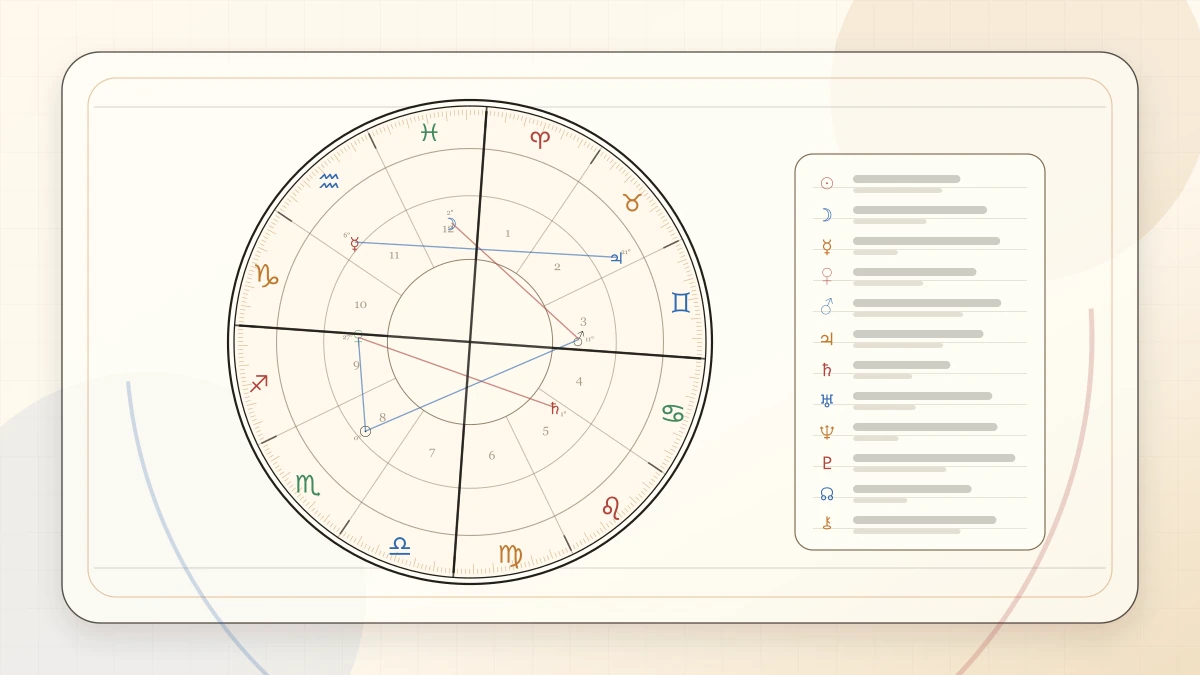
Houses, Aspects, and Planets
Sun Meaning in Astrology
This topic becomes easier to use when you stop treating it like an isolated label and start reading it as part of chart details. Houses, aspects, and planet meanings only become accurate when you compare them with the rest of the wheel.
Quick answer
The goal is to understand what life area or relationship pattern the symbol points to, then compare it with planets, signs, and the wider chart before taking the meaning literally.
Table of contents
What this part of the chart covers
Sun Meaning in Astrology is easiest to understand when you ask what kind of life area, function, or relationship it describes. Once that role is clear, the rest of the interpretation becomes more grounded.
This matters because readers often memorize keywords without understanding the practical question behind them.
How to read it in context
No house, aspect, or planet works alone. The sign modifies style, the house modifies life area, and aspects modify the way the energy behaves under pressure or opportunity.
That is why you want a reading method instead of a keyword list.
- Start with the core role of the house, aspect, or planet.
- Then compare the sign, nearby placements, and repeated themes in the chart.
- Use exact chart tools when the answer depends on house location or orb-sensitive aspects.
Common mistakes
A common mistake is treating one symbol as if it predicts the whole life area by itself. Another is reading only the positive side or only the difficult side.
Practical interpretation looks at what the symbol tends to emphasize and how the chart may support or complicate that emphasis.
What this means for you
If the topic feels too broad on its own, that is normal. Pair it with a full birth chart, house calculator, or supporting guide so you can see the placement in action.
That usually turns a generic-seeming idea into a much clearer reading.
Sun Meaning in Astrology quick reference
Use this quick reference as the high-level map for sun meaning in astrology. It shows what to check first, what to compare next, and which part of the guide matters most when you want a useful answer instead of a vague impression.
For houses, aspects, and planet meanings, the premium reading starts with which house, aspect, planet, or chart factor is being interpreted. From there, compare life area, planetary function, aspect behavior, sign expression, and chart repetition with the full wheel, house rulers, aspect patterns, dignity, and repeated themes so the article becomes a practical decision aid rather than a loose list of meanings.
| Step | What to check | Why it matters |
|---|---|---|
| Symbol role | Decide whether the topic is a planet, house, aspect, or point. | Clarifies what kind of information the symbol can actually provide. |
| Chart location | Check sign, house, ruler, and nearby aspects. | Shows how the symbol behaves in the real chart. |
| Pattern strength | Look for repetition across several placements. | Repeated themes deserve more weight than isolated details. |
| Interpretation | Translate the symbol into a practical question. | Makes the reading useful instead of abstract. |
Reference chart
Sun Meaning in Astrology reference chart
A scan-friendly view of the core layers behind this guide, built to help you decide what to read, compare, and calculate next.
Symbol type
House/aspect/planet
Know what kind of chart factor you are interpreting before choosing keywords.
Context layer
Full wheel
Chart context decides whether the meaning is loud, subtle, easy, or pressured.
Reading lens
Context
One symbol becomes clearer when the surrounding chart repeats or modifies it.
Next step
Exact chart
Use a calculator when house position or aspect orb matters.
How to use this guide well
Sun Meaning in Astrology becomes more helpful when you treat the article as a reading framework. Start with the question the page answers, then compare that answer with the chart layer, timing layer, or symbolic layer that applies to the topic. That sequence keeps the meaning clear and useful.
Use it to turn keywords into interpretation by asking what the symbol does, where it acts, and how strongly it repeats.
The best reader takeaway is a cleaner way to notice patterns, ask better follow-up questions, and decide whether a calculator, article, or personal chart detail should be checked next.
- Read the quick answer first so you know the core point.
- Use the table to decide what to check before you personalize the meaning.
- Compare the article with at least one related calculator or supporting guide.
- Write down one practical question the guide helps you answer today.
Make the reading more useful
A premium astrology or numerology article should give you language for a pattern, a timing cue, a chart layer, or a reflective practice. Sun Meaning in Astrology becomes strongest when the idea is connected to the details that matter for the question.
House, aspect, and planet meanings become strongest when they are read with context. Context is the difference between a keyword and a useful reading.
When the topic feels personally important, the next step is to move from general meaning into context. Use House and Aspect Tools, compare nearby articles, and keep the interpretation connected to real choices, real relationships, and the actual details available to you.
- Identify the symbol type before interpreting it.
- Compare sign, house, ruler, and nearby aspects.
- Give more weight to repeated themes than isolated placements.
- Translate the result into one practical reflection question.
Frequently asked
Can I read this topic on its own?
You can start there, but the strongest answer comes from comparing it with the full chart and nearby placements.
Why does chart context matter so much here?
Because signs, houses, planets, and aspects all modify each other. Context is what turns a keyword into an interpretation.
Do I need exact birth time for this?
If the question depends on houses or angles, yes. If the topic is only about a planet or a sign, you can often start without it.
What should I compare after this guide?
A full birth chart, a house calculator, or a supporting article on the related sign or planet is usually the best next move.
What is the biggest reading mistake?
Forcing one placement to explain everything is the biggest mistake. Use it as one part of a larger pattern instead.
Related calculators
Use the matching tool when you want a direct chart or timing result after reading the guide.
12 Houses Calculator
Complete 12-house overview page for readers who want the full natal house framework before drilling into one exact placement.
House Placement Calculator
Manual placement page that combines one known planet and one known house into a reusable interpretation page.
Planet Meaning Finder
Plain-English planet reference page for beginner chart readers.
Related articles
Keep reading with nearby topics that deepen the same question from another angle.
How to Read Your Birth Chart: A Beginner's Guide
Use this guide to understand the chart more clearly, know what the key symbols mean, and take the next step with confidence.
12 min read
Sun, Moon, and Rising Signs Explained
Use this guide to understand the chart more clearly, know what the key symbols mean, and take the next step with confidence.
12 min read
How to Read Chart Aspects Without Overthinking
Use this guide to understand the meaning of the placement, the life area it touches, and how to read it in context.
10 min read
Moon Meaning in Astrology
Use this guide to understand the meaning of the placement, the life area it touches, and how to read it in context.
9 min read
Keep exploring
Use the category page and the main hubs when you want the next layer of context.
House, aspect, and planet meanings you can actually use
Use these guides when you want to understand what a house, planet, or aspect means before layering it into a fuller chart reading.
Articles hub
Read more plain-language guides on houses, aspects, and chart details.
Guides hub
Use step-by-step chart reading guides when you want more context.
Birth Chart Tools
Explore exact house, placement, and aspect calculators next.
Previous article
How to Read Chart Aspects Without Overthinking
Next article
Moon Meaning in Astrology