
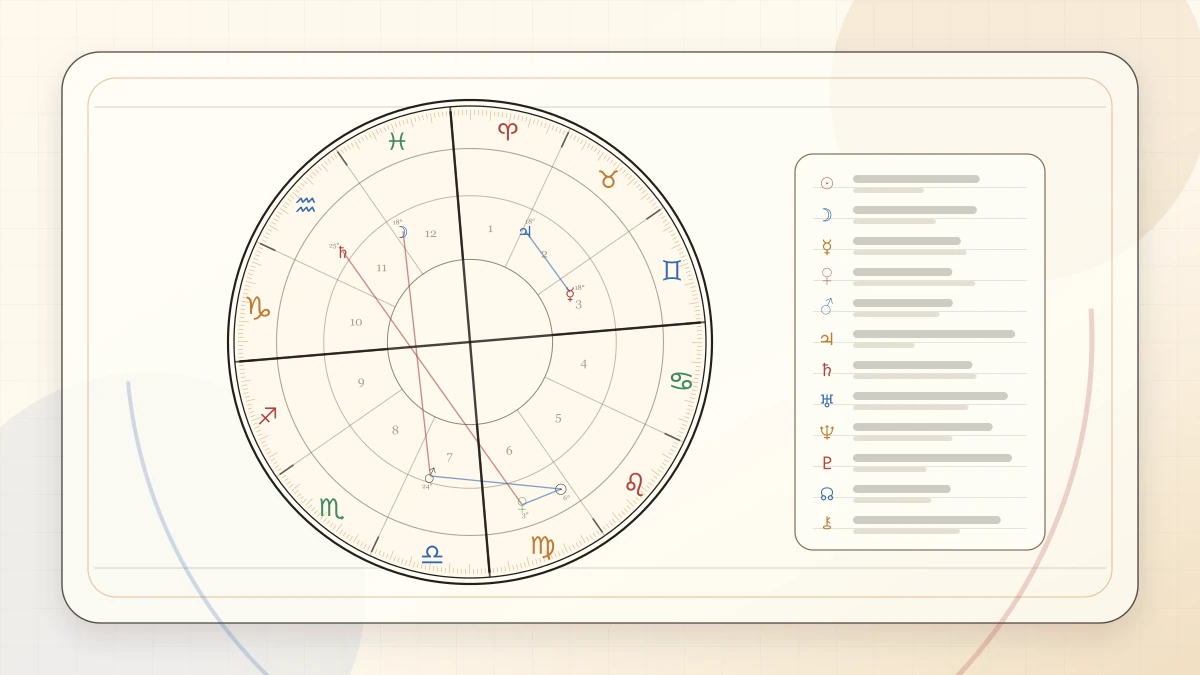
Houses, Aspects, and Planets
Saturn Meaning in Astrology
Saturn stands for boundaries, persistence and responsibility: skills built by repetition, commitments kept and limits that give a life shape. A limit can support you or confine you, depending on context.
Table of contents
- Example or practical exercise
- Saturn: structure, limits and the work of maturity
- Why Saturn has a hard reputation, and why that is not a rule
- Saturn’s clock: about 29.5 years around the zodiac
- Saturn in each sign, with its traditional dignities
- Saturn in the houses: where you build slowly
- Saturn aspects, and an overworked or underworked Saturn
- A constructed chart: Leila’s Saturn clock
- An exercise: audit one structure in your life
- Saturn’s quarter-cycle ages, from the first square to the third return
- Using the ages as checkpoints
- What this does and does not establish
Example or practical exercise
Leila's Saturn at 10 degrees Virgo moves about 12 degrees a year, so it returns there at about age 29 or 30 and reaches the opposite point, 10 degrees Pisces, at about 14 to 15.
Saturn: structure, limits and the work of maturity
Saturn stands for boundaries, persistence and responsibility. It is the part of a chart concerned with what takes time: skills built by repetition, commitments kept after the excitement fades and limits that give shape to a life. Where Jupiter asks how much more there could be, Saturn asks what is worth building and how long it will take.
A limit can be a skeleton or a cage, and which one it is depends on the person and the context. Saturn’s symbolism covers both, which is why the planet takes such different meanings in different readings.
Why Saturn has a hard reputation, and why that is not a rule
Traditional astrology sorted the planets into helpful and difficult ones, and Saturn, slow, cold and distant, was placed among the difficult ones. That label has been repeated for centuries. It is a tradition and not a rule, and nothing about a Saturn placement establishes punishment, failure or hardship.
Many modern astrologers read Saturn as a teacher of structure. Others find that framing too tidy. Both are interpretive choices, so use the version that helps you ask better questions.
Saturn’s clock: about 29.5 years around the zodiac
Saturn goes around the zodiac in about 29.5 years and spends about 2.5 years in each sign. It appears to turn retrograde for about 4.5 months every year. Its first return to its natal degree comes at about 28 to 30, the second at about 57 to 60 and the third at about 86 to 89. Because of the retrograde turns, one return can touch the natal point up to three times over a couple of years.
In a transit, Saturn takes about two to three years to move through a house, depending on its size. Many people notice nothing dramatic at any of these points. They are useful as markers for reviewing commitments.
Saturn in each sign, with its traditional dignities
Saturn is traditionally at home in Capricorn and Aquarius and exalted in Libra. It is in detriment in Cancer and Leo, and in fall in Aries. That is an old judgment about how easily Saturn’s style fits a sign, and is no measure of how a person fares.
| Sign | Dignity | How structure tends to be built |
|---|---|---|
| Aries | Fall | Learning to wait, plan and finish what you start |
| Taurus | None | Building slowly, valuing what is stable |
| Gemini | None | Disciplining attention and speech |
| Cancer | Detriment | Boundaries around family and feeling; caution about closeness |
| Leo | Detriment | Responsibility for self-expression; wary of being seen |
| Virgo | None | Meticulous standards and a strong work ethic |
| Libra | Exalted | Fairness through clear agreements and duty |
| Scorpio | None | Controlled intensity and respect for privacy |
| Sagittarius | None | Tested beliefs, with a need for firm ground |
| Capricorn | At home | Ambition, authority and long-term planning |
| Aquarius | At home | Ordered ideals, principle and structure for groups |
| Pisces | None | Giving form to feeling, with firm limits on dissolving |
Saturn in the houses: where you build slowly
The house of Saturn shows where responsibilities gather and where progress is gradual. The table groups houses by the kind of ground they cover.
| Houses | Area | Saturn’s question |
|---|---|---|
| 1, 6 and 10 | Presence, routine and reputation | What am I willing to be responsible for in plain view? |
| 2, 5 and 11 | What you value, create and hope for | Which commitments are worth keeping up? |
| 3 and 9 | Learning and communication | What do I need to study or say carefully? |
| 4, 7, 8 and 12 | Home, commitment, what is shared and what is private | Which obligations give me roots, and which weigh me down? |
Saturn aspects, and an overworked or underworked Saturn
Saturn tends to steady whatever it touches. Contact with the Sun is read as discipline for identity, the Moon as caution in feeling, Venus as slow, serious commitment and Mars as a brake on the accelerator. Mercury and Saturn together are read as careful, structured thought.
An overworked Saturn is harsh with itself, rigid about rules and carries too much alone. An underworked Saturn avoids commitments, resists limits and struggles to finish. As tendencies, they can be tested against your own habits.
A constructed chart: Leila’s Saturn clock
Leila is invented for this example. Her Saturn is at 10° Virgo, which is 150 plus 10, or 160 degrees. Saturn covers 360 degrees in about 29.5 years, which is about 12 degrees a year, and 30 degrees in a sign at that pace takes about two and a half years. Her first return, when Saturn is back at 10° Virgo, comes at about 29 or 30. The halfway point, the opposite degree 10° Pisces, comes at about 14 to 15.
Her Sun is at 12° Capricorn, or 282 degrees. The gap is 282 minus 160, or 122 degrees, 2 degrees from a trine. Her Rising sign is Gemini, so Virgo is the fourth house in whole signs (Gemini, Cancer, Leo, Virgo). A reading might ask what responsibility to home and roots feels like when it fits her sense of self.
An exercise: audit one structure in your life
A Saturn reading becomes practical when you look at the structures you actually live with.
- Pick one rule, routine or commitment you keep.
- Write what it gives you and what it takes from you.
- Decide whether it still supports you.
- If it does, note one way to make it easier to keep.
- If it does not, choose one small change and a date to review it.
Saturn’s quarter-cycle ages, from the first square to the third return
Saturn’s cycle of about 29.5 years divides into quarters of about 7.4 years, and each quarter marks a different angle to its natal place. The ages are rough, because Saturn’s speed and its retrograde turns move each one by a year or so.
| Angle to natal Saturn | Rough ages |
|---|---|
| Square (90 or 270 degrees) | About 7, 22, 37, 52, 66, 81 |
| Opposition (180 degrees) | About 15, 44, 74 |
| Return (0 degrees) | About 29 to 30, 59, 88 to 89 |
Using the ages as checkpoints
Astrologers read each age as a moment to review what you are building and what you carry. The Saturn opposition at about 44 comes close to the Uranus opposition at about 40 to 42, so the early to mid forties carry two traditional midlife markers at once. Whether that means anything for you is for you to say.
What this does and does not establish
Saturn's hard reputation is a tradition, not a rule, and no placement establishes punishment, failure or inevitable hardship.
Related calculators
Use the matching tool when you want a direct chart or timing result after reading the guide.
12 Houses Calculator
Complete 12-house overview page for readers who want the full natal house framework before drilling into one exact placement.
House Placement Calculator
Manual placement page that combines one known planet and one known house into a reusable interpretation page.
Planet Meaning Finder
Plain-English planet reference page for beginner chart readers.
Calculation references
- Swiss Ephemeris: positions, angles and house-system conventions
Technical reference for calculation conventions. It does not certify an interpretation or mean every live tool uses this engine.
Related articles
Keep reading with nearby topics that deepen the same question from another angle.
How to Read Your Birth Chart: A Beginner's Guide
Read your birth chart in five steps: find the Sun, Moon and Rising sign, count the elements, note crowded houses, locate the chart ruler, then read the two or three closest aspects.
6 min read
Sun, Moon, and Rising Signs Explained
Your Sun sign describes what you are aiming to be, your Moon sign what you need to feel settled, and your Rising sign how you meet the world and how it first meets you.
6 min read
Mars Meaning in Astrology
Mars is the planet of drive and initiative: wanting something, going after it, competing and defending a boundary. Its sign and house suggest how and where that push tends to move.
6 min read
The 12 Houses Explained
The twelve houses split a birth chart into twelve areas of life, measured from the horizon at your birthplace. A planet's sign shows how it behaves, and its house shows where that behavior appears.
6 min read
Keep exploring
Use the category page and the main hubs when you want the next layer of context.
Previous article
Mars Meaning in Astrology
Next article
Career Astrology for Beginners