
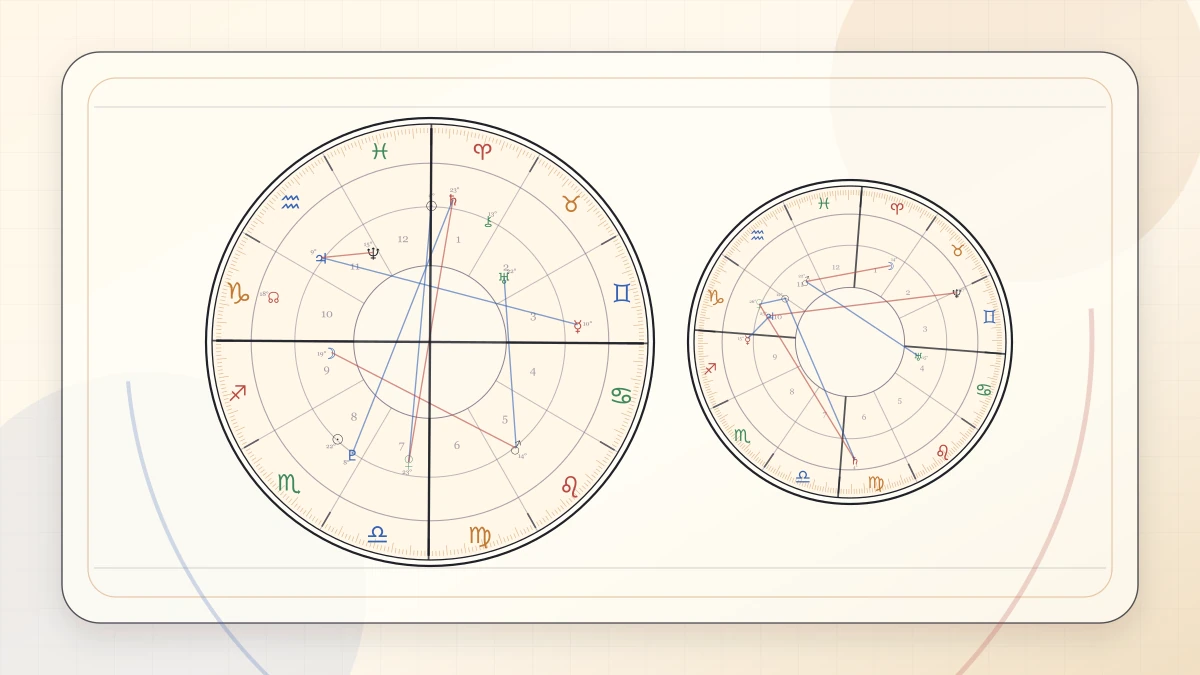
Planetary Transits
What a Square Transit Can Mean
A square transit is a moving planet 90 degrees from a point in your chart. Astrologers read it as friction that asks for adjustment, with the planet pair setting the question.
Table of contents
- Example or practical exercise
- What a square is and why every point has two of them
- Tension and pressure to act: how a square differs from other aspects
- Examples of planet pairs and the questions they raise
- How speed changes what a square feels like
- A constructed example: two squares to one natal Venus
- A reflective method for working with a square
- What a square does not say
- A constructed example: a square that crosses a sign line
- Questions readers ask about square transits
- What this does and does not establish
Example or practical exercise
For natal Venus at 22 degrees Taurus, the square points are 22 Leo and 22 Aquarius; transit Saturn at 20 Leo is applying, raising which of the things you love ask for steady care.
What a square is and why every point has two of them
A square is an angle of 90 degrees, a quarter of the 360-degree circle, measured around the zodiac between a moving planet and a point in your chart. Signs three apart, such as Aries and Cancer, share a modality (cardinal, fixed or mutable, the three ways a sign relates to change) but differ in element. A square therefore pairs two things that move in the same style and speak different languages.
Because the angle can be measured in either direction, each natal point has two square points: add 90 degrees and subtract 90 degrees. Check both, since a moving planet can approach either one.
Tension and pressure to act: how a square differs from other aspects
Astrologers have long read the square as the aspect of friction. Where a trine flows and an opposition balances, a square tends to be described as pressure, a sense that something is out of alignment and asks for adjustment. Modern writers often point out that squares are also what get people moving, because friction is uncomfortable enough to prompt a decision.
That is the traditional reading, and it is a way of describing tension, not a verdict. Whether you feel any pressure at all depends on your circumstances, not on the angle.
Examples of planet pairs and the questions they raise
The pair matters more than the aspect. The table lists several transit squares and the question each can raise, with a small reflection and no prediction attached.
| Transit square | A question it can raise | A small reflection |
|---|---|---|
| Mars square natal Mercury | Is your pace of speaking and deciding fitting for the moment? | Wait a day before sending a sharp message. |
| Saturn square natal Sun | Which of your responsibilities did you choose? | List what you chose and what you inherited. |
| Jupiter square natal Venus | How much is enough? | Note where you said yes out of enthusiasm. |
| Uranus square natal Moon | What in your routine no longer fits? | Try one small change to a daily rhythm. |
| Mercury square natal Saturn | Which plans need a clearer structure? | Write the plan as three plain steps. |
| Neptune square natal Mercury | Where is the picture still vague? | Ask for specifics and write them down. |
How speed changes what a square feels like
A Mars square lasts a few days, while a Saturn square lasts a couple of months in a single pass and can stretch across most of a year once retrograde passes are added. The first is closer to a mood or a flash of impatience; the second is closer to a standing question you keep returning to. When you read a square, read the speed of the moving planet along with the pair.
A constructed example: two squares to one natal Venus
This example is constructed. Take a natal Venus at 22 degrees Taurus. Taurus begins at 30 degrees, so the position is 30 plus 22, or 52. Adding 90 gives 142, which is 22 degrees Leo, since Leo begins at 120. Subtracting 90 gives negative 38, and adding 360 gives 322, which is 22 degrees Aquarius, since Aquarius begins at 300.
Suppose transit Saturn is at 20 degrees Leo, which is 140. That is 2 degrees short of the first square point and inside a 2-degree orb, so the contact is applying. The second square point at 22 degrees Aquarius is quiet unless another planet visits it, and a Mars visit there would last about four days.
The reading starts with the pair, not the geometry: Saturn is about commitment and upkeep, and Venus is about affection and what you value. The question this square can raise is which of the things you love also ask for steady care. No event follows from the question, and the answer may be nothing at all.
A reflective method for working with a square
Use this routine at the start of a window, then once more when the planet is separating.
- Name the pair in plain words, for example “duty meets affection”.
- Say what each side wants to do, and note that both share a style.
- Ask whether you feel any pressure right now, and where. If you feel none, write that down.
- Choose one small, reversible action that responds to the pressure.
- When the planet is separating, review what you did and what you learned.
What a square does not say
The traditional label for squares is hard, but hard does not mean bad. A square names a point of friction that may or may not be noticeable, and many people pass through them with nothing to report. It does not establish an event, a loss or a conflict.
It also does not tell you which side of the pair should give way. A square between Mars and Saturn, for instance, is not a ruling that effort must lose to caution or the other way around. The useful reading is the question, such as how to pace effort so it lasts, and you are free to answer it in your own terms or not at all.
If you want to test a square against your own experience, keep a short note across the window and compare the notes with the dates afterward. Honest notes will show you whether the angle matched anything, and a blank page is a fair result.
A constructed example: a square that crosses a sign line
This example is constructed. Take a natal Moon at 28 degrees Aries, which is 28. Adding 90 gives 118, which is 28 degrees Cancer, since Cancer begins at 90. Subtracting 90 gives negative 62, and adding 360 gives 298, which is 28 degrees Capricorn, since Capricorn begins at 270.
Suppose transit Mars is at 0 degrees Leo, which is 120. That is 2 degrees past 118, so Mars forms a square to the Moon even though it has already left Cancer. A reading that looked only at signs would miss it, so check degrees as well as signs. Mars is moving ahead, so the square is separating, and at about half a degree a day it passed exact about four days earlier.
In reading terms, Mars is about push and the Moon about comfort and routine. The question is where you have been moving faster than your routines can hold, and the answer might be nowhere.
Questions readers ask about square transits
Is a square worse than an opposition? Neither is worse. A square is read as friction that asks for adjustment, and an opposition as a tug between two sides. Which one feels heavier depends on the planets involved and on your circumstances.
What if no planet is making a square to my chart right now? Then there is nothing to read, which is ordinary. A tight window is a short stretch of time, and most natal points are untouched by any given planet most of the time.
Does it matter whether a square is applying or separating? Astrologers differ. Some weight the approach, when the square is building, while others weight the exact moment and the days just after. Choose one habit and keep notes, so you can see which fits your experience.
What this does and does not establish
Hard does not mean bad: a square names possible friction but does not establish an event, a loss or a conflict.
Related calculators
Use the matching tool when you want a direct chart or timing result after reading the guide.
Current Transits Calculator
Exact current-sky snapshot for a selected city, built for repeat-use daily astrology readers.
Retrograde Calendar
Exact retrograde-period page for year-based planning, editorial planning, and current-sky timing checks.
Transit to Natal Calculator
Exact current-sky comparison against one verified natal chart for more personal practical transit guidance.
Calculation references
- Swiss Ephemeris: positions, angles and house-system conventions
Technical reference for calculation conventions. It does not certify an interpretation or mean every live tool uses this engine.
Related articles
Keep reading with nearby topics that deepen the same question from another angle.
What an Opposition Transit Can Mean
An opposition transit is a moving planet 180 degrees from a point in your chart. Astrologers read it as a tug between two legitimate things, often involving other people.
6 min read
Mercury Retrograde Meaning and a Practical Checklist
Mercury retrograde is a few weeks, three or four times a year, when Mercury appears to drift backward as seen from Earth. Astrologers read it as a time to review, revise and double-check.
6 min read
How to Read Current Transits Without Overreacting to Every Aspect
Choose your question first, list the slow-planet contacts within a tight orb, then add fast ones only for timing. A Saturn contact lasting months outweighs a Moon contact lasting hours.
6 min read
Saturn Return Explained
A Saturn return is when Saturn comes back to the degree it held at your birth, about every 29.5 years. Astrologers read it as a checkpoint for responsibility and the structures you have built.
6 min read
Keep exploring
Use the category page and the main hubs when you want the next layer of context.
Previous article
What an Opposition Transit Can Mean
Next article
Ceres Meaning in Astrology