
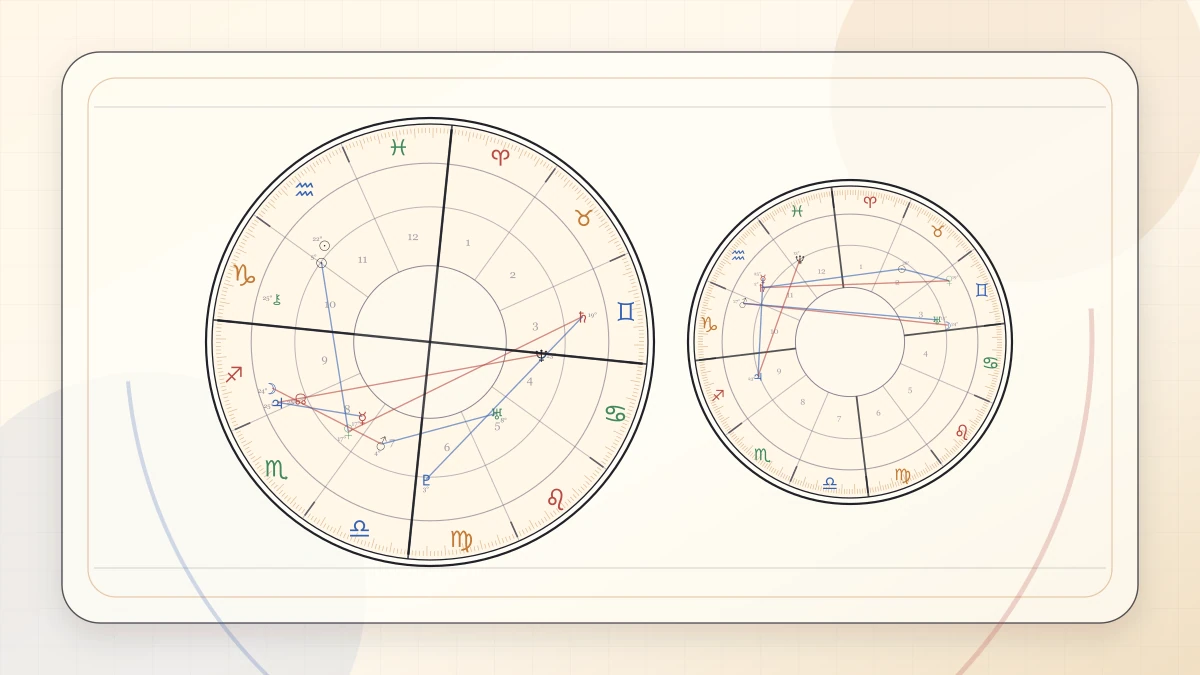
Planetary Transits
What an Opposition Transit Can Mean
An opposition transit is a moving planet 180 degrees from a point in your chart. Astrologers read it as a tug between two legitimate things, often involving other people.
Table of contents
- Example or practical exercise
- What an opposition is: two points facing each other
- A tug between two things, and often other people
- Examples of opposing poles
- The axis in your houses
- A constructed example: Jupiter opposite a natal Mercury
- A method for working with an opposition
- When other people are involved
- A constructed example: Saturn opposite a Sun on the 4th and 10th axis
- When your natal chart already contains an opposition
- What this does and does not establish
Example or practical exercise
Ravi has natal Mercury at 5 degrees Pisces, and transit Jupiter at 3 Virgo is about 24 days from opposing it, prompting him to check which of his large ideas need careful detail.
What an opposition is: two points facing each other
An opposition is an angle of 180 degrees, half the circle, between a moving planet and a point in your chart. Opposite signs, such as Aries and Libra, share a modality and sit in complementary elements: fire with air, and earth with water. That is why opposites often look like two halves of one question.
Unlike a square, which has two target points, an opposition has only one. Add 180 degrees to the natal position, or subtract it, and you land on the same place.
A tug between two things, and often other people
Where a square pressures you to act, an opposition is usually read as a tug between two legitimate things. Neither side is the villain; each carries something you want. Older astrology counted the opposition among the hard aspects and linked it with open disagreement, but modern astrologers more often read it as polarity and balance, which can mean choosing a point between the two sides or taking turns.
Astrologers also link oppositions to other people, because the point opposite the Ascendant is the Descendant, the angle of partnership, and the seventh house of other people sits there. That is a way of reading, and an opposition does not establish an opponent or a conflict. The tug can sit inside you, between two parts of your own life.
A useful way to hold it is as a seesaw. Leaning too far toward one pole makes the other pole louder, so a reading usually asks what a fair middle position would look like, and whether it has to be permanent or only for the length of the window.
Examples of opposing poles
Each opposition in the table has two poles and a question, with no outcome attached.
| Transit opposition | First pole | Second pole | A balancing question |
|---|---|---|---|
| Saturn opposite natal Venus | duty and structure | enjoyment and affection | What can be both kept up and enjoyed? |
| Jupiter opposite natal Moon | wanting more room | comfort and familiar routines | How much growth can your daily rhythm hold? |
| Mars opposite natal Sun | push and initiative | identity and what you stand for | Does the push serve who you are? |
| Venus opposite natal Mars | keeping the peace | wanting to act | When is keeping the peace also putting something off? |
| Uranus opposite natal Saturn | freedom and change | stability and commitments | Which commitments are worth renewing? |
| Mercury opposite natal Jupiter | the facts and details | the big picture and belief | Does the plan hold up on both counts? |
The axis in your houses
An opposition links two houses on opposite sides of the chart. Which axis it lies on can sharpen the pair of themes.
- Houses 1 and 7: yourself and your closest partners.
- Houses 2 and 8: what is yours and what is shared.
- Houses 3 and 9: near and far, everyday learning and wider beliefs.
- Houses 4 and 10: private life and public role.
- Houses 5 and 11: creative play and the groups you belong to.
- Houses 6 and 12: daily routine and rest or retreat.
A constructed example: Jupiter opposite a natal Mercury
This example is constructed. Ravi has natal Mercury at 5 degrees Pisces. Pisces begins at 330 degrees, so Mercury sits at 335. Subtracting 180 gives 155, and Virgo begins at 150, so the opposition point is 5 degrees Virgo.
Suppose transit Jupiter is at 3 degrees Virgo, which is 153. It is 2 degrees short of exact, inside a 2-degree orb, and applying. At Jupiter's average pace of about a degree every 12 days, exact is about 24 days away, a little over three weeks, and retrograde can change that.
The pair is Mercury, thinking and speaking, against Jupiter, expansion and belief. Ravi thinks in impressions and hunches, and Jupiter is in a sign devoted to detail. The question for him is which of his large ideas would benefit from a careful check. That is a prompt, and nothing in the chart says what he will decide.
A method for working with an opposition
The method below is aimed at the tug itself, not at winning either side.
- Write the two poles as two plain sentences, one for each side.
- Under each, write what it protects and what it risks.
- Look for a third option that gives each side part of what it wants, such as a schedule or a trial period.
- If other people are involved, note which part of the tug belongs to them and which to you.
- At the separating stage, record what you chose and what you would change.
When other people are involved
If the opposite pole shows up as a person, the useful move is to talk with them and not about them. A chart can give you words for the two positions, but it cannot decide who is right.
If something between you and another person hurts, a chart is not the place to settle it. Talk with someone you trust, and if a situation feels unsafe, contact a qualified professional or a local support service.
A constructed example: Saturn opposite a Sun on the 4th and 10th axis
This example is constructed. A person has Cancer rising and the Sun at 12 degrees Aries, which is 12. Adding 180 gives 192, which is 12 degrees Libra, since Libra begins at 180. In whole-sign houses with Cancer rising, Aries is the tenth house and Libra the fourth, so the opposition lies on the axis between public role and private life.
Suppose transit Saturn is at 10 degrees Libra, which is 190, in the fourth house. It is 2 degrees short of exact. At about a degree a month it needs about two months to arrive, and a retrograde turn could bring it back across the point later.
The pair is Saturn, duty and structure, against the Sun, identity and what you stand for, and the axis adds home against public role. The question is what a fair middle looks like, such as how much of the week belongs to each. It is a prompt, and the chart does not say what the person will choose.
When your natal chart already contains an opposition
A natal opposition is two of your own planets sitting 180 degrees apart, for example a Venus at 10 degrees Taurus (30 plus 10, or 40) and a Mars at 10 degrees Scorpio (210 plus 10, or 220). A transiting planet that is conjunct one end is automatically opposite the other, so a single visit touches both. Transit Jupiter at 10 degrees Taurus would be conjunct the Venus and opposite the Mars at the same time.
Read that visit as one theme with two poles and not as two separate contacts. Which end feels louder is a question for your own notes, and the angle does not decide it.
What this does and does not establish
An opposition does not establish an opponent or a conflict, and a chart cannot decide who is right between two people.
Related calculators
Use the matching tool when you want a direct chart or timing result after reading the guide.
Current Transits Calculator
Exact current-sky snapshot for a selected city, built for repeat-use daily astrology readers.
Retrograde Calendar
Exact retrograde-period page for year-based planning, editorial planning, and current-sky timing checks.
Transit to Natal Calculator
Exact current-sky comparison against one verified natal chart for more personal practical transit guidance.
Calculation references
- Swiss Ephemeris: positions, angles and house-system conventions
Technical reference for calculation conventions. It does not certify an interpretation or mean every live tool uses this engine.
Related articles
Keep reading with nearby topics that deepen the same question from another angle.
Outer Planet Transits Through the Houses
When Uranus, Neptune or Pluto moves through a house of your chart, astrologers read that area of life against a long backdrop: change for Uranus, ideals for Neptune, rebuilding for Pluto.
6 min read
What a Square Transit Can Mean
A square transit is a moving planet 90 degrees from a point in your chart. Astrologers read it as friction that asks for adjustment, with the planet pair setting the question.
6 min read
Mercury Retrograde Meaning and a Practical Checklist
Mercury retrograde is a few weeks, three or four times a year, when Mercury appears to drift backward as seen from Earth. Astrologers read it as a time to review, revise and double-check.
6 min read
How to Read Current Transits Without Overreacting to Every Aspect
Choose your question first, list the slow-planet contacts within a tight orb, then add fast ones only for timing. A Saturn contact lasting months outweighs a Moon contact lasting hours.
6 min read
Keep exploring
Use the category page and the main hubs when you want the next layer of context.
Previous article
Outer Planet Transits Through the Houses
Next article
What a Square Transit Can Mean