
Houses, Aspects, and Planets
Juno Meaning in Astrology
Juno, the third asteroid discovered, is read by modern astrologers as a symbol of commitment and agreements, in marriage and also in business partnerships, close friendships and promises to yourself.
Table of contents
- Example or practical exercise
- Juno: the asteroid and its discovery
- The myth: Juno, Hera and marriage
- How modern astrologers read Juno
- Juno by sign, grouped by element
- Juno in the houses, in four groups
- What does Juno look like in a real chart? A constructed example
- Aspects to Juno, and Juno between two charts
- What Juno cannot tell you
- Using Juno to prepare a conversation about expectations
- Common questions about Juno
- What this does and does not establish
Example or practical exercise
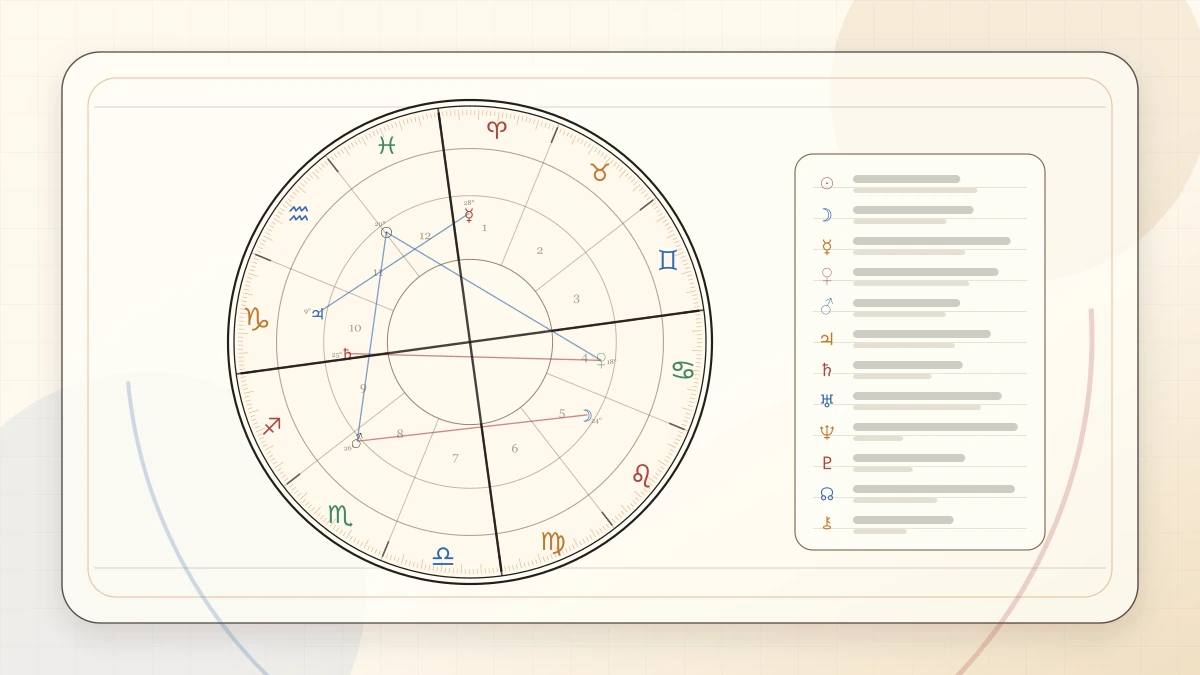
With Cancer rising, Juno at 7 degrees Capricorn sits in the seventh house and squares Saturn at 8 degrees Libra with a 1-degree orb, a prompt for a conversation about expectations.
Juno: the asteroid and its discovery
Juno is an asteroid, one of the small rocky bodies that orbit the Sun in the belt between Mars and Jupiter. It was found in 1804 by Karl Harding in Germany, the third asteroid discovered, and is much smaller than Ceres, about 235 kilometers across. It orbits in about 4.4 years.
In the early nineteenth century astronomers counted the first asteroids as planets for a few decades. Later, as many more were found, they were reclassified. Astrologers still use the first four, and Juno is one of them.
The myth: Juno, Hera and marriage
Juno was the Roman queen of the gods, wife of Jupiter, and a goddess of marriage and of women’s welfare. The Greeks knew her as Hera. Many stories show her pursuing her husband’s wandering, and she is often a figure of jealousy and of dignity at once.
Modern astrologers read less of the jealousy and more of the underlying question: what do you expect of a committed partnership, and what will you not accept?
How modern astrologers read Juno
In modern readings Juno stands for commitment and agreement: what you look for in a long partnership, how you handle promises and where you want equal standing. Some astrologers read it in synastry, the comparison of two charts, as a sign of shared expectations.
Juno does not tell you whether you will marry, or whether any relationship will last. It is a secondary symbol, and many astrologers do not use it.
Its position needs a chart program or an ephemeris that includes the asteroids. Because Juno takes about 4.4 years to circle the Sun, it spends roughly four to five months in a sign on average, so people born a few years apart often differ in Juno’s sign.
Juno by sign, grouped by element
The sign shows the style of commitment you tend to expect. These are traditional characterizations, and people vary.
- Fire (Aries, Leo, Sagittarius): a partnership expected to be lively, honest and free to grow.
- Earth (Taurus, Virgo, Capricorn): commitment shown through dependable action, shared routines and long-term building.
- Air (Gemini, Libra, Aquarius): partnership valued as conversation, fairness and equal standing.
- Water (Cancer, Scorpio, Pisces): commitment felt as emotional loyalty, closeness and trust.
Juno in the houses, in four groups
The house shows where the theme of agreement gathers in your life.
| Houses | Where commitment is felt | A question to ask |
|---|---|---|
| 1 to 3 | In how you present yourself and in everyday exchanges | What promises do I keep to myself? |
| 4 to 6 | At home, in creative projects and in daily work | What do I expect of those I live and work with? |
| 7 to 9 | In close partnership, shared matters and shared beliefs | What does equal standing look like for me? |
| 10 to 12 | In public roles, in groups, and in private life | What am I committed to when no one is watching? |
What does Juno look like in a real chart? A constructed example
This chart is constructed for teaching. Cancer is Rising, with whole-sign houses. Juno sits at 7 degrees Capricorn. Capricorn begins at 270, so Juno is at 270 + 7 = 277 degrees. Counting from Cancer (1st), Capricorn is the 7th house, the house of partnership.
Saturn sits at 8 degrees Libra, which is 180 + 8 = 188 degrees, in the 4th house. The gap is 277 − 188 = 89 degrees, a square with an orb of 1 degree.
A reading might ask how a serious, structured idea of commitment, Juno in Capricorn, sits with a need for balance at home, Saturn in Libra. A conversation about expectations is more useful than any verdict. The chart does not say whether this person will marry.
Aspects to Juno, and Juno between two charts
Juno is read with the usual angles and a tight orb, often about three degrees or less. Contacts to Venus, Saturn and the Descendant are the ones people discuss most often. A conjunction to Venus links commitment with affection, and a contact to Saturn links it with responsibility.
In synastry, some astrologers look for one person’s planet touching the other’s Juno and read it as a shared theme in how each treats agreements. It supplies words for a conversation. It does not rate the pairing.
What Juno cannot tell you
It cannot predict marriage, divorce or the success of a relationship. It does not show whether a person is faithful or what they intend. Those depend on behavior and on conversations between two people.
If a partnership feels unsafe, put safety first and talk with someone you trust or a local support service. A chart is not the place to settle it.
Using Juno to prepare a conversation about expectations
Use a chart program or an ephemeris that includes the asteroids to find Juno’s sign, house and any aspect within about three degrees.
- Write down Juno’s sign and the style of commitment it suggests.
- List three expectations you hold in a partnership, whether or not you have one.
- Mark which of them are firm and which could bend.
- Choose one to say aloud to someone you trust, or to write in a letter.
- Notice how their answer compares with yours, and treat any difference as a topic to discuss.
Common questions about Juno
Is Juno the same as Venus? No. Venus concerns attraction and what you enjoy. Juno concerns commitment and agreement. Some astrologers read both when they look at a relationship.
Does Juno need a birth time? The date gives its sign for most people. The house needs a birth time.
Do I need to use Juno? No. Many astrologers never do. Treat it as one secondary symbol among many.
Is Juno only about marriage? No. Marriage is the old image, but modern readers apply it to any long-term commitment, including business partnerships and close friendships, and to the promises you keep with yourself.
What this does and does not establish
Juno cannot predict marriage, divorce or the success of a relationship, and it cannot show whether a partner is faithful.
Related calculators
Use the matching tool when you want a direct chart or timing result after reading the guide.
12 Houses Calculator
Complete 12-house overview page for readers who want the full natal house framework before drilling into one exact placement.
House Placement Calculator
Manual placement page that combines one known planet and one known house into a reusable interpretation page.
Planet Meaning Finder
Plain-English planet reference page for beginner chart readers.
Calculation references
- Swiss Ephemeris: positions, angles and house-system conventions
Technical reference for calculation conventions. It does not certify an interpretation or mean every live tool uses this engine.
Related articles
Keep reading with nearby topics that deepen the same question from another angle.
Ceres Meaning in Astrology
Ceres, the largest object in the asteroid belt and now classed as a dwarf planet, is read by modern astrologers as a symbol of nourishment, care and how you give and receive support.
6 min read
Vesta Meaning in Astrology
Vesta, the brightest asteroid seen from Earth, is read in modern astrology as a symbol of focus, devotion and sustained effort: where your attention settles and what you keep tending.
6 min read
The 12 Houses Explained
The twelve houses split a birth chart into twelve areas of life, measured from the horizon at your birthplace. A planet's sign shows how it behaves, and its house shows where that behavior appears.
6 min read
Conjunction, Square, Trine, and Opposition Explained
The major aspects are angles between two planets: conjunction at 0 degrees, square at 90, trine at 120 and opposition at 180, with the sextile at 60. Planets in aspect modify each other.
6 min read
Keep exploring
Use the category page and the main hubs when you want the next layer of context.
Previous article
Ceres Meaning in Astrology
Next article
Vesta Meaning in Astrology