
Houses, Aspects, and Planets
Vesta Meaning in Astrology
Vesta, the brightest asteroid seen from Earth, is read in modern astrology as a symbol of focus, devotion and sustained effort: where your attention settles and what you keep tending.
Table of contents
- Example or practical exercise
- Vesta: the asteroid and its discovery
- The myth: the hearth fire and its priestesses
- How modern astrologers read Vesta
- Vesta by sign: where focus goes
- Vesta in the houses, in four groups
- What does Vesta look like in a real chart? A constructed example
- An overworked Vesta and an underworked Vesta
- Aspects to Vesta worth noticing
- What Vesta does not establish
- A reflection routine: where does your attention go?
- Common questions about Vesta
- What this does and does not establish
Example or practical exercise
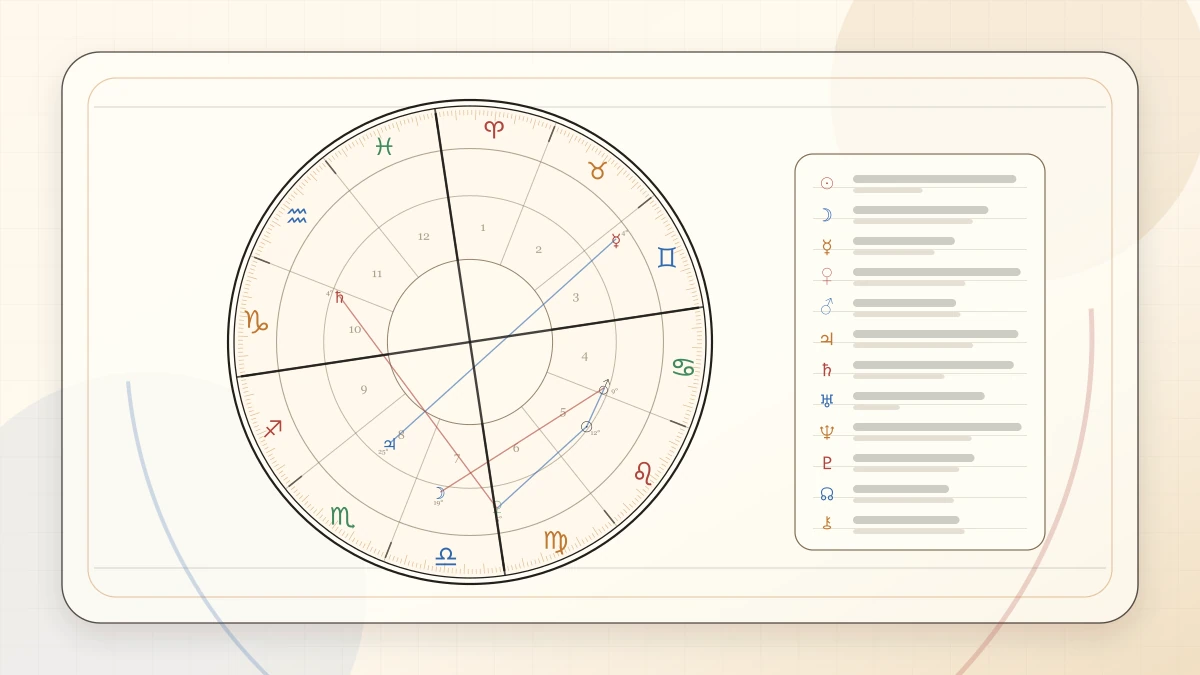
With Aquarius rising, Vesta at 3 degrees Taurus in the fourth house forms a sextile with a 2-degree orb to the Moon at 1 degree Pisces, raising a question about work and rest at home.
Vesta: the asteroid and its discovery
Vesta is an asteroid, a small rocky body orbiting the Sun in the belt between Mars and Jupiter. It was found in 1807 by Heinrich Olbers in Germany, the fourth asteroid discovered. It is about 525 kilometers across, and an orbit of about 3.6 years means it spends about 3.6 months in each sign on average.
It is the brightest asteroid as seen from Earth, and under a dark sky it can sometimes be seen without a telescope. A spacecraft orbited it in the early 2010s.
The myth: the hearth fire and its priestesses
Vesta was the Roman goddess of the hearth, matching the Greek Hestia. Her priestesses, the Vestals, tended a sacred fire in her temple in Rome. The fire was kept burning without a break, and its care was a serious duty, since it stood for the home of the whole city.
Astrologers draw out the themes of devotion, steady attention and keeping something alight. The myth is also a reminder that tending a fire is work.
How modern astrologers read Vesta
In modern readings Vesta stands for focus, dedication and sustained practice: what you tend with care, what you protect from distraction and where effort feels like devotion. It is also linked with privacy and with the question of what deserves your full attention.
This is a modern interpretation. It does not establish a vocation, a spiritual status or any need for sacrifice.
Vesta by sign: where focus goes
The sign shows the style of focus. The lines are traditional characterizations, and people vary.
| Sign | Style of focus |
|---|---|
| Aries | Bursts of concentrated drive on a chosen project |
| Taurus | Patient, hands-on work and routines that last |
| Gemini | Attention that follows curiosity and several threads at once |
| Cancer | Devotion to home, family and the people close to you |
| Leo | Creative work done with pride and heart |
| Virgo | Careful craft, with attention to detail |
| Libra | Dedication to fairness, beauty and partnership |
| Scorpio | Deep, private concentration that goes to the root |
| Sagittarius | Commitment to a belief, a field of study or a path |
| Capricorn | Disciplined effort toward a long-term goal |
| Aquarius | Devotion to a cause, a group or an idea |
| Pisces | Quiet, imaginative devotion that may be hard to put into words |
Vesta in the houses, in four groups
The house shows the area of life where focus and devotion tend to gather.
- Houses 1 to 3: focus in how you present yourself, what you develop and what you study day to day.
- Houses 4 to 6: focus at home, in creative practice and in the craft of daily work.
- Houses 7 to 9: focus within close relationships, in shared matters and in belief or study.
- Houses 10 to 12: focus in public work, in a group or cause, or in private retreat.
What does Vesta look like in a real chart? A constructed example
This chart is constructed for teaching. Aquarius is Rising, with whole-sign houses. Vesta sits at 3 degrees Taurus. Taurus begins at 30, so Vesta is at 33 degrees. Counting from Aquarius (1st), Pisces is 2nd, Aries 3rd and Taurus 4th, the house of home.
The Moon is at 1 degree Pisces, which is 330 + 1 = 331 degrees. To compare, add 360 to Vesta: 33 + 360 = 393, and 393 − 331 = 62 degrees. A sextile is 60, so this is a sextile with a 2-degree orb. Pisces is the 2nd house.
A reading might ask where focused effort sits at home, and whether it suits the Moon’s emotional needs. It prompts a question about balance between work and rest. It is not a statement about vocation.
An overworked Vesta and an underworked Vesta
When Vesta is overworked, focus crowds out rest. A single project absorbs everything, other people get what is left, and stopping feels like failure. The fire is tended so closely that nobody can sit near it.
When Vesta is underworked, attention scatters. Projects begin without being tended, and nothing is given the long, quiet effort that would let it deepen. The balanced use is choosing what to keep burning and allowing the rest to rest.
Aspects to Vesta worth noticing
Vesta is read with the usual angles and a tight orb of about three degrees or less. The contacts people discuss most are those to the Sun, Moon and Saturn.
- Sun: identity bound up with what you commit to, so work and self can seem hard to separate.
- Moon: a need for quiet routines and a protected space in which to concentrate.
- Saturn: discipline that comes easily, with a risk of making effort a standard to be met.
What Vesta does not establish
It does not show a calling, a spiritual status or a duty to give something up. Asteroid readings are secondary symbols, and many astrologers do not use them. To find Vesta you need a chart program or an ephemeris that includes the asteroids.
Start with the Sun, Moon and Rising sign. Add Vesta only if the theme of devotion helps you ask better questions.
A reflection routine: where does your attention go?
Use Vesta’s sign and house as a starting point.
- Write down Vesta’s sign and its style of focus.
- Note the house and the area of life it points to.
- List the three things you spent the most attention on this week.
- Mark which of them you would choose again and which you took on by default.
- Set aside one block of time for what you chose, and one block that is protected for rest.
Common questions about Vesta
Is Vesta about being single or celibate? Not necessarily. The priestesses of the myth took vows, but modern astrologers read Vesta as focus and devotion, and not as a rule about relationships.
Does Vesta need a birth time? The date gives its sign for most people. The house needs a birth time.
Is Vesta only about work? No. Devotion can attach to a craft, a person, a faith or a home. The sign and house point to where your attention tends to settle, and they cannot say which of those it is.
What this does and does not establish
Vesta does not reveal a calling, a spiritual status or a duty to give something up, and asteroid readings are secondary symbols.
Related calculators
Use the matching tool when you want a direct chart or timing result after reading the guide.
12 Houses Calculator
Complete 12-house overview page for readers who want the full natal house framework before drilling into one exact placement.
House Placement Calculator
Manual placement page that combines one known planet and one known house into a reusable interpretation page.
Planet Meaning Finder
Plain-English planet reference page for beginner chart readers.
Calculation references
- Swiss Ephemeris: positions, angles and house-system conventions
Technical reference for calculation conventions. It does not certify an interpretation or mean every live tool uses this engine.
Related articles
Keep reading with nearby topics that deepen the same question from another angle.
Juno Meaning in Astrology
Juno, the third asteroid discovered, is read by modern astrologers as a symbol of commitment and agreements, in marriage and also in business partnerships, close friendships and promises to yourself.
5 min read
Pallas Meaning in Astrology
Pallas, the second asteroid found, is read in modern astrology as a symbol of strategy, pattern recognition and creative problem-solving, drawing on the myth of Pallas Athena.
6 min read
The 12 Houses Explained
The twelve houses split a birth chart into twelve areas of life, measured from the horizon at your birthplace. A planet's sign shows how it behaves, and its house shows where that behavior appears.
6 min read
Conjunction, Square, Trine, and Opposition Explained
The major aspects are angles between two planets: conjunction at 0 degrees, square at 90, trine at 120 and opposition at 180, with the sextile at 60. Planets in aspect modify each other.
6 min read
Keep exploring
Use the category page and the main hubs when you want the next layer of context.
Previous article
Juno Meaning in Astrology
Next article
Pallas Meaning in Astrology