
Houses, Aspects, and Planets
Neptune Meaning in Astrology
Neptune stands for imagination, idealism, compassion and the dissolving of boundaries, and the same openness can bring confusion or wishful thinking. These are modern readings, since ancient astrology never knew the planet.
Table of contents
- Example or practical exercise
- What Neptune is and how it was found
- Neptune and Pisces: a modern convention
- Neptune by sign: the flavor of each generation
- Neptune in the houses, in four groups
- Aspects to Neptune in a natal chart
- An overworked Neptune and an underworked Neptune
- What does Neptune look like in a real chart? A constructed example
- A reflection exercise for your own Neptune
- Common questions about Neptune
- What this does and does not establish
Example or practical exercise
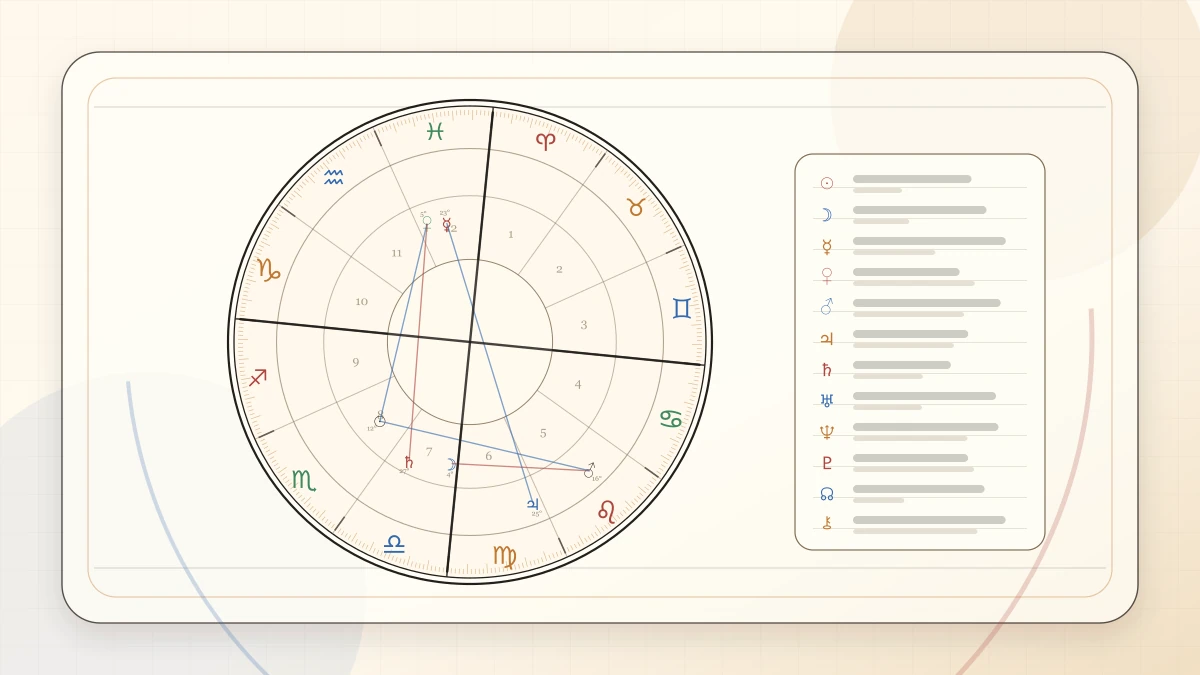
With Aries rising, Neptune at 8 degrees Capricorn in the tenth house opposes Mercury at 12 degrees Cancer with a 4-degree orb, raising questions about idealized pictures of public life and home.
What Neptune is and how it was found
Neptune is the outermost of the eight planets astronomers recognize, a cold blue giant about thirty times farther from the Sun than the Earth is. It cannot be seen without a telescope, which suits the way astrology reads it: as the symbol of what is faint, distant and hard to pin down.
It was found in 1846 after astronomers noticed that Uranus was straying from its predicted path. Calculation suggested where an unseen planet might be pulling on it, and observers pointed a telescope there and found it. It was named for the Roman god of the sea, and its glyph is a trident.
In a natal chart, the chart cast for your birth moment, Neptune stands for imagination, idealism, compassion and the dissolving of boundaries. The same openness can bring confusion or wishful thinking. These are modern readings, because the ancient tradition never knew the planet.
Neptune and Pisces: a modern convention
Traditional astrology scored only the seven visible bodies for essential dignity, an old system that rates how comfortably a planet expresses itself in each sign. Neptune has no place in it. Modern astrologers give Neptune to Pisces because the sea and its blurred edges seem to fit, but that is a convention, and some astrologers still read Pisces through its traditional ruler, Jupiter.
Neptune by sign: the flavor of each generation
Neptune takes about 165 years to circle the zodiac and spends about 14 years in each sign, so a sign is shared by everyone born across that stretch. It describes a mood in the air of a generation more than any one person. The years below are approximate.
| Sign | Born about | Flavor |
|---|---|---|
| Aries | 1862-1875 | Ideals pursued by direct action; visions that want a first step |
| Taurus | 1875-1889 | Dreams anchored in beauty, nature and comfort |
| Gemini | 1889-1902 | Imagination moving into words, stories and new ways to share news |
| Cancer | 1902-1915 | Longing for home, belonging and an idealized family |
| Leo | 1915-1929 | Glamour, performance and the romance of the spotlight |
| Virgo | 1929-1943 | Ideals tested against detail; a wish to be useful and doubt about what is real |
| Libra | 1943-1957 | Dreams of harmony, fairness and the perfect partnership |
| Scorpio | 1957-1970 | Fascination with hidden motives, intimacy and what lies beneath |
| Sagittarius | 1970-1984 | A search for meaning, with many faiths and philosophies on offer |
| Capricorn | 1984-1998 | Ideals about achievement and institutions; dreams given structure |
| Aquarius | 1998-2011 | Visions of networks, technology and shared community |
| Pisces | about 2011 to the mid-2020s | Neptune at home: compassion, imagination and blurred lines |
Neptune in the houses, in four groups
The house shows where Neptune’s imagination and uncertainty tend to operate. Read the twelve houses in four groups of three rather than one at a time.
- Houses 1 to 3: a porous sense of self, a vivid inner life and thinking that moves by impression and image.
- Houses 4 to 6: an idealized home and roots, a creative imagination, and a wish for daily work to feel meaningful.
- Houses 7 to 9: partners seen through ideals, shared feelings that are hard to name, and belief that is felt more than argued.
- Houses 10 to 12: a public image that is hard to define, dreams held with groups, or deep privacy and a pull toward solitude.
Aspects to Neptune in a natal chart
An aspect is a set angle between two bodies, such as 0, 60, 90, 120 or 180 degrees, and natal orbs of about six to eight degrees are common, though there is no official figure. Neptune moves slowly, so contacts to the fast personal planets are the ones that mark one person.
- Sun: identity colored by ideals, with some uncertainty about where the self ends and the image begins.
- Moon: sensitivity to the moods of a room, and a need for quiet to sort your feelings from other people’s.
- Mercury: poetic, intuitive thinking whose plain facts deserve an extra check.
- Venus: romantic or artistic taste, and a tendency to love the idea of someone.
- Mars: drive that follows inspiration and may find blunt action awkward.
- Saturn: a push and pull between dream and structure, which can become a way to build something imaginative.
An overworked Neptune and an underworked Neptune
When Neptune is overworked, imagination crowds out checking. Everything is a feeling or a hunch, plans stay at the dream stage, and it is easy to idealize people and then feel let down. Boundaries seem unkind, so saying no feels hard.
When Neptune is underworked, wonder gets little room. Someone may distrust whatever cannot be measured, shut out music, art or quiet, and feel oddly flat without knowing why. Compassion can be waved off as sentimentality. The balanced use is imagination paired with a way of testing it.
What does Neptune look like in a real chart? A constructed example
This chart is constructed for teaching and belongs to no real person. It has Aries Rising and whole-sign houses. Neptune sits at 8 degrees Capricorn. Capricorn begins at 270 degrees on the zodiac wheel, so Neptune is at 270 + 8 = 278 degrees. Counting from Aries as the 1st house, Capricorn is the 10th, the house of public role.
Mercury sits at 12 degrees Cancer. Cancer begins at 90, so Mercury is at 90 + 12 = 102 degrees. The gap is 278 − 102 = 176 degrees, which is 4 short of an opposition at 180. That is a 4-degree orb, inside the usual range.
A reading stays with questions. Do ideas about public life, in the 10th, match what is actually in front of you? Mercury is in the 4th, so is the picture of home equally idealized?
A reflection exercise for your own Neptune
Use these steps with a chart program or an ephemeris, a table of planetary positions. The aim is a pause for clarity, not a verdict.
- Find Neptune’s sign, its house and any aspect to it within about six degrees.
- Read the generational flavor for the sign and note which parts you recognize in your own era’s ideals.
- Name the life area of the house and one ideal you hold there.
- Beside that ideal, write one fact that supports it and one thing you have not yet checked.
- Choose a small way to test it this week, such as asking a direct question, and note what you learn.
Common questions about Neptune
Is Neptune the same thing as Pisces? No. Neptune is a planet and Pisces is a sign of the zodiac. Modern astrologers link the two by convention, so a person can have a prominent Neptune with no emphasis on Pisces, and the reverse.
Do I need my birth time to find Neptune? Not for the sign. Neptune moves less than a tenth of a degree a day, so a birth date fixes its sign for nearly everyone. The house does need a birth time.
Does a strong Neptune mean I will be easily fooled? No. Whether anyone is being deceived is a matter of evidence, and no chart can supply it.
What this does and does not establish
Neptune cannot show whether someone is deceiving you, and a chart cannot diagnose addiction or any psychiatric condition.
Related calculators
Use the matching tool when you want a direct chart or timing result after reading the guide.
12 Houses Calculator
Complete 12-house overview page for readers who want the full natal house framework before drilling into one exact placement.
House Placement Calculator
Manual placement page that combines one known planet and one known house into a reusable interpretation page.
Planet Meaning Finder
Plain-English planet reference page for beginner chart readers.
Calculation references
- Swiss Ephemeris: positions, angles and house-system conventions
Technical reference for calculation conventions. It does not certify an interpretation or mean every live tool uses this engine.
Related articles
Keep reading with nearby topics that deepen the same question from another angle.
Uranus Meaning in Astrology
Uranus stands for change, independence, experimentation and breaks with convention. It was discovered in the late eighteenth century, so the traditional dignity system has no place for it.
6 min read
Pluto Meaning in Astrology
Pluto stands for power, depth, control and deep change. Astronomers reclassified it as a dwarf planet in 2006, but astrologers still use its position, which takes about 248 years to circle the zodiac.
6 min read
The 12 Houses Explained
The twelve houses split a birth chart into twelve areas of life, measured from the horizon at your birthplace. A planet's sign shows how it behaves, and its house shows where that behavior appears.
6 min read
Conjunction, Square, Trine, and Opposition Explained
The major aspects are angles between two planets: conjunction at 0 degrees, square at 90, trine at 120 and opposition at 180, with the sextile at 60. Planets in aspect modify each other.
6 min read
Keep exploring
Use the category page and the main hubs when you want the next layer of context.
Previous article
Uranus Meaning in Astrology
Next article
Pluto Meaning in Astrology