
Houses, Aspects, and Planets
Uranus Meaning in Astrology
Uranus stands for change, independence, experimentation and breaks with convention. It was discovered in the late eighteenth century, so the traditional dignity system has no place for it.
Table of contents
- Example or practical exercise
- Uranus, a modern planet with no traditional dignities
- Uranus beside Saturn: two views of the same sign
- About seven years per sign: how Uranus is found
- Uranus by sign: the kind of change a generation tends to favor
- Uranus in the houses: where you resist being told what to do
- Uranus aspects, and a Uranus that is overworked or underworked
- Too much change and too little
- A constructed chart: Sam’s Uranus and the age-42 opposition
- An exercise: run one small experiment
- Uranus beside Neptune and Pluto: three slow planets compared
- Questions readers ask about Uranus
- What this does and does not establish
Example or practical exercise
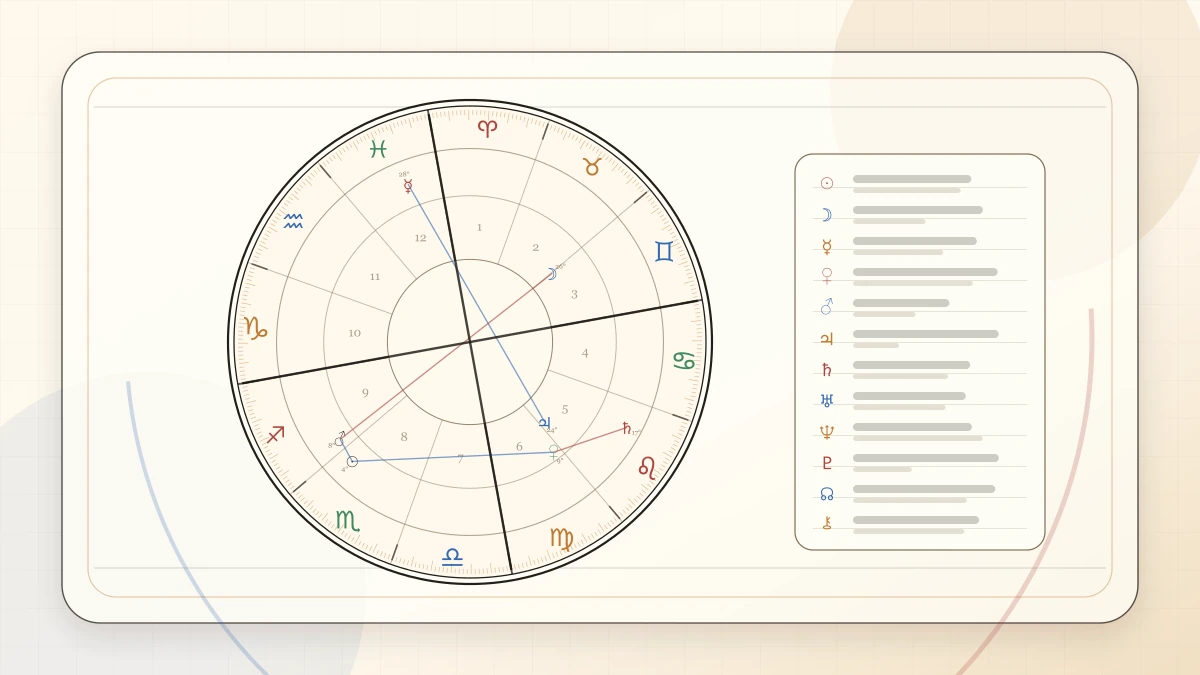
Sam's Uranus at 8 degrees Libra sits in his tenth house with Capricorn rising, squares his Sun at 10 degrees Cancer with a 2-degree orb and reaches its opposition at about age 40 to 42.
Uranus, a modern planet with no traditional dignities
Uranus stands for change, independence, experimentation and breaks with convention. It was discovered in the late eighteenth century, long after the traditional system of seven planets was built. Astrologers added it later, which is why the old dignity scheme has no place for it.
Many modern astrologers name Uranus as a co-ruler of Aquarius, a sign traditionally ruled by Saturn. That is a modern choice and not an old rule. Exaltations for Uranus are disputed, so none are stated here.
Uranus beside Saturn: two views of the same sign
Aquarius shows the difference well. Traditionally its ruler is Saturn, so the sign reads as ordered, principled and committed to shared rules. With Uranus added, the same sign reads as inventive, detached and eager to revise those rules.
Neither reading cancels the other. A chart reader who uses both is really asking two questions about any group or system: what keeps it steady, and what would make it better. That pairing also explains why Uranus and Saturn contacts in a chart are often described as change meeting structure.
About seven years per sign: how Uranus is found
Uranus takes about 84 years to go around the zodiac and spends about 7 years in each sign, which works out to roughly 4 degrees a year. Everyone born within that stretch shares a Uranus sign, so it tells you about a generation more than about an individual. The house and aspects are what make it personal.
Its opposition to its own natal place comes at about 40 to 42, half a cycle, and is a traditional midlife marker. Many people notice nothing dramatic then, and the symbolism does not promise a crisis. A Uranus return would come at about 84.
Uranus by sign: the kind of change a generation tends to favor
Because the sign is shared widely, read these lines as flavors of change and not as personality labels.
| Sign | Kind of change it tends to favor |
|---|---|
| Aries | Breaking away through bold, individual action |
| Taurus | Rethinking what is stable, valued or owned |
| Gemini | New ways of communicating and learning |
| Cancer | Changing ideas of home and family |
| Leo | Fresh forms of self-expression and creativity |
| Virgo | Reworking routines, skills and daily systems |
| Libra | Reinventing how people relate and cooperate |
| Scorpio | Challenging what is hidden, shared or controlled |
| Sagittarius | Widening beliefs and breaking with old frameworks |
| Capricorn | Remaking institutions and structures of authority |
| Aquarius | Experimenting with community and ideals |
| Pisces | Loosening boundaries between the practical and imagined |
Uranus in the houses: where you resist being told what to do
The house of Uranus marks where you seek freedom and where routine feels confining. In the first and tenth houses that tends to appear as an unconventional presence or career. In the third, ninth and eleventh it shows in unusual ideas, travel and groups, and in the seventh it can mean a need for room inside partnerships.
In the fourth, second and sixth houses it asks how much change your home, resources and routines can hold. In the fifth, eighth and twelfth it shows as a wish to do things differently in creative play, in shared matters and in private time. These are questions for reflection, and no placement makes upheaval or rebellion inevitable.
Uranus aspects, and a Uranus that is overworked or underworked
Uranus rarely moves quickly, so its aspects are usually long-standing. The common ones are listed here.
- Uranus and the Sun: a strong need for individuality.
- Uranus and the Moon: restlessness at home and a need for emotional space.
- Uranus and Venus: unconventional taste and independent affection.
- Uranus and Mercury: original ideas and sudden insights.
- Uranus and Saturn: change meeting structure, which can be stable innovation or a standoff.
Too much change and too little
An overworked Uranus is restless, contrary for its own sake and quick to cut ties. An underworked Uranus clings to routine, hides unusual ideas and waits for permission to change. Both are tendencies to test, and neither is a flaw assigned by a chart.
A useful check is to ask whether a change is something you want or only a reaction against what is expected. Independence that depends on opposing others is still a way of being led by them.
A constructed chart: Sam’s Uranus and the age-42 opposition
Sam is invented for this example. Uranus is at 8° Libra, which is 180 plus 8, or 188 degrees. The opposite point is 8° Aries, or 8 degrees. At about 4.3 degrees a year, 42 years is about 180 degrees, so the opposition comes at about 40 to 42, since the pace varies.
His Sun is at 10° Cancer, or 100 degrees, so the gap is 188 minus 100, or 88 degrees, which is 2 degrees from a square. His Rising sign is Capricorn, so Libra is the tenth house in whole signs (Capricorn, Aquarius, Pisces, Aries, Taurus, Gemini, Cancer, Leo, Virgo, Libra). A reading would ask how an independent streak shapes his public role and whether it pulls against his sense of self.
An exercise: run one small experiment
The healthiest way to work with Uranus is on a small scale.
- Name one routine you follow only out of habit.
- Ask what you would change if nobody minded.
- Choose a low-risk way to try it for a week.
- Note what you learn, whether you keep it or not.
Uranus beside Neptune and Pluto: three slow planets compared
The three modern outer planets are often blurred together. The table sets their clocks and themes side by side.
| Planet | Time around the zodiac | Time in a sign | Theme it is read for |
|---|---|---|---|
| Uranus | About 84 years | About 7 years | Change, independence and experiment |
| Neptune | About 165 years | About 14 years | Dissolving boundaries, imagination and idealism |
| Pluto | About 248 years | About 12 to 31 years | Depth, power and transformation |
Questions readers ask about Uranus
Do I need a birth time for my Uranus sign? No. Uranus moves only about 4 degrees a year, so the date fixes its sign unless you were born close to the day it changed sign. The house needs a birth time.
How is Uranus different from Mars? Both can look sudden from outside. Mars is a hot, personal impulse to act. Uranus is a cooler, more detached break with a pattern, often made for a principle and not a feeling.
Why is the Uranus opposition discussed and not a Neptune one? Uranus is the only one of the three that completes a cycle in a long life. Neptune and Pluto are read mostly by sign and house.
What this does and does not establish
No Uranus placement makes upheaval, rebellion or sudden change inevitable, and its themes are modern interpretations.
Related calculators
Use the matching tool when you want a direct chart or timing result after reading the guide.
12 Houses Calculator
Complete 12-house overview page for readers who want the full natal house framework before drilling into one exact placement.
House Placement Calculator
Manual placement page that combines one known planet and one known house into a reusable interpretation page.
Planet Meaning Finder
Plain-English planet reference page for beginner chart readers.
Calculation references
- Swiss Ephemeris: positions, angles and house-system conventions
Technical reference for calculation conventions. It does not certify an interpretation or mean every live tool uses this engine.
Related articles
Keep reading with nearby topics that deepen the same question from another angle.
Jupiter Meaning in Astrology
Jupiter stands for growth: expansion, learning, generosity, optimism and the search for meaning. The same quality can turn into excess, so over-reach deserves as much attention as opportunity.
6 min read
Neptune Meaning in Astrology
Neptune stands for imagination, idealism, compassion and the dissolving of boundaries, and the same openness can bring confusion or wishful thinking. These are modern readings, since ancient astrology never knew the planet.
6 min read
The 12 Houses Explained
The twelve houses split a birth chart into twelve areas of life, measured from the horizon at your birthplace. A planet's sign shows how it behaves, and its house shows where that behavior appears.
6 min read
Conjunction, Square, Trine, and Opposition Explained
The major aspects are angles between two planets: conjunction at 0 degrees, square at 90, trine at 120 and opposition at 180, with the sextile at 60. Planets in aspect modify each other.
6 min read
Keep exploring
Use the category page and the main hubs when you want the next layer of context.
Previous article
Jupiter Meaning in Astrology
Next article
Neptune Meaning in Astrology