
Houses, Aspects, and Planets
North Node Meaning in Astrology
The North Node is the point where the Moon's path crosses the Sun's apparent path heading north. Astrologers read its sign and house as a direction of growth toward less familiar qualities.
Table of contents
- Example or practical exercise
- What the North Node is in plain astronomy
- The Dragon’s Head and Rahu: older names for the same point
- A direction, not a destination: how to read the North Node
- The North Node in each sign, as a question
- The planet that rules your North Node sign
- Planets that touch the North Node
- A constructed example: North Node at 14 degrees Gemini
- How to work with your North Node in four steps
- What the North Node cannot tell you
- Questions readers ask about the North Node
- What this does and does not establish
Example or practical exercise
With Aries rising, a mean North Node at 14 degrees Gemini sits in the third house, the South Node lies opposite at 14 degrees Sagittarius in the ninth, and Venus is 3 degrees from the node.
What the North Node is in plain astronomy
The Moon’s path around Earth is tilted about five degrees to the path the Sun appears to follow across the sky, called the ecliptic. The two paths cross at two places. The point where the Moon crosses heading north is the North Node, and the point opposite it is the South Node. They are not bodies, only places where two paths intersect.
These points move backward through the zodiac, completing one circuit in about 18.6 years. That is 360 divided by 18.6, or about 19 degrees a year, so the node spends about a year and a half in each sign. A mean node moves smoothly, while a true node wobbles around it by a degree or two, and chart programs let you choose.
The Dragon’s Head and Rahu: older names for the same point
Medieval Western astrology called the North Node the Dragon’s Head, and Indian astrology calls it Rahu. Eclipses happen near the nodes, which is why many early traditions imagined a dragon swallowing the Sun or Moon. Older readings often described the Head as expansive and the Tail as diminishing.
The popular idea that the North Node shows a direction of growth and the South Node a place of comfort is a modern one. It is a useful reflection frame, but it is not an ancient doctrine and no past-life claim is needed to use it.
A direction, not a destination: how to read the North Node
The reading starts from a simple contrast. The sign and house of the North Node point toward qualities that may feel unfamiliar, a little awkward, or slow to come naturally. The opposite South Node points toward what feels easy. The suggestion is not that the easy thing is wrong, but that you might stretch into the other.
Because growth is a value judgment, treat the reading as an invitation. Someone may be perfectly content with their familiar strengths. The node is simply a prompt to ask what you would try if you did not have to be good at it right away.
The North Node in each sign, as a question
Phrasing each placement as a question keeps the reading reflective. These are modern characterizations, and any sign can appear with any life.
| North Node in | A question to ask |
|---|---|
| Aries | What would you begin if you did not wait for agreement? |
| Taurus | What would you value slowly instead of fixing at once? |
| Gemini | What are you curious about that you have not asked? |
| Cancer | Where could you let people see what you feel? |
| Leo | What would you make or share simply because you enjoy it? |
| Virgo | Which small, practical routine would serve what you care about? |
| Libra | How do you make room for another person’s view? |
| Scorpio | What honest conversation have you been circling? |
| Sagittarius | What larger question would you explore beyond the details? |
| Capricorn | What long commitment would you take on and see through? |
| Aquarius | Where could your ideas join a wider circle? |
| Pisces | Where might you trust a feeling you cannot yet prove? |
The planet that rules your North Node sign
The ruler of the node’s sign shows the tools for the direction. If the North Node is in Gemini, Mercury rules the sign, so Mercury’s sign, house and aspects describe the practical means: how you gather information, talk and learn. This extra step often makes the node more concrete than the sign alone.
Planets that touch the North Node
A planet within about three to five degrees of the North Node is read as tied up with the same theme, and many astrologers use tighter orbs for the nodes than for planets. A planet opposite the North Node sits on the South Node, so it belongs to the other end of the axis. Treat these contacts as supporting detail, and keep them after the sign, house and ruler.
A constructed example: North Node at 14 degrees Gemini
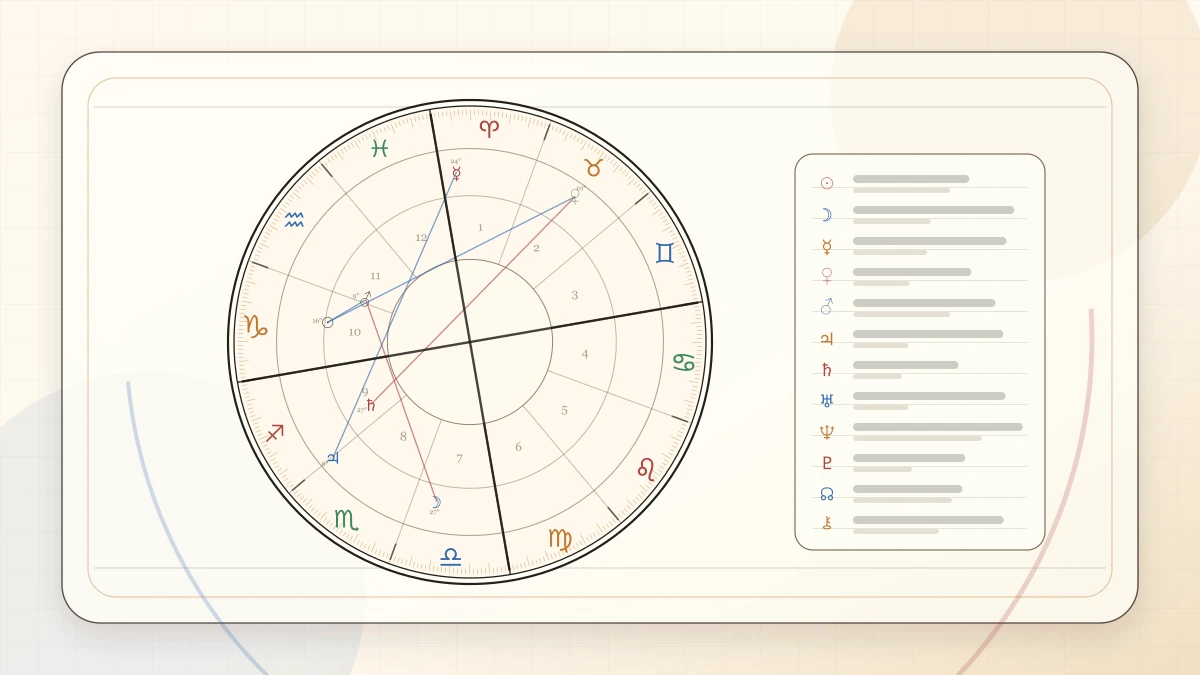
This chart is constructed for teaching and belongs to no real person. It has Aries Rising and whole-sign houses. The mean North Node is at 14 degrees Gemini, 60 + 14 = 74 degrees, so Gemini is the third house of learning and daily exchange. The South Node is opposite at 74 + 180 = 254 degrees, 14 degrees Sagittarius, in the ninth house.
Mercury, the ruler of Gemini, sits at 21 degrees Taurus, 30 + 21 = 51, in the second house of values. Venus at 17 degrees Gemini, 77 degrees, is only 3 degrees from the node. A reader might ask how this person could grow toward varied conversation, using patient and steady means, with Venus adding a wish for pleasant exchange. It is a question, not a forecast.
How to work with your North Node in four steps
A short routine keeps the idea practical and stops it from turning into pressure.
- Find the node’s sign and house, and any planet within about five degrees of it.
- Look up the ruler of the node’s sign and note its sign and house as the practical tools.
- Take the growth question for the sign and pair it with one small experiment, such as a conversation, a class or a short project.
- Review after a month, and drop anything that felt forced instead of curious.
What the North Node cannot tell you
A node placement does not establish a life purpose, a destiny or a past life, and no good evidence supports those claims. Some people find the prompts helpful and others find them irrelevant. If the reading creates pressure to become someone you are not, put it aside.
Questions readers ask about the North Node
Do I need a birth time? The sign needs only the date for most people, but a node changes sign about every year and a half, so check the date if you were born near a change. The house needs the time.
When does my node return? At about 18.6, 37, 56 and 74 years of age, when the node is back at its birth degree. Some people use these as moments to reflect on direction.
Is the true or mean node correct? Both are in use, and they usually differ by a degree or two. Say which you used.
What this does and does not establish
A node placement does not establish a life purpose, a destiny or a past life, and no good evidence supports those claims.
Related calculators
Use the matching tool when you want a direct chart or timing result after reading the guide.
12 Houses Calculator
Complete 12-house overview page for readers who want the full natal house framework before drilling into one exact placement.
House Placement Calculator
Manual placement page that combines one known planet and one known house into a reusable interpretation page.
Planet Meaning Finder
Plain-English planet reference page for beginner chart readers.
Calculation references
- Swiss Ephemeris: positions, angles and house-system conventions
Technical reference for calculation conventions. It does not certify an interpretation or mean every live tool uses this engine.
Related articles
Keep reading with nearby topics that deepen the same question from another angle.
Chiron Meaning in Astrology
Chiron is a small body between Saturn and Uranus, named for the wounded teacher of Greek myth. Astrologers read its wounded-healer theme as a modern metaphor for sensitivity and what you can offer.
6 min read
South Node Meaning in Astrology
The South Node sits exactly opposite the North Node, so the two are read as one axis. Its sign and house suggest familiar strengths you reach for easily, and what overusing them costs.
6 min read
The 12 Houses Explained
The twelve houses split a birth chart into twelve areas of life, measured from the horizon at your birthplace. A planet's sign shows how it behaves, and its house shows where that behavior appears.
6 min read
Conjunction, Square, Trine, and Opposition Explained
The major aspects are angles between two planets: conjunction at 0 degrees, square at 90, trine at 120 and opposition at 180, with the sextile at 60. Planets in aspect modify each other.
6 min read
Keep exploring
Use the category page and the main hubs when you want the next layer of context.
Previous article
Chiron Meaning in Astrology
Next article
South Node Meaning in Astrology