
Houses, Aspects, and Planets
South Node Meaning in Astrology
The South Node sits exactly opposite the North Node, so the two are read as one axis. Its sign and house suggest familiar strengths you reach for easily, and what overusing them costs.
Table of contents
- Example or practical exercise
- The South Node is always the opposite end of an axis
- Older names, and why this guide uses the modern reading
- Familiar is not the same as finished
- The South Node by element, with the matching invitation
- Planets on the South Node and the ruler of its sign
- Where the South Node sits: three kinds of house
- A constructed example: South Node at 23 degrees Capricorn
- Three ways the South Node is misread
- Questions readers ask about the South Node
- A two-column exercise for your South Node
- What this does and does not establish
Example or practical exercise
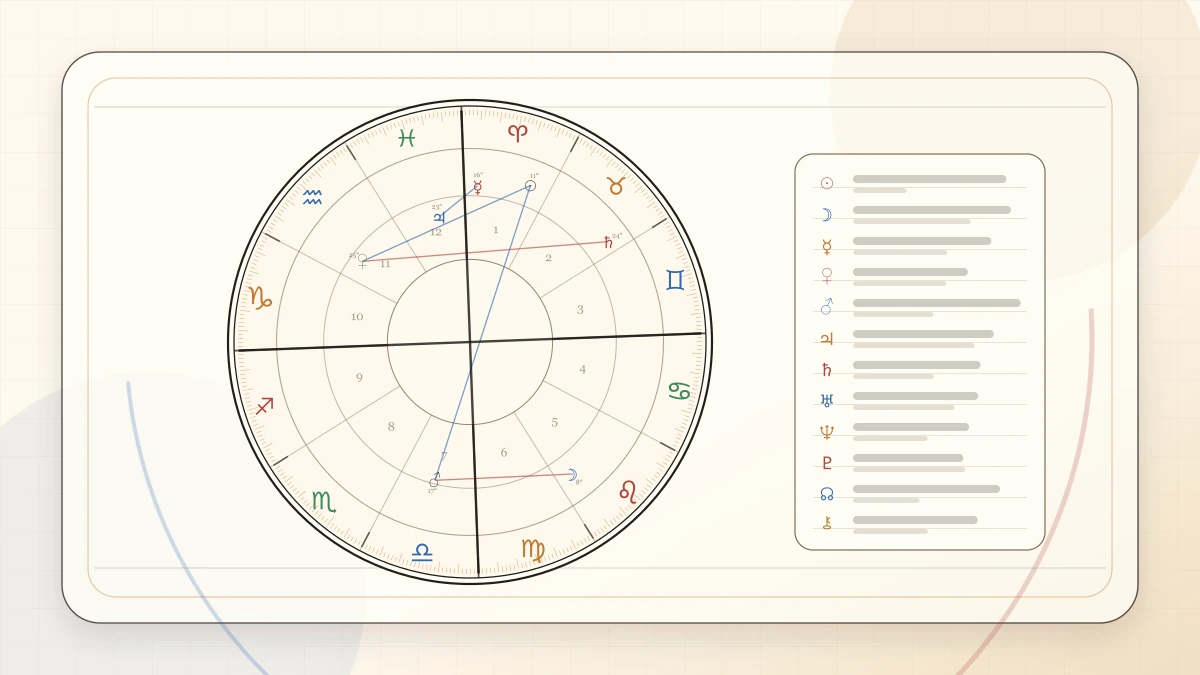
With Pisces rising, a South Node at 23 degrees Capricorn in the eleventh house faces a North Node at 23 degrees Cancer in the fifth, and Mars sits 2 degrees from the South Node.
The South Node is always the opposite end of an axis
The South Node is the place where the Moon’s path crosses the Sun’s apparent path heading south. It sits exactly 180 degrees from the North Node, so you do not calculate it separately. If the North Node is at 113 degrees, the South Node is at 113 + 180 = 293 degrees. Its house is the opposite house of the North Node’s, and its sign the opposite sign.
Like the North Node, it is a calculated point, not a body, and it moves backward through the zodiac in about 18.6 years. Because the two always travel together, it makes sense to read them as one axis with two ends.
Older names, and why this guide uses the modern reading
The point’s older names, the Dragon’s Tail and Ketu, and the history of the nodes are covered in our guide to the North Node meaning in astrology, so they are not repeated here. Older writers tended to read this end of the axis as a place of loss or release. This guide uses the modern frame, which treats it as familiar, well-practiced ground, because that frame turns the point into useful questions about habits.
Familiar is not the same as finished
A fair reading of the South Node starts with what is useful. The sign and house suggest abilities you reach for without effort, and those skills are real strengths. The question for reflection comes later: what happens when you rely on them every time, even when the situation calls for something else?
A useful test is to ask whether you chose the habit this time or simply defaulted to it. That gives each placement three parts: what feels familiar, what it costs when it is overused, and what the opposite end of the axis invites. The cost is not a flaw. It is simply what any habit costs when it is the only tool in the box.
The South Node by element, with the matching invitation
Grouping the twelve signs by element gives a short overview. The North Node at the opposite end sits in the element shown in the last column.
| South Node element | May feel familiar | May cost | North Node element |
|---|---|---|---|
| Fire | Acting quickly, leading, enthusiasm | Overrunning other people’s pace | Air |
| Earth | Reliability, steady effort, practical sense | Settling into routine too long | Water |
| Air | Ideas, conversation, a wider view | Staying in the head and away from feeling | Fire |
| Water | Sensitivity, empathy, loyalty | Absorbing mood and avoiding directness | Earth |
Planets on the South Node and the ruler of its sign
A planet close to the South Node, inside the same tight orb you use for the North Node, is read as part of the familiar pattern, often as a skill so practiced that it is not noticed. The ruler of the South Node’s sign adds detail: its sign, house and aspects show how the habit is carried out.
A planet opposite the South Node is conjunct the North Node, so it asks to be read at the other end of the axis. Keep these points secondary to the sign and house.
Where the South Node sits: three kinds of house
House type gives a quick first pass before you read the exact house.
- Angular houses (1, 4, 7, 10): the habit is visible, tied to identity, home, partnership or public role.
- Succedent houses (2, 5, 8, 11): the habit sits with what you build, create, share or hope for with others.
- Cadent houses (3, 6, 9, 12): the habit works behind the scenes, in learning, service, belief or inner life.
A constructed example: South Node at 23 degrees Capricorn
This chart is constructed for teaching and belongs to no real person. The South Node is at 23 degrees Capricorn, 270 + 23 = 293 degrees, so the North Node is at 23 degrees Cancer, 90 + 23 = 113. With Pisces Rising and whole-sign houses, Capricorn is the eleventh house of friendships and groups, and Cancer is the fifth, the house of play and creative risk.
Mars at 21 degrees Capricorn, 291 degrees, is 2 degrees from the South Node. Saturn, which rules Capricorn, is at 9 degrees Aquarius, 309 degrees, in the twelfth house of rest and privacy. A reader might describe a person who is capable and dependable in groups, with drive spent on organizing, who may be invited to show tenderness and play. The twelfth-house Saturn suggests that much of the effort is quiet.
Three ways the South Node is misread
A few common mistakes make this point heavier than it is.
- As a debt or punishment. A node is a place on a diagram, and nothing about it suggests that something is owed.
- As something to remove. The skills at the South Node are real, and the usual suggestion is to add to them, not discard them.
- As a record of a past life. No evidence supports this, and the reading of familiar habits works without it.
Questions readers ask about the South Node
Is it bad to have a comfortable South Node? No. Comfort is not a problem, and the reading only asks you to notice when it becomes the only option.
Should I read the South Node before the North? Many people find it easier to start with what feels familiar and then move to the stretch, but either order works.
Can the South Node describe a role I fall into with family or friends? Some readers use it that way, as words for the part you slip into without deciding, such as the organizer or the peacemaker. Keep it to your own habits. A chart cannot say who started a pattern or what anyone else intends.
What if the South Node sounds nothing like me? That happens. The modern reading is one frame among several, and a placement that does not ring true after honest reflection can simply be set aside. Return timing and birth-time questions work exactly as they do for the North Node.
A two-column exercise for your South Node
This takes about fifteen minutes and a sheet of paper. It turns the axis into one small, low-stakes experiment.
- Write two column headings: Held, for what you do easily, and Offered, for what you could try.
- Under Held, list three habits that match your South Node sign and house, and next to each, one situation where it served you well.
- Under Offered, list two things that match the North Node sign and house and that feel slightly unfamiliar.
- Pick one item from the Offered column and turn it into an experiment small enough to finish within a week.
- Review it after a month and note what was uncomfortable, what was interesting and whether you want to continue.
What this does and does not establish
The South Node is not a debt, a punishment or a record of a past life, and its familiar skills are not something to remove.
Related calculators
Use the matching tool when you want a direct chart or timing result after reading the guide.
12 Houses Calculator
Complete 12-house overview page for readers who want the full natal house framework before drilling into one exact placement.
House Placement Calculator
Manual placement page that combines one known planet and one known house into a reusable interpretation page.
Planet Meaning Finder
Plain-English planet reference page for beginner chart readers.
Calculation references
- Swiss Ephemeris: positions, angles and house-system conventions
Technical reference for calculation conventions. It does not certify an interpretation or mean every live tool uses this engine.
Related articles
Keep reading with nearby topics that deepen the same question from another angle.
North Node Meaning in Astrology
The North Node is the point where the Moon's path crosses the Sun's apparent path heading north. Astrologers read its sign and house as a direction of growth toward less familiar qualities.
6 min read
Quincunx Meaning in Astrology
A quincunx, or inconjunct, is a 150-degree angle between two planets, five signs apart, with a narrow orb of about 2 to 3 degrees. It describes an awkward fit rather than a clash.
6 min read
The 12 Houses Explained
The twelve houses split a birth chart into twelve areas of life, measured from the horizon at your birthplace. A planet's sign shows how it behaves, and its house shows where that behavior appears.
6 min read
Conjunction, Square, Trine, and Opposition Explained
The major aspects are angles between two planets: conjunction at 0 degrees, square at 90, trine at 120 and opposition at 180, with the sextile at 60. Planets in aspect modify each other.
6 min read
Keep exploring
Use the category page and the main hubs when you want the next layer of context.
Previous article
North Node Meaning in Astrology
Next article
Quincunx Meaning in Astrology